

Retail media management is the work of planning, buying, optimizing and measuring the advertising a retailer or marketplace sells on its own properties, so that a brand’s products get seen by shoppers who are already close to buying. For a brand, it means deciding where to advertise, which formats to use, how much to bid, and how to read results that each retailer reports in its own way. This guide explains the moving parts and shows how to run them across several European marketplaces.
TL;DR
- Retail media is advertising built on a retailer’s or marketplace’s first-party shopper data, and managing it means running campaigns, budgets and reporting across each retailer’s own rules.
- Start with on-site formats such as sponsored product ads, then add banners and off-site formats to cover the full funnel.
- Each retailer defines attribution windows, impressions and ROAS differently, so standardize your measurement before comparing results.
- A listing that is poorly translated, mapped or stocked wastes ad spend, so content and logistics come before bids.
- If you sell from Slovenia, plan language, delivery and marketplace requirements per country, one market at a time.
Table of Contents
- What retail media management actually covers
- Retail media, retail media networks and commerce media
- The data behind the targeting
- Formats: on-site, off-site and the sponsored product core
- How to manage campaigns across retailers
- Measurement: comparing results fairly
- Localizing for Europe, and for Slovenia
- Our perspective
- Where DEVOE fits
- A first 90 days plan
- FAQ
- Sources
What retail media management actually covers
IAB Europe describes retail media as the advertising space, retail data assets and in-store opportunities that a retailer or marketplace owns and makes available to brands for advertising campaigns, with goals such as brand awareness, driving sales and new product discovery.
Management is what happens after you have access to that inventory. In practice it includes:
- Channel selection: which retailers and marketplaces deserve budget, based on where your buyers shop.
- Campaign setup: keywords, product groups, audiences, formats and budgets.
- Listing readiness: titles, images, attributes and translations that let ads convert.
- Optimization: adjusting bids, pausing weak products, scaling strong ones.
- Reporting: pulling numbers from several retailers into one view you can act on.
The last point is where many brands struggle. Every retailer has its own dashboard, its own definitions and its own rhythm, so the job is as much operational as it is creative.
Retail media, retail media networks and commerce media
The terms overlap, and it helps to separate them.
Retail media is the advertising itself. A retail media network (RMN) is the ecosystem that delivers it. IAB Europe’s change management guide describes an RMN as a retailer or ad tech platform owned advertising and insights ecosystem using first-party shopper data to activate media onsite, offsite and in store, built on first-party data, retail media channels and closed-loop measurement.
A retail media platform (RMP) is the software layer. IAB Australia’s glossary defines it as a technology solution that manages, executes and analyzes campaigns within the network.
Commerce media is the wider umbrella. IAB Europe’s May 2026 definitions say commerce media networks, which include retail media networks, let brands reach shoppers throughout their buying journey, on and off owned platforms, using commerce data for planning, execution and measurement. eMarketer adds that the term also covers financial media and any network using transactional data to power advertising.
For a brand, the practical difference is simple. Retailers run networks and sell inventory. Brands buy it. Retail media management sits on the brand side of that table.
The data behind the targeting
Retail media works because retailers know what shoppers actually buy. A Voyado article from July 2026 groups first-party data into three audience types:
| Audience type | Who is in it | Typical use |
|---|---|---|
| Purchase-based | Customers who bought in a category or brand within a set period | Conquesting, replenishment, cross-sell |
| Loyalty-driven | Segmented by programme status, frequency or lifetime value | Rewarding best customers, premium launches |
| Behavioral | Shoppers who browsed or searched but have not converted | Closing the gap on high-intent visitors |
The same source notes that loyalty audiences are powerful because they capture behavior across channels, from online purchases to in-store scans and app activity.
The objective changes what the data does. eMarketer reports a case in which a Mexican milk brand ran two campaigns on identical Walmart audience segments: the branding campaign returned 4x ROAS while the ROI-focused one returned 13 to 14x. The lesson is not the specific numbers. It is that audience and goal must be set together, and that you should judge each campaign against its own purpose.
If you want to go deeper on audience work outside marketplaces, our piece on knowing your customers with AI targeting covers the targeting side.
Formats: on-site, off-site and the sponsored product core
IAB Europe lists on-site formats as sponsored product ads, sponsored search results, display banners, brand pages and video. Off-site retail media uses retailer data to buy advertising outside the retailer’s own shopping platform, including display, video, social, CTV and DOOH.
Its product matrix goes further and includes sponsored brands, tenancies and takeovers, in-store digital signage and handheld scanners. Most brands will never use the whole list. Marketplaces mainly offer the on-site group.
Sponsored products first
IAB Europe’s guide defines a sponsored product as a paid ad promoting a single product within a retailer, marketplace or search engine, mostly on a pay-per-click model where advertisers bid on keywords or product categories.
This is the usual starting point for a marketplace brand because:
- It appears where shoppers are already searching.
- You pay for clicks, so spend can be capped by product.
- It rewards good listings: relevant titles, strong images and competitive pricing improve results.
Building a full funnel
The same IAB Europe guide recommends combining product listing ads with banner campaigns to reach shoppers at every stage of the on-site journey, keeping a continuous on-site presence between seasonal peaks, and adding off-site ads to build awareness and consideration. A sensible sequence for a new brand is sponsored products, then banners or brand pages, then off-site once you have stable on-site performance.
How to manage campaigns across retailers
Running one marketplace is manageable. Running five is a system. IAB Europe’s omnichannel guide gives a useful checklist, written from the retailer side but equally useful for brands: know which channels to prioritize and what channels customers use, identify retail media opportunities in each customer activity, and have a shared KPI that unifies initiatives.
A workable process looks like this:
- Pick the marketplaces by customer, not by size. A fashion brand and a pharmacy brand do not shop the same places.
- Get the catalog right. Map your data to each marketplace’s attributes and fix rejected items before you advertise.
- Localize the content. Translate titles and descriptions, and adapt them to how local shoppers search.
- Launch sponsored products on your best sellers. Use a small set of proven products rather than the whole range.
- Add visibility formats. Brand pages, banners and seasonal pushes follow once the base is stable.
- Review weekly, restructure monthly. Move budget toward what earns, and cut what does not.
- Report in one format. One shared sheet or dashboard, with the same definitions for every retailer.
IAB Europe’s change management guide makes a point that applies to brands too: retail media is not an add-on but a structural shift that needs alignment across trade, marketing, data, product and customer experience, with clear accountability. If your marketplace sales, ad budget and stock planning sit in different teams, expect friction.
Measurement: comparing results fairly
Epsilon’s 2023 global study, cited by IAB Europe, found that 47% of brands considered total sales and return on ad spend the most important metrics for retail media campaigns.
Those numbers look simple and are not. IAB Europe’s sponsored products guide warns that retailers differ in attribution windows, impression counting and ROAS formulas, and recommends standardizing measurement across platforms for accurate comparison.
In practice, write down for each retailer:
- the attribution window (how many days after a click counts as a sale);
- whether sales are counted for the advertised product only or for the wider brand;
- whether impressions are counted when loaded or when viewed;
- how ROAS is calculated.
Then build a single scorecard with your own agreed definitions. The metrics worth tracking together:
| Metric | What it answers |
|---|---|
| ROAS | How much revenue each unit of ad spend brings |
| Total sales and share of sales from ads | Whether ads grow the business or only claim existing sales |
| Cost per click and conversion rate | Whether the listing and bid are healthy |
| New-to-brand share | Whether you are reaching new buyers |
| Share of search or visibility | Whether you are present on the terms that matter |
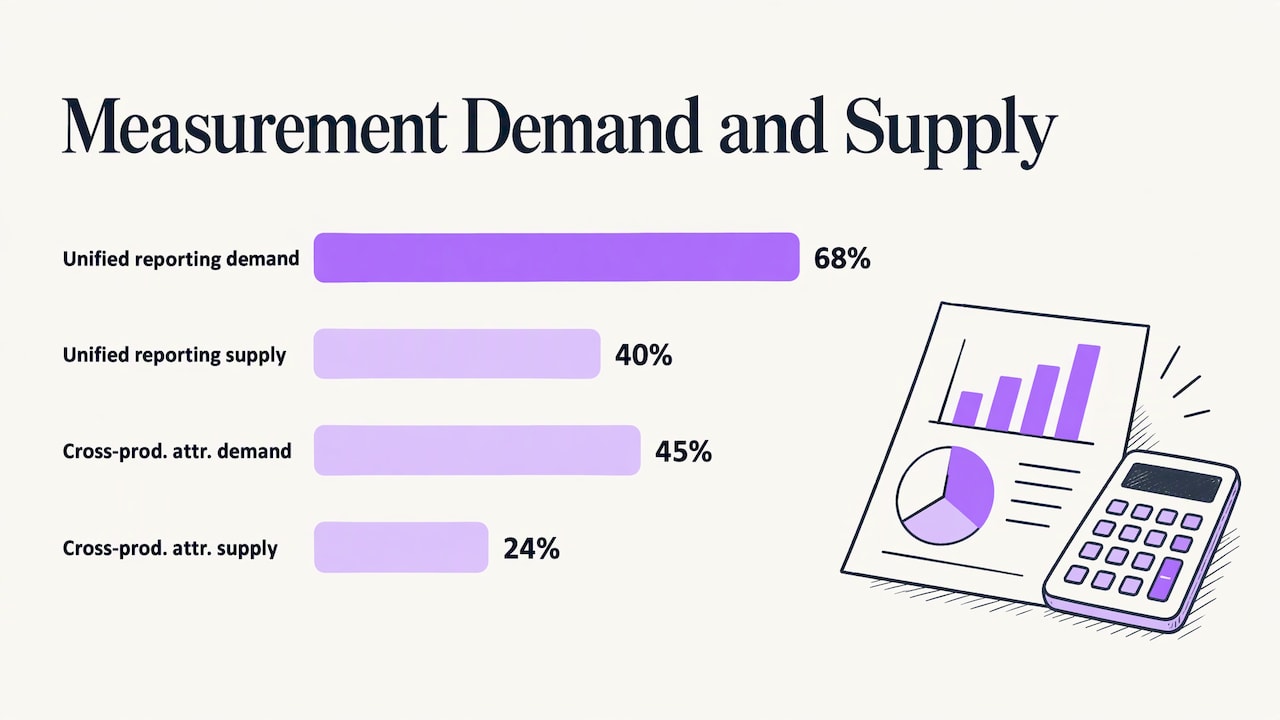
The industry knows measurement is still maturing. IAB Europe’s 2026 attitudes report finds that buyers want more than sellers deliver: demand for unified online and offline reporting is 68% against 40% supply, and for cross-product attribution 45% against 24%. Closed-loop attribution is the direction of travel: IAB Europe notes that retailers integrating loyalty programs and first-party data can connect in-store and online activity for a clearer view of what drives conversions. IAB Europe also expects large advertisers to ask for third-party verified media quality and measurement partners to become part of standard workflows.
Localizing for Europe, and for Slovenia
Slovenia is a small home market, so most Slovenian brands that want to grow online end up selling abroad. Marketplaces make that realistic, but each country behaves differently, and advertising only works once the basics are in place.
Language and search behavior. A literal translation of your product title rarely matches what a shopper in the Netherlands, Germany or Poland types into a search box. Retail media bids on those terms, so keyword research per language is part of the job, not an extra.
Marketplace fit. Different marketplaces lead in different regions and categories. Some are broad general marketplaces, others specialize in fashion, beauty or pharmacy. Matching your brand to the right ones matters more than being everywhere.
Data and onboarding. Each marketplace asks for product data in its own structure. Errors in mapping, missing attributes or rejected images can keep products from being advertised at all.
Logistics and delivery promise. Delivery speed and returns handling influence conversion and often ad eligibility. Decide early whether you ship cross-border from Slovenia or use a local fulfillment arrangement.
Pricing and currency. Check local price points, VAT treatment and marketplace fees per country with your accountant before you set ROAS targets, because margin determines what you can afford to bid.
Order of entry. Open one or two marketplaces first, learn what a click costs in your category, and then expand. Launching in many countries at once spreads budget too thin to learn from.
These are planning points, not legal advice. For tax and customs questions in each target country, speak to a qualified advisor.
Our perspective
Most brands come to us asking about ads. Most of the time, the ad is the last thing that needs fixing.
In our experience, retail media rewards the brand that has done the unglamorous work first: clean product data, content written for local shoppers, a logistics setup that keeps the delivery promise, and a listing that deserves the click. When those are in place, sponsored products and visibility formats amplify something that already works. When they are not, ads pay for traffic that bounces.
That is why we do not treat advertising as a stand-alone service. Our approach covers matchmaking with the right marketplaces, onboarding with data mapping and error resolution, content creation and translation, store visual branding, logistics setup, targeted advertising and performance reporting, with direct coordination with marketplace decision-makers. One team owning the whole chain means the person adjusting your bids also sees your content, your stock and your reporting.
We also believe in one scorecard. Brands working across several marketplaces drown in dashboards. We bring performance into a single view with consistent definitions, so decisions about budget are made on comparable numbers.
tinkara
Where DEVOE fits
If you want to expand into European marketplaces without building a team for each one, DEVOE Managed is designed to take you from strategy to ongoing growth management: choosing the right marketplaces, onboarding your catalog, creating localized content, running targeted advertising and reporting on results.

We work with marketplaces including Amazon, Bol, eBay, Zalando, About You, Modivo, Douglas and Shop Apotheke. If you already know where you want to sell, start with the page for that marketplace: Sell on Amazon, Sell on Zalando, Sell on Bol.com, Sell on Shop Apotheke or the others listed on our site.
A first 90 days plan
A brand new to marketplace advertising can use this outline as a starting frame and adjust it to its category.
Weeks 1 to 3: foundation. Choose one or two marketplaces. Map and upload the catalog, resolve errors, localize titles and descriptions, and prepare images to the marketplace’s standards. Confirm stock and delivery terms.
Weeks 4 to 8: first campaigns. Launch sponsored product campaigns on a limited set of best sellers. Keep structures simple, separate branded and generic keywords, and set a budget you can afford to learn with. Agree the metric definitions you will use.
Weeks 9 to 12: expand and refine. Add products that show good conversion, test banners or brand pages around a seasonal moment, and review which search terms produce profitable sales. Decide whether the data supports opening a third market or an off-site format.
Throughout, keep a continuous presence rather than switching campaigns on only for peaks, in line with IAB Europe’s advice on maintaining on-site visibility between seasonal highs. For more on the tools that support this kind of work, see our list of top AI digital marketing tools.
FAQ
What is retail media management?
It is the planning, buying, optimization and reporting of advertising sold by retailers and marketplaces, using their shopper data and ad inventory. For brands it covers format choice, keyword and audience setup, budgets, listing quality and cross-retailer measurement.
How is retail media different from commerce media?
Commerce media is the broader term. IAB Europe’s May 2026 definitions place retail media networks inside commerce media networks, which also cover other businesses that use transaction data for advertising. Retail media specifically refers to ads sold by retailers and marketplaces.
Which retail media format should a brand start with?
Most brands start with sponsored product ads, because they appear in search results where shoppers are comparing options and are bought on a pay-per-click basis. Once those are stable, add banners, brand pages and later off-site formats to cover earlier stages of the funnel.
How do I compare results across different marketplaces?
Check how each retailer defines its attribution window, impressions and ROAS, then report everything with one set of definitions of your own. IAB Europe recommends standardizing measurement across platforms because the differences can change the results noticeably.
Can a Slovenian brand run retail media in other European countries?
Yes, by selling through marketplaces in those countries and advertising within them. You need localized content, correctly mapped product data and a delivery setup that fits each market. Starting with one or two countries lets you learn before scaling.
Sources
- IAB Europe, Retail Media 101 Guide (June 2024)
- IAB Europe, Retail & Commerce Media Definitions (May 2026)
- IAB Europe, Bitesize Guide to Change Management in Retail Media
- IAB Australia, Retail Media Glossary (September 2023)
- eMarketer, Commerce media, financial media, retail media: the differences
- Voyado, How retailers can use first-party data for retail media targeting
- eMarketer, First-party data and omnichannel strategies drive retail media
- IAB Europe, Retail Media Advertising Product Matrix
- IAB Europe, Guide to Sponsored Products
- IAB Europe, Omnichannel Guide (October 2024)
- IAB Europe, Attitudes to Retail Media Report 2026