

Product page optimization means improving every element of a product detail page that influences whether a visitor buys: title, images, copy, price display, reviews, trust signals and the buy button. For a brand selling on European marketplaces, the work has a second layer. Each marketplace has its own data rules, languages and shopper habits, so a page that converts on your own US site rarely converts unchanged in Amsterdam, Berlin or Warsaw. We build and manage marketplace listings for brands, and this guide covers the fundamentals first, then what changes when the page lives on Amazon, Bol, Zalando or another European marketplace.
TL;DR
- A product page has one job: giving the shopper enough information and confidence to buy. Optimization removes uncertainty, risk and friction.
- Images and the add-to-cart area get the most attention and carry the most weight in the purchase decision.
- On marketplaces, the listing is a data record first: complete attributes, correct language and category-compliant content decide whether shoppers ever see it.
- Change one element at a time, measure conversion rate, and keep a continuous cycle going.
- Selling across several European marketplaces multiplies the work, which is why brands hand it to a managed service.
Table of Contents
- What product page optimization actually covers
- The elements that matter most, in order
- A quick audit table
- Optimizing for search on your own site
- Where marketplaces change the rules
- A repeatable optimization routine
- Common mistakes
- Doing this across several European marketplaces
- Our perspective
- FAQ
- Sources
What product page optimization actually covers
The phrase also names an Apple feature for testing App Store pages. This article is about e-commerce: physical products sold online, on your own store or on a marketplace.
Shopify’s guide describes it as covering every element on a product detail page that influences a purchase, from the title and images to pricing display, reviews and calls to action. The goal is to answer buying questions before the shopper has to ask them.
Omniconvert’s framing is useful for planning. It treats a product page as having one job, helping the shopper decide with confidence, and sorts the work into three kinds:
- Removing uncertainty: what am I buying, will it fit, what will shipping cost?
- Removing risk: is the seller trustworthy, can I return it?
- Removing friction: where is the button, does the page work on my phone?
Every change you consider should fall under one of those three. If it doesn’t, it is decoration.
The elements that matter most, in order
Not every element deserves equal effort. The evidence points to a clear order.
Images come first
A 2018 eye-tracking study of 300 shoppers on large US retail pages found the product image took around 20% of total time on the page. Shoppers rated the image and the add-to-cart section as the two areas most useful for the purchase decision, followed by the product name and suggested products.
Images also answer the question shoppers most often cannot resolve from text. Baymard Institute’s research found that 42% of users try to work out a product’s size from the images, which becomes needlessly hard without an in-scale image, such as the product next to a hand or a familiar object.
A practical image set for most products:
- A clean main image that shows the whole product.
- An in-scale image that makes size obvious.
- Close-ups of material, texture or the details a buyer would check in a shop.
- A lifestyle image showing the product in use.
- Where relevant, a short video.
Marketplaces add their own technical image rules on top, and a rejected main image can suppress a listing. We cover this in our guide to ecommerce image optimization for European marketplaces.
Title, bullets and description
The title tells shoppers and search engines what the product is. Good titles are accurate, lead with what a buyer would type, and follow the marketplace’s format rules.
For the body copy, the structure matters as much as the words. A 2019 study by Bleier, Harmeling and Palmatier, summarized by the American Marketing Association, ran 16 lab experiments and found that bulleted features were 83% stronger for informativeness than any other design element. Conversational language was 139% stronger for social experience, and product videos 106% stronger for sensory appeal.
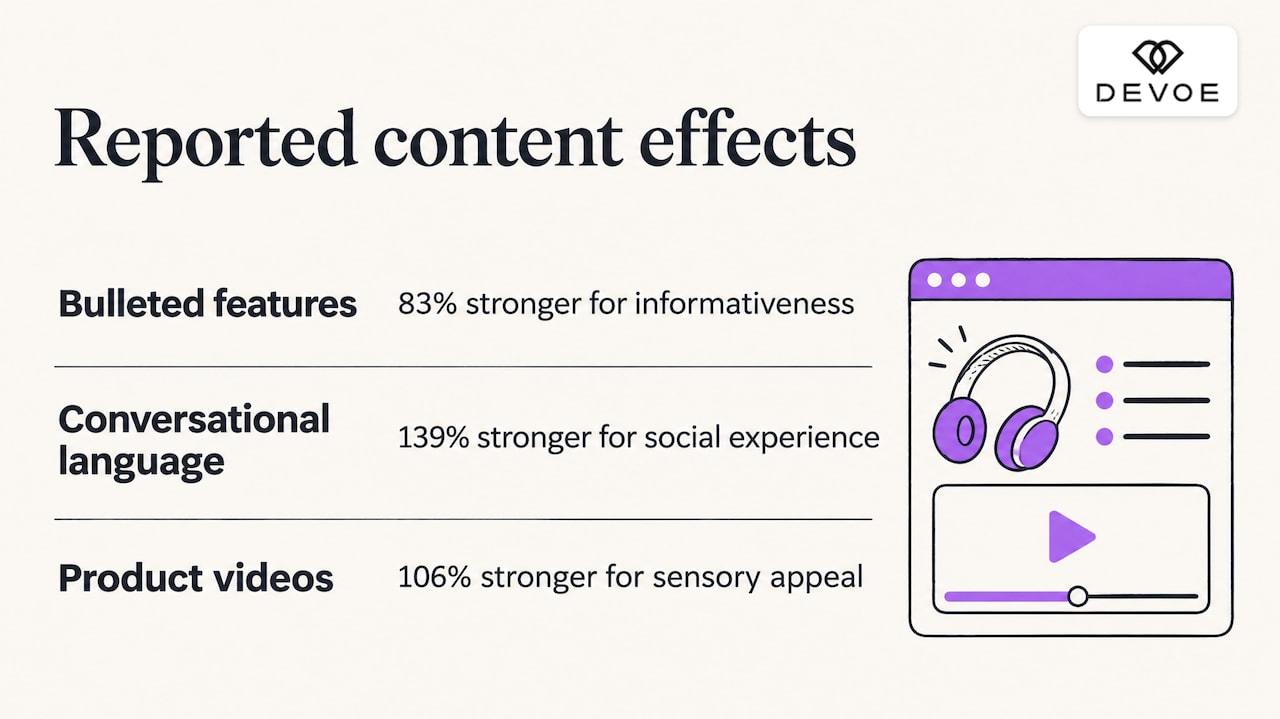
The same study gives a decision rule. Products people judge on facts, like a charger or a drill, benefit from an informative page. Products people judge by experience, like a fragrance or a fashion item, benefit from a more social page. Decide which your product is before you write a word.
The National Association of Wholesaler-Distributors recommends unique product descriptions of 150 words or fewer, with scannable bullet points covering key features and benefits. Treat that as a ceiling for the main description, not a target.
Price, availability and the buy button
Nielsen Norman Group’s ecommerce research says effective pages combine text and other media to communicate product details, availability, price and a clear way to purchase. Check three things on every page:
- The price sits next to the buy button, with shipping cost or a clear shipping note.
- Availability is stated where the shopper decides, not buried in the footer.
- The button is visible without scrolling on a phone.
Reviews and trust
Reviews answer the risk question. On marketplaces they also influence visibility. UK government export guidance on marketplaces advises encouraging reviews to boost visibility and conversion. We explain how this plays out across European platforms in why reviews matter for brands selling on European marketplaces.
A quick audit table
Use this table to score one page in about ten minutes.
| Element | What good looks like | Question it answers |
|---|---|---|
| Title | Clear product name, key attribute, brand, in the local language | What am I buying? |
| Main image | Whole product, meets platform rules | Is this what I want? |
| Gallery | In-scale, detail, lifestyle, video | Will it fit and look right? |
| Bullets | Scannable, benefit-led, facts first | Does it do what I need? |
| Attributes | Size, material, colour, weight all filled in | Can I filter and trust it? |
| Price and shipping | Visible near the button | What will it cost me? |
| Reviews | Visible rating near the title | Do others trust it? |
| Returns | Stated plainly | What if it’s wrong? |
Optimizing for search on your own site
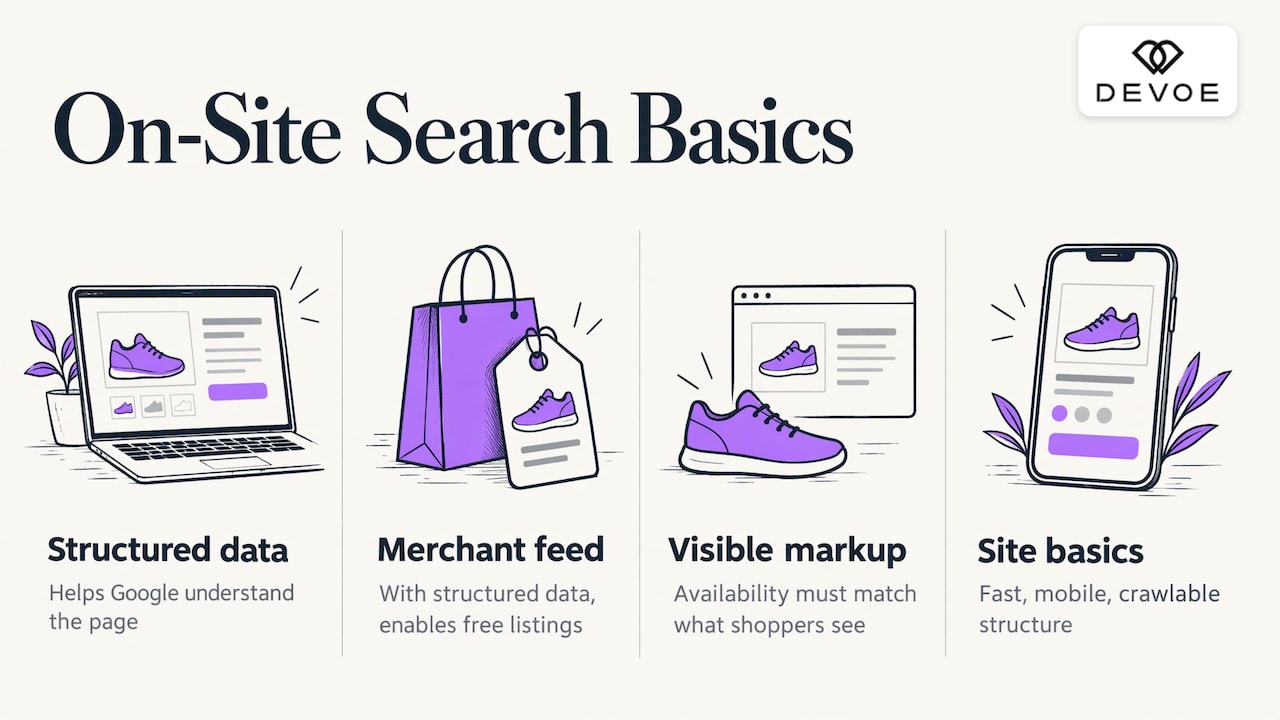
If you sell on your own store as well as on marketplaces, the product page also has to be found. Google’s ecommerce documentation advises sharing product data with Google, including structured data, and designing URL structures and navigation for crawling.
Two details are worth knowing. Structured data is not a ranking factor in itself, but it helps Google understand the page, and pairing it with a Merchant Center feed makes products eligible for free shopping listings. And markup must match what shoppers see: mismatched availability markup reduces eligibility for rich results.
The technical foundation matters too: fast loading, clean mobile layouts and crawlable structure. This overview of what an SEO-friendly website needs to rank covers the site-level basics that product pages sit on.
Where marketplaces change the rules
On your own store, you control the layout. On a marketplace, you control the content that fills a fixed template. That shifts the work in four ways.
1. Attributes are the page
Marketplace search and filters run on structured data. Amazon’s guide to its European stores says high-quality listings with clear images, brands, descriptions and detailed attributes such as size, manufacturer part number and material help customers find and buy products. UK government guidance says the same: complete and accurate attributes such as size, colour and weight are a listing fundamental. A missing attribute means a product that filters skip.
2. Language is more than translation
Selling in all six of Amazon’s EU stores requires translating products into each local language, either with the platform’s built-in tool for eligible products or an external translation provider. The UK guidance goes further: titles and descriptions should match local usage, and search keywords belong in the listing. A German shopper searches with German terms, not translated English ones.
Two of our guides go deeper: what to translate and how and how to adapt products for new markets, including sizing, units and regulatory labelling.
3. Every marketplace has its own audience
A fashion-led platform, a general marketplace and a beauty retailer each reward different content. Category approval requirements also differ. The same government guidance advises checking them before you list. Our marketplace pages describe how we approach each one: Amazon, Bol, eBay and Zalando.
4. Content has to stay consistent across channels
The NAW whitepaper notes that a product information management system can keep product data up to date and optimized across every channel, even when channel requirements differ. Once you sell in five countries on three platforms, the real risk is stale or mismatched data: the wrong stock, an outdated price, an old image. Our guide to marketplace inventory management covers the stock side, and the wider picture is in our cross-border ecommerce guide for selling in Europe.
A repeatable optimization routine
Brands that treat optimization as a project stall. Brands that treat it as a cycle improve. Omniconvert describes it as a continuous loop of measuring, testing and improving.
- Pick the pages that matter. Start with best sellers and with products that get traffic but few orders.
- Audit against the table above. Mark each gap as uncertainty, risk or friction.
- Fix the data first. Titles, attributes and images in the right language and format. These are rules, not opinions, so they are not worth testing.
- Test the judgment calls. Main image, bullet order, description length. Change one element at a time and run the test until the result is statistically significant, as Omniconvert advises.
- Track the right numbers. Conversion rate, add-to-cart rate, bounce rate, average session duration and cart abandonment. On marketplaces, add impressions, click-through rate and the share of sales from advertising.
- Roll out the winner, then localize it. A winning image in one market is a hypothesis in the next.
For marketplaces, the testing tools are narrower than on your own site, so careful before-and-after comparisons and disciplined one-change-at-a-time habits matter more.
Common mistakes
- Translating word for word. The listing reads as foreign and misses local search terms.
- Copying one description to every marketplace. Format rules and shopper expectations differ.
- Leaving attributes half empty. The product drops out of filtered search.
- Using a gallery of one image. Shoppers cannot judge size or quality.
- Updating the site but not the marketplaces. Prices and availability drift apart.
- Optimizing once. Competitors, reviews and platform rules keep moving.
Doing this across several European marketplaces
One page, well optimized, is manageable. A catalog of hundreds of products across several countries, each with its own language, attributes and image rules, is a different job. Our service covers the whole chain: matching the brand to the right marketplaces, onboarding with data mapping and error resolution, content creation and translation, store visual branding, logistics setup, targeted advertising, ongoing optimization and performance reporting.
If you are planning a first European launch or fixing listings that underperform, DEVOE Managed is the starting point. We work with marketplaces including Amazon, Bol, eBay, Zalando, About You, Modivo and Douglas, and we coordinate directly with marketplace decision-makers.

If you already know your target platform, go to its page: Sell on Amazon, Sell on Zalando or Sell on Bol.com.
Our perspective
Most brands think of a product page as a design task. We think of it as a data task with a design layer on top. On a European marketplace, the shopper never sees your brand story if the listing fails first: wrong language, missing attributes, an image the platform rejects.
That is why we start with the match between brand and marketplace, then onboarding, then content. Optimizing a page for a platform your category does not suit wastes the effort. Optimizing it in the wrong language wastes it twice.
Localization is where most expansions are won. A listing written for the local audience, with local search terms and the attributes shoppers filter by, is what turns visibility into sales. We build content for each market, and we keep optimizing it after launch, because rankings, reviews and platform rules keep changing.
Our advice to brands: treat the first launch as the start of a cycle, not the end of a project. Audit, fix, measure, repeat. Doing that across several marketplaces and languages at once is exactly the work we take off a brand’s hands.
tinkara
FAQ
What is product page optimization?
It is the practice of improving each element of a product page, such as title, images, copy, price display, reviews and buy button, so more visitors buy. The aim is to remove uncertainty, risk and friction. On marketplaces it also includes complete product data and local-language content.
How do I optimize a product page for SEO?
Write a clear, accurate title and unique description, add structured data that matches what shoppers see, and keep URLs and navigation easy to crawl. Google’s ecommerce documentation also recommends sharing product data through Merchant Center. Fast loading and a clean mobile layout support all of it.
Which product page element matters most?
Images and the add-to-cart area. In a 2018 eye-tracking study of 300 shoppers, the product image drew about 20% of page time and was rated, with the add-to-cart section, as most useful for deciding. Build a strong gallery before you polish anything else.
How is optimizing for a marketplace different from my own store?
You fill a fixed template rather than design a page, so attributes, titles, images and language decide visibility. Each marketplace has its own category rules and image requirements. Selling in several European countries also requires translated, locally worded listings.
How do I know if my changes worked?
Track conversion rate, add-to-cart rate, bounce rate and cart abandonment, and change one element at a time. Wait until the result is statistically significant before you roll out the winner. On marketplaces, also watch impressions and click-through rate.
Sources
- Ecommerce Product Page Optimization: 11 Elements (Shopify)
- Product Page Optimization: 24 Tactics (Omniconvert)
- Which elements matter most on a Web shopping page? (Quirks)
- Product Page UX Best Practices 2026 (Baymard Institute)
- Ecommerce UX Product Pages (Nielsen Norman Group)
- Structure Your Product Page for Success (American Marketing Association)
- Creating the Perfect Product Detail Page (NAW whitepaper)
- SEO Best Practices for Ecommerce Sites (Google Search Central)
- 14 Ways to Improve Ecommerce Product Pages for SEO (Ahrefs)
- 10 advanced ecommerce SEO tips (Search Engine Land)
- How to start selling on Amazon’s European stores
- How to use online marketplaces (business.gov.uk)