

A Slovenian company can sell on Amazon Europe through one seller account that reaches ten European stores. The work is not the sign-up. It is choosing the right first market, getting VAT and product compliance right, and publishing listings that read as native in each language. This guide walks through that path in the order you will meet it.
TL;DR
- One Amazon seller account lets you list in the main European stores, and Slovenia has been a supported country since February 2020.
- Register a legal entity first, then verify identity and bank details for everyone on the account.
- Start with one or two stores, usually Germany or another large market, and translate listings properly instead of auto-translating them.
- Plan fulfillment, VAT, product safety and packaging rules before launch, not after the first order.
- Protect and build the brand with Brand Registry, A+ Content and a store page, then keep optimizing after launch.
Table of Contents
- What “Amazon Europe” means for a Slovenian seller
- What you need to register and verify
- Which Amazon store should you start with?
- Fulfillment: Amazon warehouses or your own shipping
- VAT, product safety and packaging
- Listings that sound local
- Launching and growing the brand
- Our perspective
- How DEVOE can run this with you
- FAQ
- Sources
What “Amazon Europe” means for a Slovenian seller
Amazon does not run one European store. It runs several country stores that you can manage from a single account. According to Amazon’s cross-Europe selling page, one account reaches customers via Amazon.co.uk, .fr, .de, .it, .es, .pl, .nl, .se, .com.be and .ie, and you manage listings and inventory for all of them in one place.
Slovenia is on the list of supported seller countries. The Slovenian government announced in February 2020 that its Ministry of Economic Development and Technology had worked with Amazon on the technical solutions, so Slovenian companies could start selling through Amazon Europe from that week.
Two practical points follow from this:
- Slovenia has no Amazon store of its own. Your customers are in other countries, so everything customer-facing (language, delivery promise, returns, customer service) has to work for them.
- One account does not mean one market. Each store has its own shoppers, competitors, search terms and rules. Treat every store as a separate launch that shares a back office.
What you need to register and verify
The company comes first
To sell through Amazon Europe, a business first has to exist in an appropriate legal form in Slovenia. Data d.o.o. explains that online and mail-order retail falls under SKD code 47.910, so check that your company’s registered activities cover it before you start.
Documents and checks
Amazon’s registration guide lists what you should have ready: a government-issued ID, a credit card, a bank account, business registration, proof of address and tax information. In the first step you enter business details such as location, type, name, registration number, address and phone number.
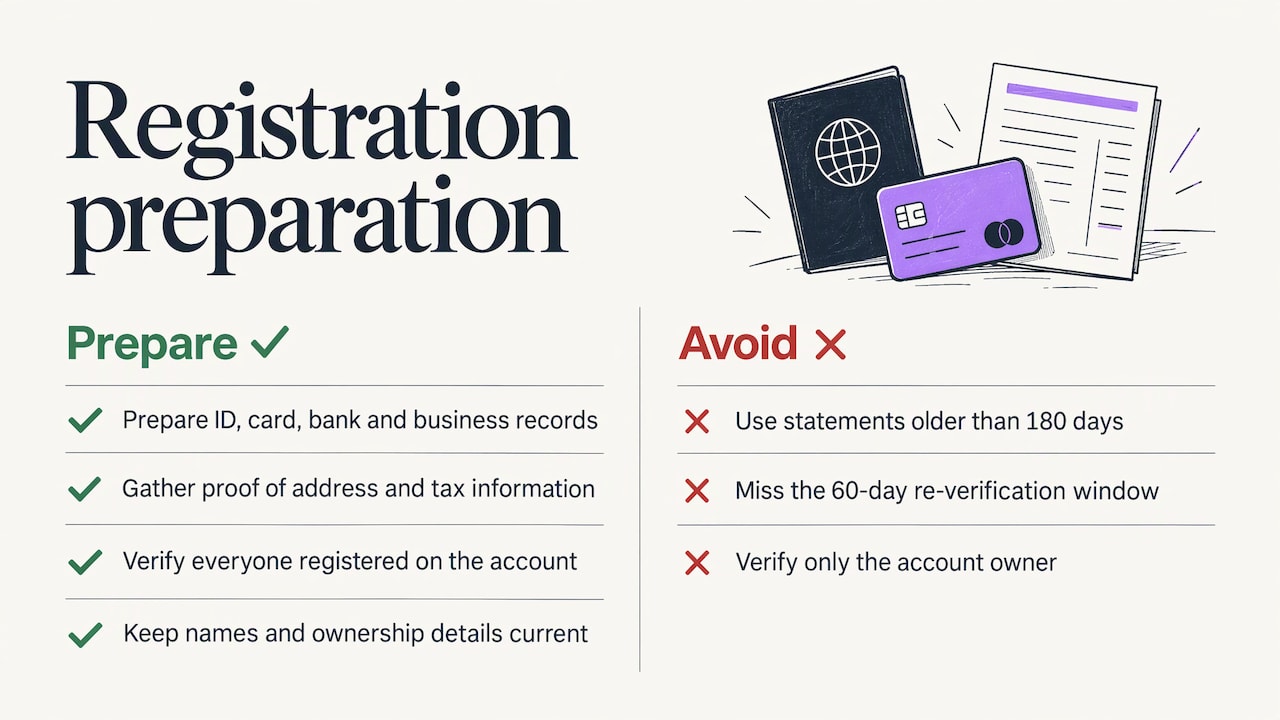
For identity verification, Amazon’s EU registration guide asks for a color scan of a passport (including the signature page) or driver’s license, plus a bank or card statement issued within the past 180 days.
The verification covers more than the account owner. Amazon’s verification compliance guide says it applies to everyone registered on the account: point of contact, legal representative, beneficial owners, trustees and secondary users. It also allows up to 60 days to complete re-verification, after which selling and payouts may be restricted. Keep the names, documents and ownership details in your account current, so a routine re-check never freezes your sales.
A simple preparation checklist
- Confirm the company’s activity code and registration details match what you enter in the account.
- Collect ID scans for every person who must be verified.
- Prepare a recent bank statement (issued within the last 180 days).
- Agree internally who owns the account, so one person is not a single point of failure.
- Choose a professional selling plan, since brand tools and the expansion tools below are built around it.
Which Amazon store should you start with?
This is the decision that shapes your first year, and most guides skip it. The honest answer is: start where demand is proven and your product and logistics fit, then expand.
Amazon’s two biggest European stores are Germany and the UK. ECDB’s analysis of 2023 net sales puts amazon.de at about US$17.36 billion and amazon.co.uk at about US$16.61 billion, well ahead of amazon.es, in third place. Size is not the whole story, though. Use these criteria:
| Criterion | What to ask |
|---|---|
| Demand | Do shoppers in this country already search for your product type on Amazon? |
| Competition | How many established brands and private labels sit on the first page? |
| Language | Can you produce native-quality copy and customer service in it? |
| Logistics | Can you reach the country quickly from your warehouse or an Amazon fulfillment center? |
| Compliance | Are there extra rules for your category (electronics, cosmetics, toys, food)? |
| Post-Brexit | For the UK, are you ready for separate customs and tax rules? |
For many Slovenian brands, Germany is the natural first store: the largest audience, a neighboring logistics corridor and a market that rewards well-built listings. A brand with a strong Dutch or Italian customer base might reasonably begin there instead. Whichever you choose, run one store properly before adding the next. The expansion tools below make adding stores quick, so you do not need to rush.
Fulfillment: Amazon warehouses or your own shipping
Amazon’s Expand to Europe guide describes two basic options.
- Fulfillment by Amazon (FBA). You send inventory to Amazon fulfillment centers in Europe, and Amazon stores, packs and ships orders. The guide notes that Pan-European FBA distributes units across multiple EU countries at no additional cost.
- Fulfilled by Merchant. You ship orders yourself, optionally with a network of vetted global shipping providers offering discounted rates.
How to choose:
| FBA | Merchant-fulfilled | |
|---|---|---|
| Delivery speed | Prime-style fast delivery | Depends on your carrier and origin |
| Inventory | Held in Amazon warehouses, needs forecasting | Held in your own stock |
| Reach | Strong with Prime shoppers | Good for slower-moving or bulky items |
| Workload | Lower per-order effort | You handle packing, shipping and returns |
FBA tends to suit fast-moving products and brands that want the Prime audience. Merchant fulfillment can suit a first test of a market, when you do not want stock sitting abroad yet. Either way, remember that moving stock between countries has tax consequences, covered next.
VAT, product safety and packaging
This part decides whether your launch is smooth or stuck. Ask your tax adviser to confirm your setup, since rules depend on your products and where stock sits.
VAT
Amazon’s cross-border sales guide explains that VAT rates differ from country to country, and that moving your own goods between EU countries, or having FBA move them between fulfillment centers, may be treated as a taxable transaction. That means using Pan-European FBA can create VAT registration duties in the countries where your stock is held. Speak to a Slovenian tax adviser or accountant who handles cross-border e-commerce before your first shipment.
Product safety and the responsible person
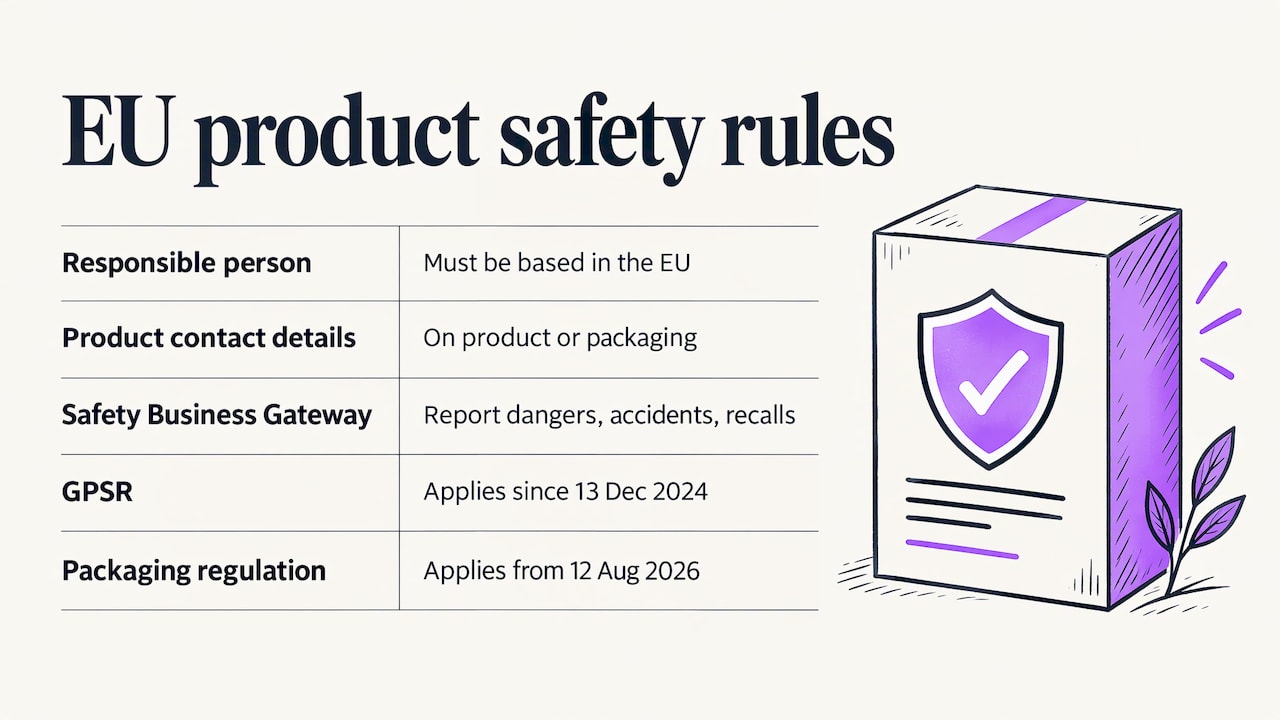
The EU’s Your Europe portal states that goods sold on the EU market must be safe and meet EU requirements protecting health, safety, animals, the environment and consumer rights. Dangerous products, accidents and recalls must be reported to the national authority through the Safety Business Gateway.
The General Product Safety Regulation has applied since 13 December 2024 and, as summarized by Wuunder, requires an EU-based responsible person whose contact details appear on the product or packaging. The same source notes that the EU Packaging and Packaging Waste Regulation applies directly from 12 August 2026, with a declaration of conformity per packaged product. A Slovenian company is already inside the EU, but check that your labels and packaging carry the required information for the countries you sell into.
Electronics and other regulated categories
If you sell electrical or electronic equipment, Amazon’s guide points to RoHS and WEEE rules, including the crossed-out wheeled bin symbol and membership of an authorized recycling scheme in each Member State where applicable products are sold. Other categories have their own requirements, so check the category rules in Seller Central before you list.
Listings that sound local
The cheapest mistake to avoid is a machine-translated listing. Amazon’s own guidance on Europe says listings should be in the native language of the country where you sell, and that copy written in regional dialects is central to a successful search strategy. It also reminds sellers that VAT rules vary by country and GDPR applies.
In practice, a good localized listing:
- uses the keywords German, French or Dutch shoppers actually type, not literal translations of your Slovenian or English terms;
- converts sizes, units and voltage or plug types where they matter;
- adapts claims, benefits and imagery to local expectations;
- includes manuals, safety information and labels in the local language;
- keeps the tone consistent with your brand across stores.
Write each language from scratch with a native speaker who knows your category, then check the result against what top-ranking competitors in that store do.
Launching and growing the brand
Start with the brand foundation
According to Amazon’s e-commerce start guide, a brand presence on Amazon is built from a Professional seller account, enrollment in Brand Registry, A+ Content to customize listings, and a storefront created with the Stores tool. The same page notes that Brand Registry registers your brand in all European countries at no extra cost, so the protection travels with you as you expand.
Expand with Amazon’s free tool
Once you sell in at least one store, the European Expansion Accelerator lets you extend to nine EU stores in a couple of clicks. Amazon says account set-up, translations, listings, shipping setup and eligibility checks run automatically within three business days, and the tool is free for professional sellers already active in one European store. Amazon’s cross-Europe page adds that it creates listings and pricing and enrolls products in fulfillment programs.
Automation gets you live fast. It does not make you competitive. Machine-created listings still need a human pass for keywords, titles, images and A+ Content in the markets that matter most to you.
What to do in the first 90 days
- Weeks 1 to 2: finish verification, Brand Registry and category approvals.
- Weeks 2 to 4: publish localized listings with strong images and A+ Content for your first store.
- Weeks 4 to 8: send stock to the fulfillment center or begin merchant shipments, and switch on targeted advertising for your best-selling products.
- Weeks 8 to 12: review search terms, reviews, returns and margins, then decide on the second store.
Track conversion rate, advertising cost against sales, stock cover and return reasons. These show where to improve before you spend on a new market.
Our perspective
Most brands we talk to treat Amazon Europe as a registration task. We see it as a market-entry project with a back office attached. The account is the easy part. What decides results is choosing the right first store, building listings that feel native, and having someone steer advertising, content and logistics after launch.
That is how we work at DEVOE. We help brands find the marketplaces that fit them, take care of onboarding with data mapping and error resolution, create and translate the content, and keep optimizing once the store is live. We also coordinate directly with marketplace decision-makers, which shortens the path when something needs to be solved.
For a Slovenian brand with a small team, this means you keep your focus on product and customers while we handle the marketplace machinery. And because Amazon is rarely the only good channel, we can build the same foundation for other European marketplaces when you are ready.
tinkara
How DEVOE can run this with you
If you would rather not build the Amazon operation from scratch, our Sell on Amazon service covers the whole route: marketplace matchmaking, onboarding, content creation and translation, targeted advertising, store visual branding, logistics setup and performance reporting. We tailor listings to each local audience and manage growth after launch. Our DEVOE Managed page explains how the ongoing engagement works.
Amazon also works well alongside other channels. If fashion, beauty or Dutch-speaking customers are in your plan, see how we handle Zalando, Bol and Douglas.
FAQ
Can a company in Slovenia sell on Amazon Europe?
Yes. Slovenia became a supported country in February 2020, after the Slovenian ministry worked with Amazon on the technical set-up. You need a registered Slovenian company with online retail among its activities, and you complete Amazon’s identity and bank verification.
Which Amazon stores can I reach with one account?
Amazon lists ten European stores reachable from one account: the UK, France, Germany, Italy, Spain, Poland, the Netherlands, Sweden, Belgium and Ireland. You manage listings and inventory centrally, but each store needs its own localized content and pricing.
Should I use FBA or ship orders myself?
FBA stores, packs and ships for you and gives access to Prime delivery, with Pan-European FBA spreading stock across EU countries. Shipping yourself keeps stock under your control and suits early tests. Many brands begin merchant-fulfilled, then move bestsellers to FBA.
Which Amazon market is the biggest in Europe?
Germany and the UK are the two largest by net sales, with Spain behind them. The biggest market is not automatically the best first one for you, so weigh competition, language, logistics and compliance for your product.
Sources
- Sell Across Amazon Europe Marketplaces
- Slovenian companies enabled to launch their business through Amazon Europe
- Slovenian companies can participate on Amazon Europe
- Amazon seller registration in 5 steps
- Amazon EU registration guide
- Guide to verification compliance process
- Top Online Stores in Europe
- Expand to Europe
- EU Imports and Cross-Border Sales
- Selling products in the EU
- International shipping EU regulations
- US vs. Europe selling on Amazon
- The European Expansion Accelerator
- Start an ecommerce Business