

Cross-border fulfillment is the work of getting an online order from your stock to a customer in another country: storing, picking, packing, clearing customs and delivering. For a brand expanding into Europe, the useful question is not only which warehouse model to choose. It is how that model connects to the marketplaces where European shoppers buy, because each marketplace sets its own data, content and delivery expectations. We built our marketplace expansion service around that connection, and this guide gives you the fulfillment picture you need before you commit to a setup.
TL;DR
- Cross-border fulfillment means every parcel crosses at least one border, so customs paperwork, duties, taxes and returns become part of each order.
- There are three practical models: ship from home, stock held in the target market, or a hybrid. The right one depends on order volume and how predictable demand is.
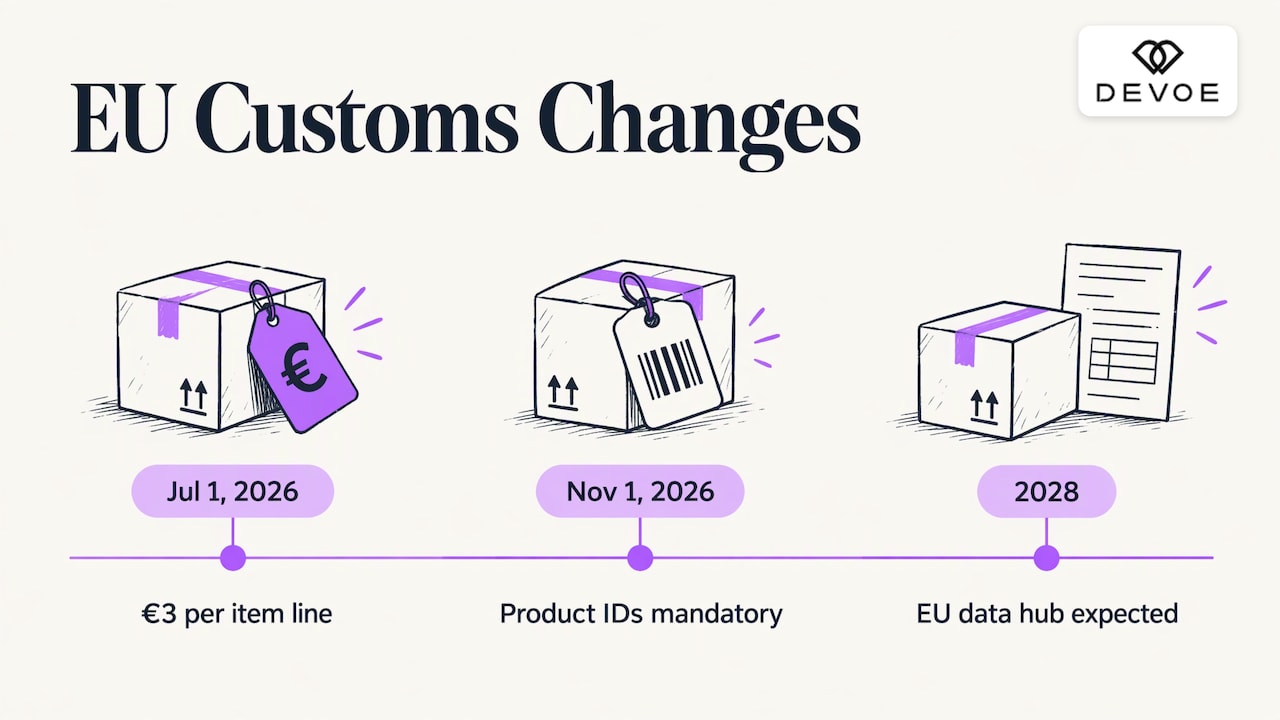
- The EU ended its low-value duty-free exemption on July 1, 2026, so small B2C parcels now carry a flat customs fee per item line, and you need to price it in.
- Marketplace integration (inventory sync, order routing, error-free product data) decides whether fulfillment runs smoothly across several European channels.
- Plan the landed cost per order and the returns route before you ship the first pallet.
Table of Contents
- What cross-border fulfillment actually covers
- The three models and when each fits
- Why the marketplace shapes your fulfillment choice
- Customs, duties and taxes: what changed for Europe
- Returns: plan the route before the first order
- What it costs and how long it takes
- How to choose a setup: a practical sequence
- Where we fit
- FAQ
- Sources
What cross-border fulfillment actually covers
Domestic fulfillment ends when a local carrier hands over the parcel. Cross-border fulfillment adds a layer: duties, taxes, customs declarations and country-specific rules. A useful way to see it is as a chain of stages. Shopify’s cross-border guide breaks the shipping side into first-mile pickup, transport to an international hub, air or sea freight, customs clearance in the destination country and last-mile delivery.
In practice, a brand running this chain handles seven jobs:
- Receive and inspect inventory, and record it in a warehouse system.
- Store stock by SKU, demand and market.
- Take the order from your store or marketplace through an integration.
- Pick the items.
- Pack them with the customs data attached: product description, declared value, country of origin and classification.
- Ship, clear customs and deliver.
- Handle returns and exchanges.
That sequence follows the global order fulfillment process described by Speed Commerce, and it is a good checklist for any partner conversation. Notice step three. When you sell on several marketplaces and in several countries, the integration that passes orders in and returns inventory counts, tracking and cancellations is what keeps the whole chain honest.
The three models and when each fits
Most brands choose among three setups. The labels vary, but the logic is the same.
| Model | How it works | Best for | Watch out for |
|---|---|---|---|
| Ship from home | Each parcel travels from your own warehouse to the customer abroad | Testing a new market at low volume | Slow delivery, customs on every parcel, duties at the door, costly returns |
| Stock in the target market | You ship inventory in bulk to a warehouse in the destination region and ship locally | Steady, concentrated demand | Importer of record and local tax registration, more capital tied up in stock |
| Hybrid | Best sellers held locally, the long tail shipped from home | Growing assortments with a clear top tier | More complex inventory planning |
The three models are summarized in this overview of cross-border fulfillment models. Delivery times differ sharply. Direct shipping from a single home warehouse can take 7 to 21 days, while a warehouse in the destination region can deliver in 2 to 5 days, according to one 2026 guide’s benchmarks.
A practical rule of thumb: start by shipping from home to learn which markets and products actually sell, then move your proven sellers closer to the customer. Shopping for a regional warehouse before you know your demand ties up cash. Staying on home shipping once volume is steady means paying for slow transit and repeated customs handling on every parcel.
Why the marketplace shapes your fulfillment choice
Brands that sell in Europe through marketplaces face a second layer of requirements. Each marketplace has its own product data format, its own content rules and its own delivery promise. Amazon, Bol, eBay, Zalando, About You, Modivo and Douglas do not ask for the same things, and a fulfillment setup that works for one can fail the listing checks of another.
Three questions help you decide:
- Which marketplaces will you sell on first? A fashion brand targeting Zalando and About You has different return patterns from a beauty brand on Douglas. Fashion buyers return often, so the returns route matters from day one.
- Where do your target customers expect to receive parcels from? European shoppers are used to local delivery speeds and local returns. Our guide to marketplace inventory management covers how to keep stock levels accurate when the same inventory feeds several channels.
- How clean is your product data? Errors in data mapping are a common reason listings are rejected or orders fail to sync. We go deeper on this in our overview of marketplace integration services.
If you are still deciding whether and where to enter Europe, our broader guide to cross-border ecommerce in Europe sets out the market side of the decision.
Customs, duties and taxes: what changed for Europe
Every international shipment must clear customs, which requires accurate invoices, proof of origin and official declarations. Shopify’s international logistics guide notes that customs officers use classification codes to decide the duty owed, and that mistakes can bring surprise costs and fines. Three data points deserve attention on every SKU: the HS code (the standard product classification number), the country of origin and the customs value.
The EU low-value rule
The biggest recent change for brands shipping into the EU is the end of the low-value duty exemption. According to a ShipStation and DPD webinar, as of July 1, 2026, B2C parcels face a temporary flat customs fee of €3 per commodity item line, and from November 1, 2026, product identifiers are mandatory for all B2C shipments. The same source gives a worked example: a €100 order with two product classifications incurs two €3 fees (€6), and because VAT is calculated on goods plus customs charges, a €121 order total at 21% Dutch VAT rises to €128.26.
The lesson is that the fee attaches to item lines, not to the basket. A brand shipping many different products in one order pays more than a brand shipping one. Build this into your landed cost, meaning the full cost of getting one order to the customer including shipping, duties and taxes.
The policy is still moving. The European Policy Centre describes a customs reform proposal with simplified classification buckets, a deemed importer concept that would make online marketplaces responsible for obligations, and an EU data hub for e-commerce consignments expected in 2028. Check the official EU customs pages before each season for the current rules.
Who pays: DDP or DAP
You will meet two terms constantly. DDP (delivered duty paid) means you pay duties and taxes up front, giving the customer a clean experience. DAP or DDU means the buyer pays at the door, which is simpler for you but can lead to refused deliveries. 3PL Hub’s glossary lays out the trade-off. For European consumers, who rarely expect to pay anything at delivery, we generally see DDP as the smoother route, and under the new flat fee it also makes your costs predictable.
Restricted products
Some categories need extra checks before they cross a border. Shopify’s guide lists batteries and electronics, cosmetics, perfumes and aerosols, food and beverages, and supplements among them. If your range includes beauty or health items, confirm the rules for each destination country before you ship stock.
Returns: plan the route before the first order
Returns are where cross-border margins quietly disappear. In the US alone, the National Retail Federation projected about $849.9 billion in returned merchandise for 2025, around 15.8% of sales, and a peer-reviewed review notes that cross-border returns often face customs, duty recovery and documentation complexity that can make recovery uneconomic.
Three decisions keep returns manageable:
- Use a local return address. Stock held in the destination market lets returned items go back into local inventory instead of crossing the border twice.
- Match the return method to the shopper. DHL research cited by Kodif found that 75% of European shoppers prefer out-of-home return locations such as parcel shops and lockers.
- Decide your rule for low-value items. When return shipping and processing cost more than the item is worth, a refund without a return can be the cheaper outcome.
If you ship DDP, duties paid on goods that come back can often be reclaimed through drawback or similar procedures, depending on the jurisdiction. Ask your customs broker which one applies to your lane.
What it costs and how long it takes
International fulfillment cost splits into seven buckets, as RushOrder’s guide lays out: receiving and storage, pick and pack, international shipping, duties and taxes, returns, customer support, and setup and integrations. Hidden charges tend to appear in minimum monthly fees, customs brokerage, dimensional-weight pricing and storage of slow-moving stock.
Two figures show why the model matters. One 2026 guide cites a 500 g parcel from the US to Germany at about $18 from a US warehouse versus about $4 from a warehouse in Frankfurt. Treat that as an illustration, not a quote; your carrier rates will differ. On the demand side, the Ship24 2026 report found that 41% of consumers say duties or taxes put them off cross-border purchases, and 45% cite delivery cost or time. Cost and speed are conversion problems, not only logistics problems.
Setting a rough switch point
Many guides suggest moving from home shipping to a local warehouse partner once international volume passes roughly 200 orders per month. Use this as a starting point and test it against your own numbers. Review each SKU every quarter: if the cost of shipping it from home exceeds the local alternative by a clear margin, move it.
How to choose a setup: a practical sequence
- Pick your first marketplaces and countries. Fulfillment follows demand, not the other way around.
- Calculate landed cost per order for each lane, including the €3 EU fee per item line where it applies, VAT and return costs. A 2026 FulfilQ study of 114 brands found that 84% planning transatlantic expansion had not worked this out.
- Choose home shipping, local stock or hybrid based on volume and how well you can forecast demand.
- Prepare your product data and customs data together. HS codes, origin and clear descriptions belong in the same file as titles and images, so they travel with the listing. Our guides on product localization and ecommerce translation cover the content side.
- Connect inventory in real time so the same stock cannot be sold twice across channels.
- Set the returns route and customer-facing return terms before launch.
- Review every 90 days and adjust by SKU.
Our wider guide on expanding your ecommerce business internationally in Europe shows where this sequence sits in the whole expansion plan.
Our view: fulfillment is a marketplace decision first
Brands often start with the warehouse and discover the marketplace requirements later. We see it the other way round. A marketplace listing is where a European shopper meets your brand, and the fulfillment setup is what keeps the promise made on that listing.
That is why our service starts with strategic matchmaking: finding the marketplaces that suit your products. From there we handle onboarding, including data mapping and error resolution, content creation and translation, and logistics setup, so that product data, content and delivery arrangements are prepared together rather than patched afterwards. We also coordinate directly with marketplace decision-makers.
Our position is simple: a brand entering Europe should not run fulfillment, content, advertising and marketplace onboarding as separate projects. When one team manages them, the listing, the logistics and the reporting stay consistent, and you can see what each market actually returns.
tinkara
Where we fit
If you are a brand planning to sell on European marketplaces, we manage the expansion end to end: matchmaking, integration, onboarding, localized content, targeted advertising, store visual branding, logistics setup and performance reporting. You can see how this works for individual channels on our pages for Amazon, Zalando and Bol.com, or start from DEVOE Managed.

FAQ
What does cross-border fulfillment mean?
It is the process of storing, packing and shipping an online order to a customer in another country. Compared with domestic fulfillment, it adds customs declarations, duties, taxes and country-specific rules to every shipment.
How long does international order fulfillment take?
It depends on the model. Shipping directly from a home warehouse can take roughly 7 to 21 days, while stock held in the destination region can arrive in 2 to 5 days, based on 2026 benchmarks. Peak seasons and customs checks can add time.
Do I pay duties on EU orders under the old low-value limit?
Since July 1, 2026, the EU no longer exempts low-value parcels from duty. According to ShipStation and DPD, B2C parcels face a temporary flat fee of €3 per commodity item line. Confirm the current figure on the EU’s official customs pages.
Should I ship from home or hold stock in Europe?
Ship from home while you test a market at low volume. Move proven best sellers into local stock once demand is steady, and keep the long tail shipping from home. Calculate landed cost for each lane before you decide.
Sources
- Shopify Help Center: Cross-border fulfillment guide
- Speed Commerce: Global Order Fulfillment
- Warenous: Cross-Border Fulfillment models
- Rapid Fulfillment: International Fulfillment 2026 Guide
- Shopify: International Logistics guide
- ShipStation and DPD: Ship to the EU with Confidence
- European Policy Centre: The e-commerce challenge
- 3PL Hub: Cross-Border Fulfillment glossary
- IIARD: Reverse Logistics in E-Commerce Returns Management
- Kodif: Multi-region ecommerce returns statistics
- RushOrder: International Ecommerce Order Fulfillment
- Ship24: Ecommerce Logistics Annual Report 2026
- Marketers Media: FulfilQ transatlantic expansion data