

Ecommerce translation services turn your product listings, store pages, checkout, policies and marketing into the language your buyers shop in, and adapt them to local expectations. For Slovenia and the rest of Europe, the work goes beyond swapping words. You need accurate product data, search-friendly titles, legally required information in the right language, and a process that keeps every listing consistent when your catalog changes. This guide shows what the service includes, what to translate first, which method fits which content, and how to keep quality under control.
TL;DR
- Translation is one part of localization: product content, currency, payment, shipping and customer support all need to fit the local market (Lokalise).
- Start with the content that drives sales and carries legal weight: product pages, checkout, policies, instructions and guarantee documents.
- Match the method to the risk. Use human translators for brand and legal content, and machine translation with human review for large, repetitive catalogs.
- In Slovenia, consumer information must be in a language consumers understand, and dealings with consumers must be in Slovenian.
- On marketplaces, translated listings must also fit each platform’s data fields and search logic. That is where managed onboarding saves time.
Table of Contents
- What ecommerce translation services include
- Which content to translate first
- Human, machine or post-edited: choosing the method
- How translation fits into your store and marketplace setup
- Slovenian language and compliance checks
- Translation and visibility in search
- Keeping quality consistent as the catalog changes
- Our perspective
- Marketplace content with DEVOE
- How to brief a translation provider
- Common mistakes to avoid
- FAQ
- Sources
What ecommerce translation services include
A good provider handles more than a word-for-word conversion of a spreadsheet. In practice the scope usually covers:
- Product content: titles, descriptions, bullet points, attributes, size and material terms, variant names.
- Store interface: menus, buttons, filters, cart and checkout messages, order emails.
- Marketing content: product descriptions in campaigns, email, social posts, banners.
- Legal and policy content: terms, returns, privacy notices, disclaimers.
- Technical content: specifications, manuals, help center articles.
That split mirrors how Shopify groups localization tasks: marketing, legal, technical and user interface content. Each group has a different tone, different risk and often a different best method.
Localization goes a step further. It adapts the website and product information for a local market, including product selection, marketing, payment methods, currency, photography, shipping and customer support, as Lokalise explains. A Slovenian shopper expects prices in euros, familiar payment options, delivery terms they can understand and a returns policy written for local consumer rules. A translated page that ignores these still feels foreign.
Which content to translate first
You rarely need to translate everything on day one. Order the work by what moves revenue and what creates legal exposure.
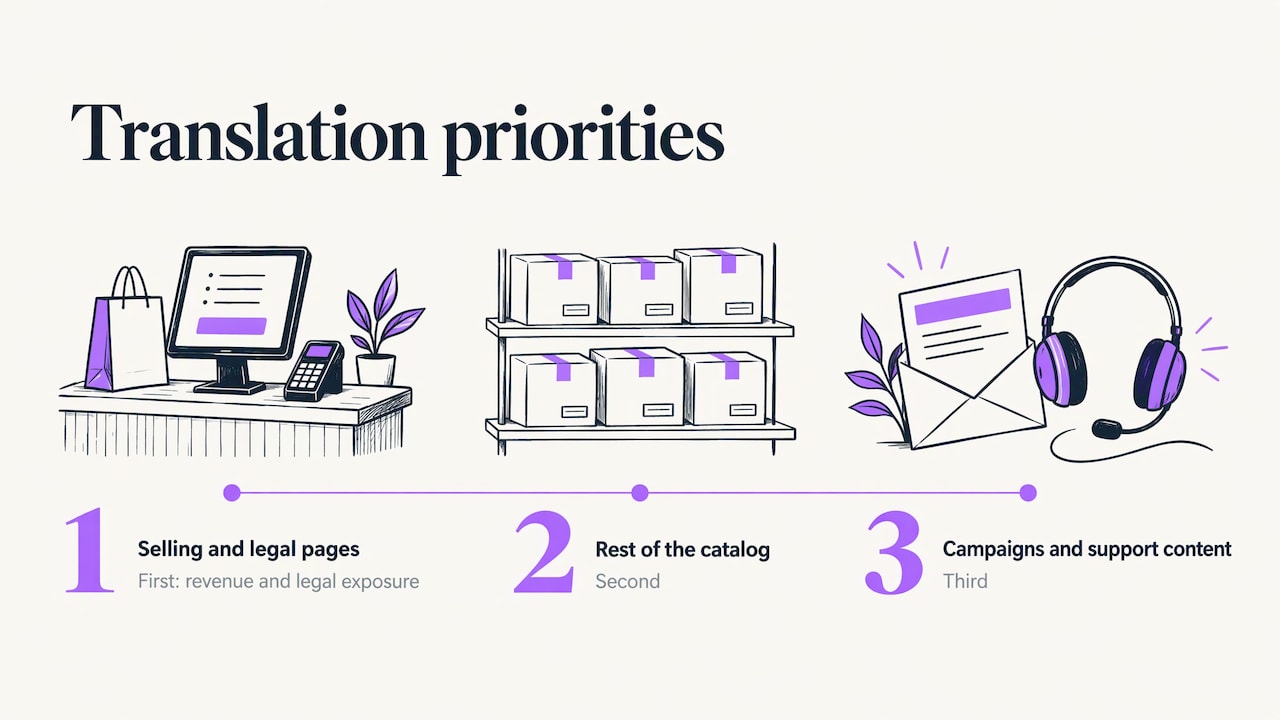
Priority 1: pages that sell and pages the law cares about
Product detail pages for your best sellers, the cart and checkout flow, delivery and returns information, and the mandatory seller details come first. A shopper who cannot read the returns terms or the product’s characteristics will not buy, and a seller who omits required information risks problems with consumer rules.
Priority 2: the rest of the catalog
Once the core pages are live, work through the long tail: secondary products, variants and category pages. This is where volume is highest and where process matters most. Consistent terminology for materials, sizes and features makes the catalog look trustworthy and keeps search results clean.
Priority 3: campaigns and support content
Email sequences, seasonal banners, social posts, FAQs and help articles come next. They are shorter-lived, so match effort to their shelf life. Evergreen help content deserves careful human work. A one-week banner can use a lighter workflow.
Human, machine or post-edited: choosing the method
There are three routes, and most stores use all three.
| Method | Best for | Watch out for |
|---|---|---|
| Human translation | Brand copy, hero product pages, legal text, ad headlines | Slower and costlier per word, so reserve it for content where tone or liability matters |
| Machine translation with human post-editing | Large catalogs, specs, repetitive attributes, help articles | Needs a style guide and glossary, or terms drift between products |
| Raw machine translation | Internal use, low-visibility content, first-pass triage | Not suited to anything a customer reads as a promise about the product |
A practical rule: the closer the text is to a buying decision or a legal statement, the more human review it should get. A product title is short but carries your search visibility and first impression, so it earns a human eye even in a machine-assisted workflow.
Build a glossary before you start
A glossary of brand names, product terms, units and banned words, together with a short style guide for tone, is the cheapest quality tool you have. It lets several translators, and any software, produce the same term for the same thing across thousands of listings. Include how to write sizes, measurements and the euro, and decide up front whether you address shoppers formally or informally in Slovenian.
How translation fits into your store and marketplace setup
The workflow matters as much as the translators. In a direct webshop, content is usually exported from your product information source or platform, translated, reviewed and re-imported into the right language version. Where possible the process should connect to your store so that new products and edits flow through without copy-and-paste.
Marketplaces add constraints. Each one has its own category tree, mandatory attributes, character limits, image rules and search logic. A description that works on your own site may be rejected or buried on a marketplace if it does not map to the right fields. That is why translation and data mapping belong in the same project.
A typical flow looks like this:
- Audit the source data: complete attributes, clean titles, correct units.
- Map your product fields to each marketplace’s required fields.
- Translate and adapt the content for the target language and platform.
- Review a sample with a native speaker, then publish.
- Monitor errors, search performance and customer questions, and revise.
Slovenian language and compliance checks
If you sell to Slovenian consumers, language is not only a marketing choice. Check these points with your legal adviser before launch.
- Dealing with consumers: Slovenia’s consumer protection act, ZVPot-1, requires businesses to deal with consumers in Slovenian. In designated areas, Italian or Hungarian must also be used for the relevant minority community.
- Product information: the same act requires information on characteristics, sales conditions, use and intended purpose to be in a language understandable to consumers in Slovenia. Generally understandable symbols and images may also be used.
- Instructions and guarantees: an official Slovenian legal text states that instructions for goods sold in Slovenia must be entirely in Slovenian, and the same applies to guarantee documents.
- Seller details and pre-contract information: the government’s SPOT portal on online selling lists what a shop must show, including company name and registered office, registration and tax numbers, and phone and email contacts. It also lists the pre-contract information on product characteristics, final price, additional costs, payment, complaints, conformity guarantee and delivery. VAT-registered businesses must present the SI tax prefix.
- Wider legal set: SPOT’s legal guide for online shops also points to the Electronic Commerce on the Market Act, the Public Use of the Slovene Language Act and the EU geo-blocking rules.
The practical lesson: treat policies, instructions and checkout wording as regulated content. Have them translated by a professional who knows consumer terminology, not left to automatic output.
Translation and visibility in search
Localized product information is what lets customers discover and buy in a target market, according to Lokalise. Shoppers search in their own words, and those are often not a literal translation of your source terms. A Slovenian buyer may use a different everyday word than the textbook equivalent, so keyword research in the target language should shape titles and descriptions.
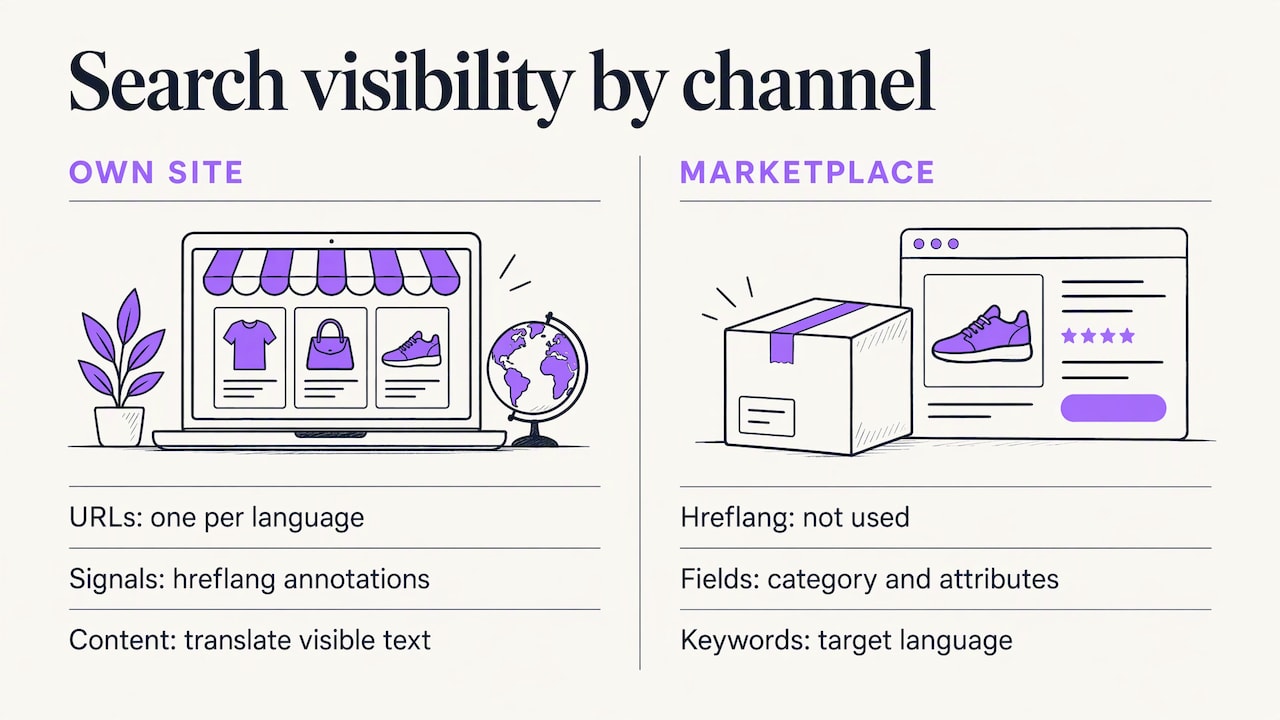
For your own site, give each language its own URL and tell search engines how the versions relate. Google’s documentation on localized versions of pages explains hreflang annotations and notes that localized pages are only considered duplicates if the main content stays untranslated. Translate the visible content, not just the navigation.
On marketplaces, there is no hreflang. Visibility depends on title structure, correct category and attributes, complete data and the keywords in the local language. Translated content that fills every attribute properly tends to be found more easily than a polished description sitting in the wrong fields.
Keeping quality consistent as the catalog changes
Translation is never finished. New products, price changes, seasonal campaigns and marketplace rule updates all create new text. Build quality into the routine:
- Use a translation memory. Reusing approved segments keeps wording identical across products and cuts repeat cost.
- Version your glossary. When a term changes, update it once and apply it everywhere.
- Review by sample. A native-speaking reviewer checks a regular slice of new content against a short checklist: terminology, tone, units, legal wording.
- Close the loop. Customer questions, returns reasons and marketplace error reports show where a translation misled someone. Feed them back to the glossary.
- Assign one owner. Someone in your team or your agency should be accountable for the language quality of each market.
Our perspective
Brands often ask us for a translator when what they need is a market entry. A flawless Slovenian, Dutch or German description does nothing if it sits in a listing with the wrong category, missing attributes or a mismatch with the marketplace’s search logic.
That is why we treat content as part of the whole expansion process. We start with strategic matchmaking, choosing the marketplaces where your product has a real audience. Then we handle onboarding, including data mapping and error resolution, and create and translate content that is tailored to each platform and its local shoppers.
Our approach is hands-on. The same team that adapts your listings also looks after advertising, store visual branding, logistics setup and performance reporting, and coordinates directly with marketplace decision-makers. Content stays consistent because it is managed as one live system, not delivered once and forgotten.
If you plan to sell across several European marketplaces, we believe one accountable partner for content and operations is the most reliable route to visibility and sustained growth.
tinkara
Marketplace content with DEVOE
If your goal is to sell on European marketplaces, translation is one step in a longer chain. DEVOE supports brands from matchmaking and onboarding through content creation and translation, ongoing optimization and reporting. See the DEVOE Managed service for the full scope, or go straight to the marketplace you are targeting: Amazon, Zalando, Bol.com, eBay, About You, MODIVO, Douglas or Shop Apotheke.

Tell us which markets and categories you have in mind, and we will propose how to localize your catalog for each one.
How to brief a translation provider
A clear brief saves rounds of revision and keeps cost predictable. Prepare these items:
- Scope: number of products, variants and words per product, plus the target languages and marketplaces.
- Content types: which items are product data, which are marketing and which are legal, so each gets the right method.
- Source files: clean exports with consistent attributes, not scattered documents.
- Brand voice: examples of copy you like, words to avoid, formal or informal address.
- Terminology: your glossary and any protected product or brand names.
- Delivery format: how translated text returns, and how it reaches your store or marketplace feeds.
- Review process: who approves, how fast, and how corrections are recorded.
Ask how the provider handles updates after launch. A catalog changes every month, so a partner who can process small batches quickly is worth more than one who only delivers large one-off projects.
Common mistakes to avoid
- Translating a poor source. Errors, missing attributes and vague titles in your original data are multiplied in every language. Fix the source first.
- Ignoring local search terms. The literal translation is not always what shoppers type.
- Forgetting the surrounding content. Images with embedded text, size charts, packaging inserts and manuals also need translation.
- Mixing formal and informal address. Pick one and put it in the style guide.
- Treating legal text as marketing. Returns, guarantees and privacy wording need accuracy, not creativity.
- No post-launch plan. Without monitoring and updates, quality declines as products change.
FAQ
Do I have to translate my store into Slovenian to sell in Slovenia?
If you deal with Slovenian consumers, the law requires you to do so in Slovenian, and product information must be in a language consumers understand, according to ZVPot-1. Instructions and guarantee documents for goods sold in Slovenia must be entirely in Slovenian under the official legal text. Confirm the details for your product category with a legal adviser.
Is machine translation good enough for product listings?
It works well as a first draft for large, repetitive catalogs, provided a human reviews the result against a glossary. Keep full human translation for brand copy, hero products, ads and legal text. The more a sentence influences a purchase or makes a promise, the more review it needs.
What is the difference between translation and localization?
Translation converts text from one language to another. Localization also adapts product selection, currency, payment methods, imagery, shipping and support to the local market, as Lokalise describes. For ecommerce, localization is what makes a shopper feel the store was built for them.
Does translation help my products show up in search?
Yes, when it is done with local keywords and complete product data. Shoppers search in their own words, so titles and descriptions should reflect them. On your own site, use separate language URLs and hreflang annotations; on marketplaces, fill every attribute correctly.
Can DEVOE handle translation for marketplaces?
Yes. Content creation and translation are part of our marketplace expansion service, alongside onboarding, data mapping, optimization and reporting. Start from the DEVOE Managed page to see how it works.
Sources
- Cross-border ecommerce: A complete guide, Lokalise
- Content Localization: How to Do It to Grow International Sales, Shopify
- Spletna prodaja, SPOT
- Vodič po zakonodaji za spletne trgovine, SPOT
- ZVPot-1, Uradni list RS
- Sprejet zakon, Slovenian government legal text
- Localized Versions of your Pages, Google Search Central
1 Comment