

Product listing optimization is the work of editing every part of a product’s marketplace listing so that shoppers find it and buy it. Done well, it covers the title, images, bullets, description, attributes and back-end fields, and it is done separately for each marketplace, because each one ranks and displays listings by its own rules. For a brand expanding into Europe, it also means writing for each country’s language and compliance rules, not translating a US page. That is the work we do for brands at Devoe: matching a brand to the right marketplaces, onboarding it and managing growth across Amazon, Bol, eBay, Zalando, About You, Modivo, Douglas and others.
This guide explains what to optimize, in what order, how to measure it, and where European expansion changes the job.
TL;DR
- A listing has two audiences: the marketplace algorithm (relevance and performance signals) and the shopper (clear, specific information). Optimization serves both.
- Fix in order of symptom: low impressions point to titles, keywords and category; good impressions with few clicks point to the main image and title; clicks without sales point to the page content, price and reviews.
- Rules differ by marketplace. Amazon, Walmart and eBay publish different title lengths, image specs and identifier requirements.
- In Europe, listings need local-language copy, local compliance details and local search terms. Translation alone does not cover it.
- Change one thing at a time and measure, or you will not know what worked.
Table of Contents
- What product listing optimization actually covers
- Does listing content really move sales?
- How to optimize a listing, step by step
- Marketplace rules are not interchangeable
- What changes when you list in Europe
- Diagnose by symptom
- When a managed service makes sense
- How Devoe handles it
- Our perspective
- FAQ
- Sources
What product listing optimization actually covers
Amazon’s seller guidance describes it as editing and curating a product’s listing details so the product is described and shown at its best. The payoff is better placement in search results and higher conversion, because shoppers get the details they need to choose.
A complete listing has the same building blocks on almost every marketplace:
- Title: the strongest relevance signal and the first thing a shopper reads.
- Images and video: the main image drives clicks, the rest drive confidence.
- Bullets and description: the persuasion layer.
- Attributes and identifiers: size, color, material, GTIN and category fields that feed filters and search.
- Back-end search terms: keywords the shopper never sees.
- Rich content: brand-story modules such as Amazon’s A+ Content for enrolled brands.
- Reviews and questions: social proof the marketplace weighs heavily.
- Price and availability: offer signals that affect ranking.
Shopify’s marketplace guide notes that most marketplace algorithms rely on two core factors: relevance (keywords, attributes, content matching the search) and performance (click-through rate, conversion rate, reviews). Amazon also weighs sales performance, pricing and fulfillment speed. eBay’s Best Match looks at relevance, listing quality, price, seller performance and shipping terms. In short, a listing cannot be optimized in isolation from price, stock and service.
Why bother? The same guide cites a 2025 Jungle Scout report finding that more than half of online shoppers start product searches on Amazon. A brand with a weak listing there hands that demand to whoever has a stronger one.
Does listing content really move sales?
There is hard evidence that it does. A peer-reviewed regression study of 128 Mercado Libre Colombia listings found that textual product descriptions significantly increased sales, as did the number of units available, while discounts were not significant in that sample. A 2026 study of 800 TikTok Shop transactions found that category, brand and experiential cues in titles raised product exposure, and brand and facial cues in cover images raised clicks.
The lesson for a brand: words and pictures are not decoration. They are the main lever you control directly.
How to optimize a listing, step by step
Here is a routine that works on any marketplace. Shopify’s guide frames it as five moves; we have added the practical detail each one needs.
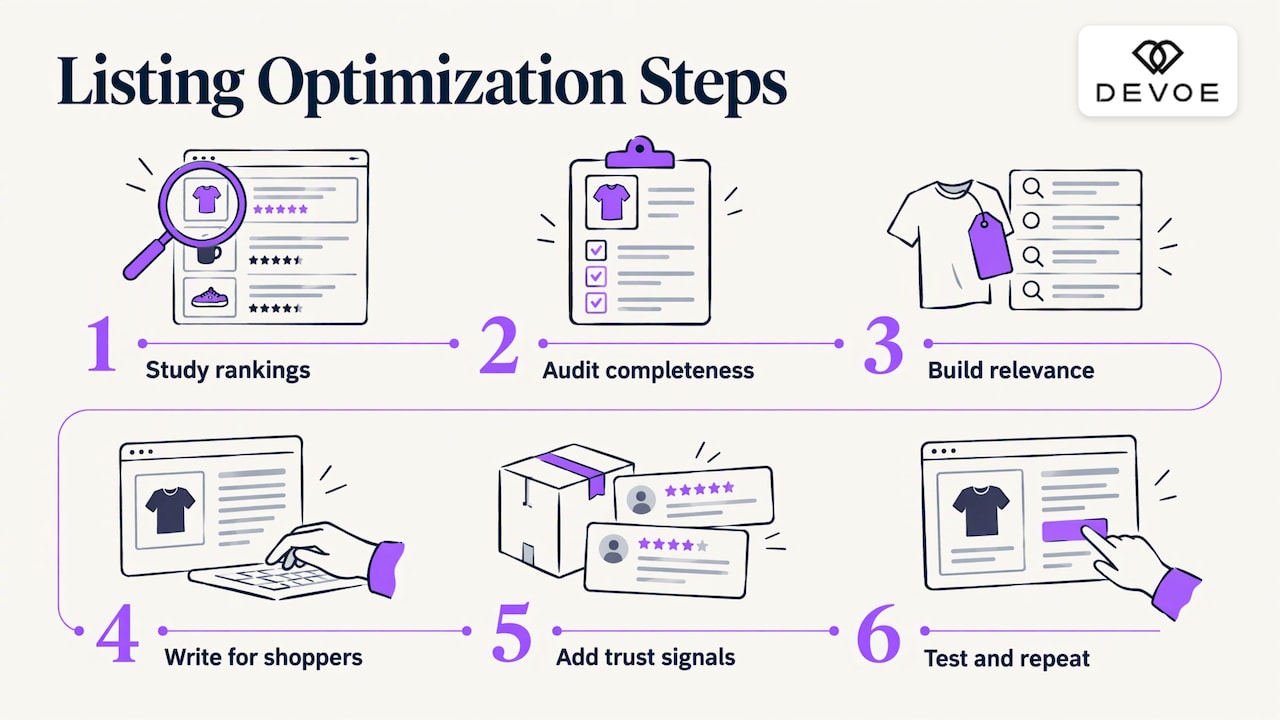
1. Study what already ranks
Search your product’s main terms on the marketplace and read the top results: their titles, image styles, price points and shipping promises. You are looking for the pattern that shoppers in that category reward. Where it goes wrong: copying a competitor’s wording wholesale. Amazon states that copying manufacturer content can hurt search ranking, so original text matters.
2. Audit for completeness
Check each listing for missing images, empty attribute fields, wrong categories and absent identifiers. eBay’s Seller Center advises adding product identifiers such as UPC, MPN or ISBN so listings surface in more relevant searches and key details fill in automatically, and adding details beyond the required fields to build buyer trust. Incomplete listings are the cheapest problem to fix and the most common one we expect in a catalog of hundreds of SKUs.
3. Build keyword relevance
Use the marketplace’s own autocomplete, related searches and the titles of top listings to find the phrases buyers actually type. Work them into the title, bullets and attributes in natural language. Amazon recommends weaving buying-intent keywords into product details and, for brands enrolled in Brand Registry, offers Brand Analytics tools such as Search Query Performance and Top Search Terms.
4. Write for the shopper
Amazon advises descriptions written like a short buying guide: who the product is for, which problem it solves, its main benefits. Keep titles at 80 characters or fewer, even though the system allows up to 200, so they read well on mobile.
5. Add trust and conversion signals
Reviews, competitive pricing and synced stock affect both ranking and the buy decision. Our guide to why reviews matter on European marketplaces covers this in more depth, and our notes on marketplace pricing strategy and inventory management cover the offer side.
6. Test and repeat
Change one element at a time. Amazon’s Manage Your Experiments tool lets eligible brands split-test titles and images. Without a controlled test, a sales jump after a rewrite may just be seasonality.
Marketplace rules are not interchangeable
A listing built for one marketplace will underperform on another. The published specifications show how far they differ:
| Element | Amazon (US) | Walmart Marketplace | eBay |
|---|---|---|---|
| Title | 80 characters or fewer recommended | 50 to 75 characters | Category-specific; identifiers help search |
| Bullets / features | Up to five bullets | 3 to 10 key features | Item specifics beyond required fields |
| Images | Up to nine photos | Four professional images, at least 1000×1000 px, white background | Quality photos plus identifiers |
| Extra tools | A+ Content, Vine, Brand Analytics for enrolled brands | Listing quality score across content, offer and performance | Best Match weighs listing quality and seller performance |
Sources: Amazon’s listing guide, Amazon’s boost guide, Walmart’s listing quality guide and eBay’s best practices.
Walmart’s guide is a good example of the logic behind these specs: it scores listings on content, offer (price, shipping speed, in-stock rate) and performance (order defects, policy adherence, customer response), and says high-quality listings are prioritized for its marketing programs and holiday campaigns.
Imagery rules differ too. A 2024 peer-reviewed A/B study found lifestyle backgrounds nearly doubled conversion for home décor on Wayfair (3.93% vs 1.99%), but had no significant effect on Amazon, where search results favor clean product shots. The same photo set cannot serve every channel. For the image side in Europe, see our guide to ecommerce image optimization.
What changes when you list in Europe
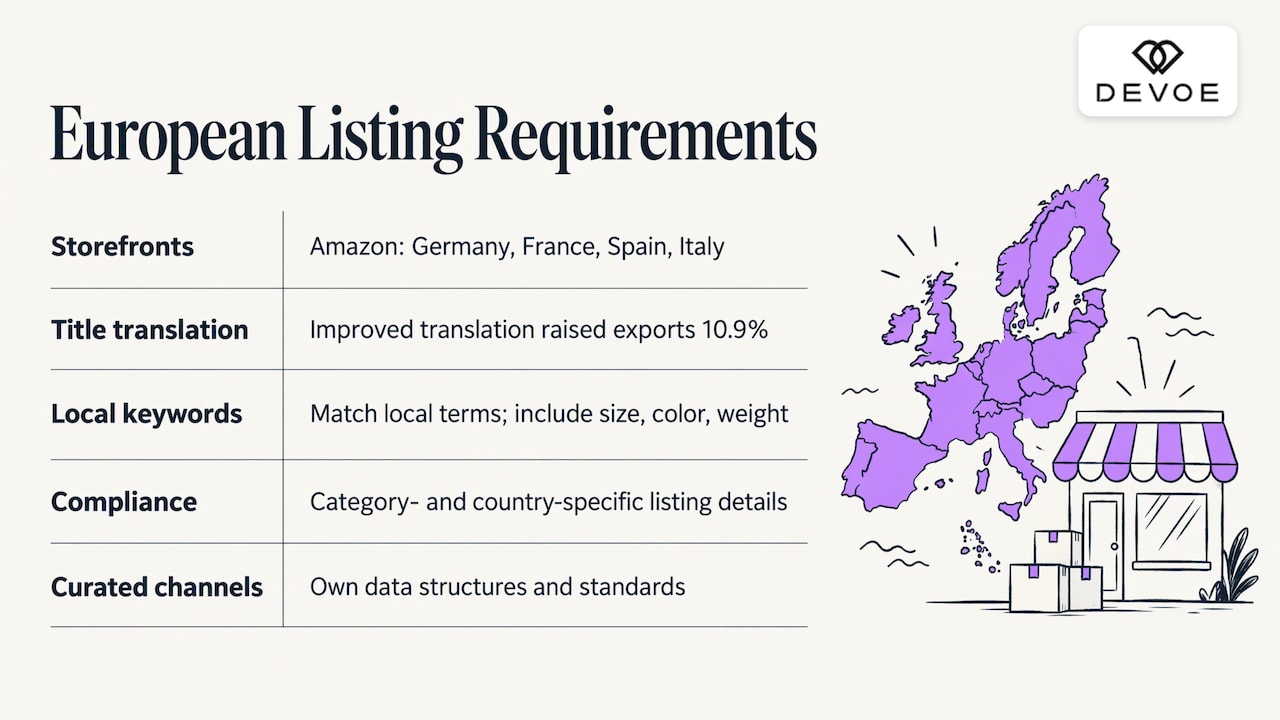
For a US brand, this is where optimization stops being a copywriting task. European marketplaces are country-specific: Amazon runs separate storefronts for Germany, France, Spain and Italy, plus others, and Bol.com, Zalando, About You, Modivo and Douglas each serve their own audiences with their own onboarding and content standards.
Language is a sales factor, not a courtesy. An eBay study by Brynjolfsson, Hui and Liu found that improved machine translation of listing titles raised exports on the platform by 10.9%, with bigger effects for cheaper and more differentiated products. If better title translation alone moved trade that much, the quality of your titles in each language is worth real effort.
Keywords are local. The UK government’s marketplace guidance tells exporters to match titles and descriptions to local use, translate where necessary, include search keywords and supply complete attributes such as size, color and weight. The words a German shopper types for a jacket are not a literal translation of what a US shopper types. Our pages on marketplace SEO and product localization go deeper.
Compliance details belong in the listing. Depending on category and country, a product page may need packaging, electronics or labeling information specific to that market. Treat these as part of the listing, not an afterthought, and confirm the current requirements for your category on the marketplace’s own seller pages before you submit.
Fashion, beauty and pharmacy channels are curated. Zalando, About You, Modivo, Douglas and Shop Apotheke have their own data structures, category trees and brand-presentation standards. Getting the product data mapped correctly is half the work. Our broader guide on expanding an ecommerce business internationally in Europe lays out how to sequence countries.
Diagnose by symptom
Rather than rewriting everything, read the numbers and fix the part that matches the problem. This approach is common in listing audits:
| What you see | Likely cause | Fix first |
|---|---|---|
| Low impressions | Weak relevance | Title, category, attributes, back-end terms |
| Impressions but few clicks | Unattractive first view | Main image, title wording, price visibility |
| Clicks but few sales | Page does not convince | Bullets, description, secondary images, reviews, price |
| Sales that stall after a spike | Stock or service signals | Inventory sync, delivery promise |
Track impressions, click-through rate, conversion rate, units, revenue, returns and ratings on a regular rhythm, and read customer feedback for repeated complaints: they are free copy briefs. Where your brand is enrolled, Amazon’s experiment tool gives you a clean way to compare versions. If you also run paid placements, the marketplace advertising guide shows how ads and listing quality feed each other: ads send traffic, but only a good listing converts it.
When a managed service makes sense
Optimizing one listing in one country is a task. Optimizing a catalog across five marketplaces in four languages, with data feeds, compliance fields, images, ads and stock to keep aligned, is an operation. Brands usually reach for outside help when:
- they are entering a new European marketplace and need listings that meet its requirements on day one;
- the catalog is large enough that manual updates fall behind;
- listings exist but impressions or conversion are flat;
- content has to exist in several languages and sound native in each.
A good service should cover the full chain: marketplace selection, onboarding, content and translation, optimization, advertising and reporting. A copy-only service leaves the data and operations problems untouched.
How Devoe handles it
We built Devoe around that full chain. For brands expanding into European marketplaces, we provide strategic matchmaking to the right marketplaces, onboarding with data mapping and error resolution, content creation and translation, ongoing optimization, targeted advertising, store visual branding, logistics setup and performance reporting. We also coordinate directly with marketplace decision-makers. Our work spans Amazon, Bol, eBay, Zalando, About You, Modivo, Douglas and Shop Apotheke.
If you want listings built for a specific channel, start with the matching page: Sell on Amazon, Sell on Bol.com, Sell on Zalando or Sell on eBay. For the whole program, see DEVOE Managed.

Our product page optimization guide shows what this looks like page by page for brands selling in Europe.
Our perspective
Most brands treat a listing as a form to fill in. We treat it as the storefront, the sales pitch and the data record at once, and each of those has a different owner inside a company. That is why listings stall: the copy is written by marketing, the data by operations, the images by a studio, and nobody owns the result on the marketplace.
Expanding into Europe makes this sharper. Every marketplace has its own requirements, every country its own language and search habits, and the decision-makers at each marketplace respond to brands that arrive prepared. We think the strongest results come when matchmaking, onboarding, localized content, advertising and reporting are run as one program by people who do it every day.
That is the model we offer: hands-on, proactive, and tied to measurable growth in visibility and sales, rather than a one-off rewrite that ages the week it ships.
tinkara
FAQ
What is product listing optimization?
It is the process of improving a product’s marketplace listing so it ranks better in search and persuades more shoppers to buy. It covers titles, images, bullets, descriptions, attributes, back-end keywords and the offer signals around them. Each marketplace applies its own rules, so the work is channel-specific.
How long should a product title be?
It depends on the marketplace. Amazon recommends 80 characters or fewer, and Walmart’s guide specifies 50 to 75 characters. Lead with the brand and the product type, then the attributes shoppers search for, and read the result on a phone screen.
Is translating my listing enough for European marketplaces?
No. Titles, bullets and keywords should be written for each country’s shoppers and search terms, and the listing should carry the attributes and compliance details that market expects. Studies on translation show that language quality affects cross-border sales, so native-quality content is part of the optimization itself.
How do I know whether optimization is working?
Track impressions, click-through rate, conversion rate, units and returns before and after each change. Change one element at a time so the result can be traced to its cause, and use a split-testing tool where the marketplace offers one.
What should a listing optimization service cover?
At minimum: keyword research per marketplace, original content and translation, image direction, attribute and data mapping, and performance reporting. For brands entering Europe, it should also include onboarding and ongoing management, which is how we scope our work at Devoe.
Sources
- Amazon: How to boost Amazon listings to drive more sales
- Amazon: How to create Amazon product listings
- Walmart Marketplace: Listing Quality guide
- eBay Seller Center: Listing best practices
- Shopify: Marketplace SEO Guide
- Dialnet: Mercado Libre Colombia listings study
- Electronic Commerce Research: product exposure and clicks on TikTok Shop
- ACM: Contextual image backgrounds and conversion
- Brynjolfsson, Hui and Liu: machine translation and eBay exports
- business.gov.uk: How to use online marketplaces
1 Comment