

A marketplace management agency is an outsourced team that runs your brand’s selling presence on online marketplaces: it chooses the right channels, gets your catalog live, writes and localizes listings, runs advertising, and reports on results. For a US brand heading into Europe, the value is having one accountable partner for the whole chain instead of juggling a consultant, a translator, a feed tool and an ad freelancer. DEVOE works this way across marketplaces such as Amazon, Bol, eBay, Zalando, About You, Modivo and Douglas.
TL;DR
- A marketplace management agency does the work of selling on marketplaces. Marketplace management software only gives your team tools to do it.
- The core scope runs from marketplace matchmaking and onboarding through content, advertising, logistics setup and reporting.
- Europe is not one market: VAT, language, delivery expectations and category rules differ by country and by marketplace.
- Judge an agency on how it handles onboarding data, localization, inventory and the metrics it reports, not on a list of logos.
- DEVOE covers the full path, from strategic matchmaking to ongoing growth management, on the major European marketplaces.
Table of Contents
- What a marketplace management agency actually does
- Why Europe changes the job
- How integration works behind the scenes
- What to assess before choosing an agency
- Measuring results
- Why a managed service beats assembling the pieces yourself
- Where DEVOE fits
- FAQ
- Sources
What a marketplace management agency actually does
The phrase gets used loosely, so it helps to separate three things that sound alike.
An agency is people. They take responsibility for outcomes on the channels: listings live, ads running, stock in sync, sales reported.
Marketplace management software is a tool. The term covers two different products. Some tools help brands publish listings, sync inventory and reprice across channels. Others help a company run its own multi-vendor marketplace, with seller onboarding and payouts. Neither replaces the decisions and daily work of selling.
A marketplace is the channel itself: Amazon, Bol, Zalando and so on. Each has its own rules, fee structure, content requirements and approval process.
For a brand, the practical question is not agency versus software. It is who owns the work. Software without a team behind it leaves a catalog of rejected listings and unanswered questions. An agency that brings its own tooling and people leaves you with a managed channel.
The services you should expect
A full-scope engagement typically spans these areas, and they are the ones DEVOE lists in its own offer:
- Strategic matchmaking. Deciding which marketplaces fit your category, price point and audience before any work starts.
- Onboarding and integration. Account setup, data mapping and resolving the errors that block products from going live.
- Content creation and translation. Listings written for the local shopper, not translated word for word.
- Store visual branding. A branded storefront or brand page where the marketplace allows it.
- Targeted advertising. Paid placement on the marketplace, tied to the products that can earn it back.
- Logistics setup. Getting stock where it needs to be so delivery promises are met.
- Ongoing optimization and performance reporting. The loop that turns a launch into growth.
If an agency offers only one or two of these, you will be the one stitching the rest together.
Why Europe changes the job
A US brand used to a single domestic Amazon account often assumes Europe is a bigger version of the same thing. It is not. Three differences shape what an agency needs to handle.
Tax and compliance sit with the country where you sell or store
EU VAT is the first surprise. The EU’s One Stop Shop scheme lets both EU and non-EU businesses register once, file one VAT return and make one payment through a single online portal for cross-border sales to consumers in the EU. It reduces the need to register in every member state, but where you hold stock can still create local obligations, so your logistics choices and your tax setup have to be planned together. Confirm the details of your own situation with a tax adviser before you ship.
Language is a ranking factor, not decoration
Shoppers search in their own language with their own vocabulary. A literal translation of a US listing misses the keywords people type and the way local buyers judge quality. That is why content creation and translation sit inside a marketplace management scope rather than being outsourced as a separate job. DEVOE’s approach is to tailor listings to each marketplace’s requirements and to the local audience. Our guides on marketplace SEO and product page optimization go deeper on how that works.
Each marketplace has a different character
Amazon is a broad, search-driven catalog. Bol is the Dutch and Belgian leader. Zalando and About You are fashion destinations, Modivo is strong in fashion across Central Europe, and Douglas is a beauty specialist. Strict content standards, category approvals and onboarding flows vary across them. Choosing the right two or three channels first, then expanding, is usually smarter than listing everywhere at once. For the wider picture, see our guide to cross-border ecommerce in Europe.
How integration works behind the scenes
Onboarding is where many first attempts stall, so it deserves a plain explanation.
Integration connects your storefront or ERP (the system that holds your inventory and accounting) to the marketplace, so that an order adjusts stock, triggers fulfillment and records revenue without anyone copying numbers by hand. According to Synder’s explanation of ecommerce ERP integration, the data that flows includes orders, inventory levels, the product catalog and payments with fees broken out. Connections are built through direct APIs, middleware platforms or native connectors.
In practice, onboarding means mapping your product data to each marketplace’s required fields, then fixing what gets rejected: missing identifiers, wrong categories, attribute values the marketplace does not accept. DEVOE’s onboarding includes this data mapping and error resolution, so the first weeks do not turn into a back-and-forth with a marketplace help desk.
Once live, inventory is the next point of failure. Overselling on one channel damages account health, and understocking wastes ad spend. Our practical guide to marketplace inventory management covers the routine in more detail.
What to assess before choosing an agency
Use these questions in your first calls. They separate a team that runs marketplaces from one that resells a generic package.
| What to look at | What a strong answer covers |
|---|---|
| Scope | Matchmaking, onboarding, content, advertising, logistics and reporting under one engagement |
| Marketplace range | Experience across several European channels, not only one |
| Localization | Native-language listings built for local search, not translated copies |
| Onboarding | A defined process for data mapping and error resolution |
| Logistics and tax | A plan for where stock sits and how VAT is handled |
| Advertising | Marketplace ads connected to your margin and catalog |
| Reporting | Clear performance reporting you can tie to revenue |
| Access to the marketplace | Direct coordination with marketplace decision-makers |
Two more points matter for a US brand in particular.
Start where you already have demand. Look at which European countries already send you orders, and launch there first. Launching a focused set of best-selling products beats listing the whole catalog, because each listing needs localized content, correct data and stock.
Do not assume the UK is the natural first stop. Post-Brexit it is a separate market with its own customs and tax treatment. Many brands do better by choosing the marketplace and country that fit the category.
Measuring results
An agency should report in a way your finance team can follow. Whatever dashboard format is used, these are the numbers that show whether the work is paying off:
- Revenue by marketplace and country, so you can see which channel earns and which is still ramping up.
- Listing quality and visibility: how many products are live, how they rank for target search terms, and how many are blocked by errors.
- Advertising efficiency: ad spend against the sales it generates, per product group.
- Margin after fees: marketplace commissions, fulfillment, returns and ad costs against price. Our pricing strategy guide explains how to set prices across countries.
- Operational health: stock availability, delivery performance and return rates.
Ask for these at the start of an engagement, so that targets exist before the first listing goes live.
Why a managed service beats assembling the pieces yourself
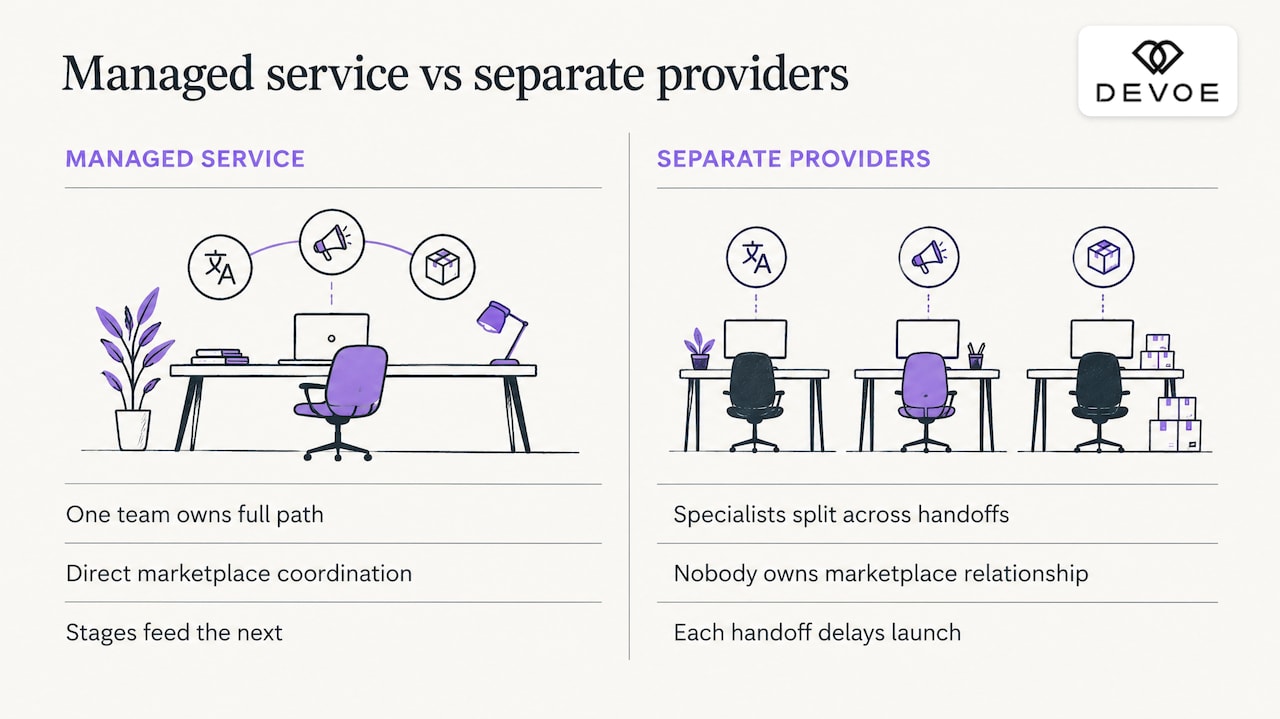
You can hire a translator, a feed tool, an ad specialist and a logistics provider separately. The trouble is the seams. The translator does not know the ad keywords, the ad specialist cannot fix the product data, and nobody owns the marketplace relationship. Each handoff is a delay, and each delay costs launch time.
A single managed service gives one team responsibility from selection through growth. It also gives you leverage: DEVOE coordinates directly with marketplace decision-makers, which matters when a category approval or listing issue needs a person rather than a ticket.
Our view: marketplaces reward ownership
We built DEVOE around a simple observation: brands rarely fail on European marketplaces because the product is wrong. They struggle because nobody owns the whole path. The listing is translated but not optimized, the ads run but the catalog data is rejected, the stock is in one warehouse while the promise says two-day delivery.
That is why we cover the entire process: strategic matchmaking, onboarding, content creation, and ongoing growth management. Each stage feeds the next. A good matchmaking decision makes onboarding smoother, and clean onboarding makes content and advertising work harder.
Our approach is hands-on and proactive. We tailor solutions to each marketplace’s requirements and to the local audience, because a listing that works on Zalando will not simply work on Bol. And we coordinate directly with marketplace decision-makers, so issues are solved by conversation.
If you are weighing marketplaces in Europe, start with one question: who will be accountable for the result in each country? We would like the answer to be us.
tinkara
Where DEVOE fits
If you are a brand ready to sell on European marketplaces and want one team to handle the work, DEVOE Managed covers matchmaking, onboarding, content, advertising, logistics setup and performance reporting. You can also go straight to the channel you have in mind: Amazon, Zalando, Bol, eBay, About You, MODIVO, Douglas or Shop Apotheke.

For a broader plan before you talk to anyone, our guide to expanding your ecommerce business internationally in Europe lays out the stages, and the page on marketplace expansion shows how we run a launch.
FAQ
What is the difference between a marketplace management agency and marketplace management software?
An agency is a team that does the work: onboarding, content, advertising, inventory and reporting. Marketplace management software is a tool that helps publish listings, sync stock and reprice, or, in another meaning of the term, helps an operator run its own marketplace. A managed service gives you the people and the process, so the tools are used with a plan.
How much does a marketplace management agency cost?
Pricing depends on scope, the number of marketplaces and the countries involved. DEVOE does not publish a price list, because engagements are built around the brand’s catalog and goals. The way to get a figure is to describe your products and target markets and ask for a proposal.
Which European marketplace should a US brand start with?
Start with the channel that matches your category and where you already see demand. Fashion brands look at Zalando, About You and Modivo, beauty brands at Douglas, and broad consumer goods at Amazon, Bol or eBay. Mastering one or two markets before expanding is the more reliable route.
Do I need to register for VAT to sell on European marketplaces?
Often yes, and it depends on where your stock is held and where you sell. The EU’s One Stop Shop lets businesses, including non-EU ones, declare VAT on cross-border sales to EU consumers through one portal. Confirm your setup with a tax adviser, and plan it together with your logistics.
How long does it take to launch?
The timeline depends on the quality of your product data, the marketplace’s approval process and your logistics setup. Clean data and a clear first-market focus shorten it the most. A launch plan with milestones per marketplace should be agreed at the start.
Sources
- EU VAT One Stop Shop (OSS), Your Europe
- What Is Ecommerce ERP Integration and How Does It Work?, Synder