

Digital shelf optimization is the ongoing work of making your products easier to find, compare and buy on every online surface where shoppers meet them: marketplaces, retailer sites, your own store and search results. For a brand entering Europe, it means one more thing. Each marketplace has its own rules, language and shopper habits, so a listing that works in the US rarely works unchanged in Germany, the Netherlands or Poland. The brands that win treat each marketplace as its own shelf, with its own content standards and targets. At DEVOE, that is the work we take on for brands: matching them to the right marketplaces, onboarding them, creating and translating content, and managing growth afterward.
TL;DR
- The digital shelf is every online touchpoint where shoppers discover, compare and buy your product. Optimization is a continuous routine, not a one-time listing project.
- Six levers decide your position: titles and descriptions, images, price, stock availability, ratings and reviews, and search placement.
- Track availability, content quality, share of search, ratings and price weekly, per product and per marketplace, starting with the products that bring most of your revenue.
- In Europe, each marketplace needs its own localized content and data setup. Translation alone is not enough.
- A strategy sets the targets for each marketplace. Optimization is the weekly work of hitting them.
Table of Contents
- What the digital shelf actually is
- Digital shelf strategy versus optimization
- The six levers that move visibility and conversion
- How to measure whether optimization is working
- A worked example: one skincare brand, three marketplaces
- Adapting the shelf for Europe
- A weekly routine you can start this month
- Where DEVOE fits
- Our view
- FAQ
- Sources
What the digital shelf actually is
In a physical store, a shelf position is something you negotiate: eye level, an end cap, a promotional display. Online, position is earned by algorithms, product data quality, reviews and pricing instead. Zoho’s academy guide describes the digital shelf as the online touchpoints where shoppers discover, evaluate and buy: your own store’s product and category pages, marketplaces, retailer websites and social commerce posts.
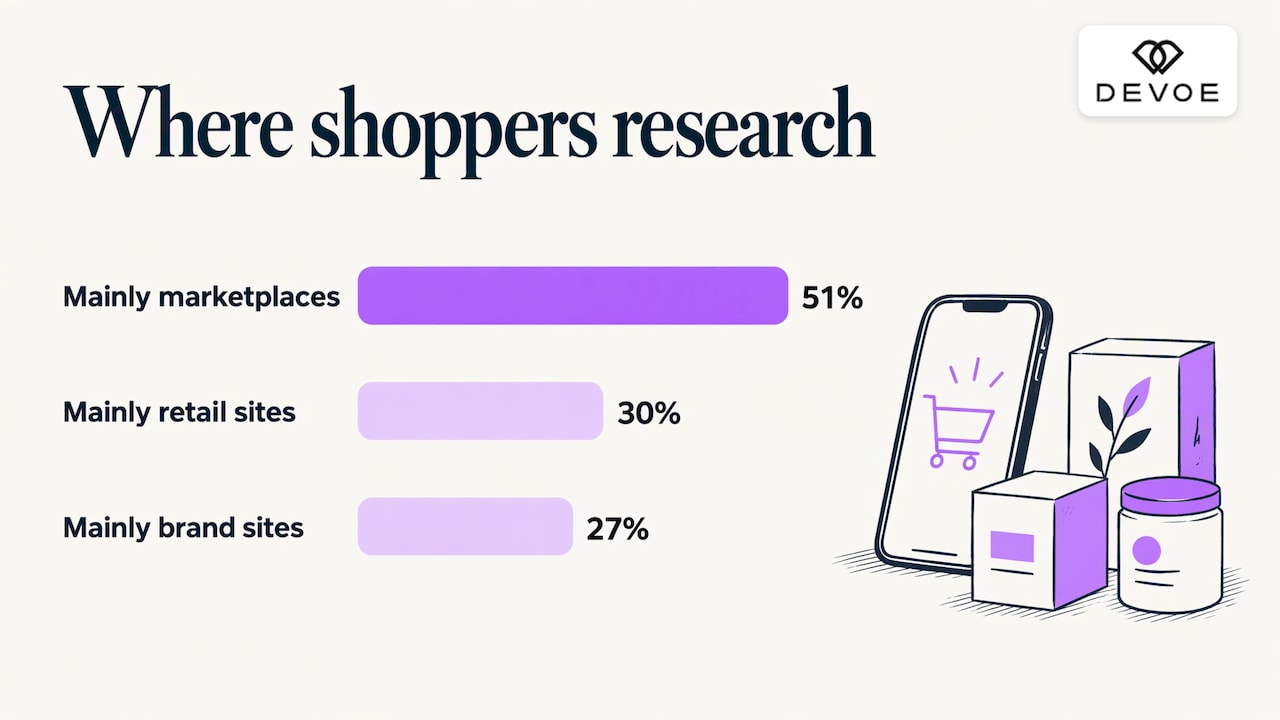
No single touchpoint is the whole shelf. In Salsify’s 2026 consumer report, as reported by Shopify, 51% of shoppers said they mainly research new products and brands on marketplaces like Amazon, 30% on retail websites and 27% on brand websites. Shoppers move between all three, so your product has to look consistent and credible in each.
For a brand selling in Europe, the shelf is split further by country and language. The same shopper may compare your product on Amazon, Bol or Zalando depending on the market and category. Each of those is a separate shelf with a separate set of competitors, so optimization has to be done marketplace by marketplace.
Digital shelf strategy versus optimization
The two terms are often used as if they were the same thing. They are not.
A digital shelf strategy is the plan. It states which marketplaces and retailers you sell on, which searches you want to rank for, what your content standard is on each, what minimum rating you accept and what in-stock level you commit to. It also decides who owns each number.
Digital shelf optimization is the recurring work that carries out that plan: fixing a title, replacing a weak hero image, correcting a price mismatch, restocking before a product drops out of search, answering what reviews reveal. PriceSpider notes that analysis and optimization never stop, and that the strategy should guide how you react.
A useful way to put it: the strategy answers “what does a good shelf look like for us on this marketplace?” The optimization routine answers “how far are we from it this week, and what do we fix first?”
The six levers that move visibility and conversion
Most guides group the factors slightly differently, but they converge on the same six. Zoho’s guide lists them as product titles and descriptions, images and video, pricing, stock availability, ratings and reviews, and search placement.
1. Titles, descriptions and attributes
Titles and attributes are what algorithms read to match a listing to a shopper’s search. Descriptions influence both search and conversion. Content should be adapted for each channel, as inriver’s guide explains, rather than pasted from one master file. Each marketplace has its own character limits, mandatory attributes and category taxonomy. Our guide to product listing optimization covers how to structure a listing for a marketplace, and the marketplace SEO guide covers how listings rank on Europe’s marketplaces.
2. Images and video
Imagery shapes buyer confidence before a shopper reads a word. Zoho recommends a clean hero image plus two to three additional shots. Marketplaces also set technical rules for image background, size and count, and these differ between platforms. See our guide to ecommerce image optimization for European marketplaces for the specifics.
3. Price
Shoppers compare. A price that is out of line with the same product elsewhere, or inconsistent between your own store and a marketplace, hurts conversion and can affect placement. Pricing on the digital shelf includes the shelf price, sale price and promotion depth, and it should be reviewed across every channel on a schedule.
4. Availability
A product that is out of stock stops converting, and according to Zoho, an out-of-stock status drops search ranking and recovery takes time. Stock that is synced in near real time across channels protects the position you have built. Our marketplace inventory management guide goes through the practical side.
5. Ratings and reviews
Reviews are a trust signal and a ranking input. Zoho reports that products with five or more reviews are 270% more likely to sell than those with none. That is a strong reason to plan how a new listing collects its first reviews, and to read the reviews you have as a source of content fixes: a repeated complaint about sizing is a description problem as much as a product one. Our article on why reviews matter on European marketplaces goes deeper. The way search engines index and show pages also affects what shoppers see first, a topic covered in this overview of Google shared pages and indexing.
6. Search placement
Placement is the result of the other five, plus sales history and fulfillment performance. It is also the metric where “on the shelf” and “found on the shelf” diverge. A product can sit in the catalog and still be commercially invisible. As the research behind this guide puts it, appearing on page five of results for an important search term is much like being placed where few shoppers look.
How to measure whether optimization is working
Digital shelf analytics is the systematic collection and review of publicly visible product data on retail sites. You do not need a large dashboard to start. You need a short list of KPIs, reviewed on a fixed day, for your most important products.
| Metric | What it tells you | Example question |
|---|---|---|
| Availability | Share of listings where the product is in stock | Is the hero product in stock on all four marketplaces we sell on? |
| Content quality | Compliance with the marketplace’s content guidelines and your own standard | Do all listings have the mandatory attributes and the full image set? |
| Share of search | Your share of results for a keyword on a given marketplace, organic and sponsored | For our top three search terms, how many of the first 10 results are ours? |
| Share of category | Your share of products on a category page | Are we visible in the category, not just in branded search? |
| Ratings and reviews | Average rating and review volume | Which listings sit below our minimum rating? |
| Price and promotions | Price gaps and promotion depth against other sellers and channels | Is the price consistent across channels? |
Availability is simple to calculate. If a product is in stock at two of four retailers, its availability score is 50.
Start with the products that carry the business. A common rule of thumb in digital shelf analytics is to focus on the top 20% of products that bring 80% of revenue. Get those right before you widen the scope.
A worked example: one skincare brand, three marketplaces
This example is illustrative, not a client case. Imagine a US skincare brand with 40 products that decides to enter Germany, the Netherlands and Poland. It ranks its products by revenue and finds that eight make up most of its sales. Those eight become the first shelf.
For each marketplace it writes a short shelf definition:
- Three to five search terms per product in the local language, not translated English terms.
- A content standard: full mandatory attributes, a hero image meeting the marketplace’s rules, two to three supporting images and a localized description.
- A minimum average rating, and a plan to collect the first reviews.
- An in-stock target and a restock trigger.
Each Monday it checks eight products across three marketplaces: 24 listings. It marks each for the five KPIs above. In week one, it finds four listings with missing attributes, two with the wrong image background and one product out of stock in the Netherlands. The fix list writes itself, and it is ranked by revenue at stake. That is optimization in practice: a short list, reviewed on a schedule, with named owners.
Adapting the shelf for Europe
Expanding into Europe is where many brands discover that the shelf cannot simply be copied. Three things need deliberate work.
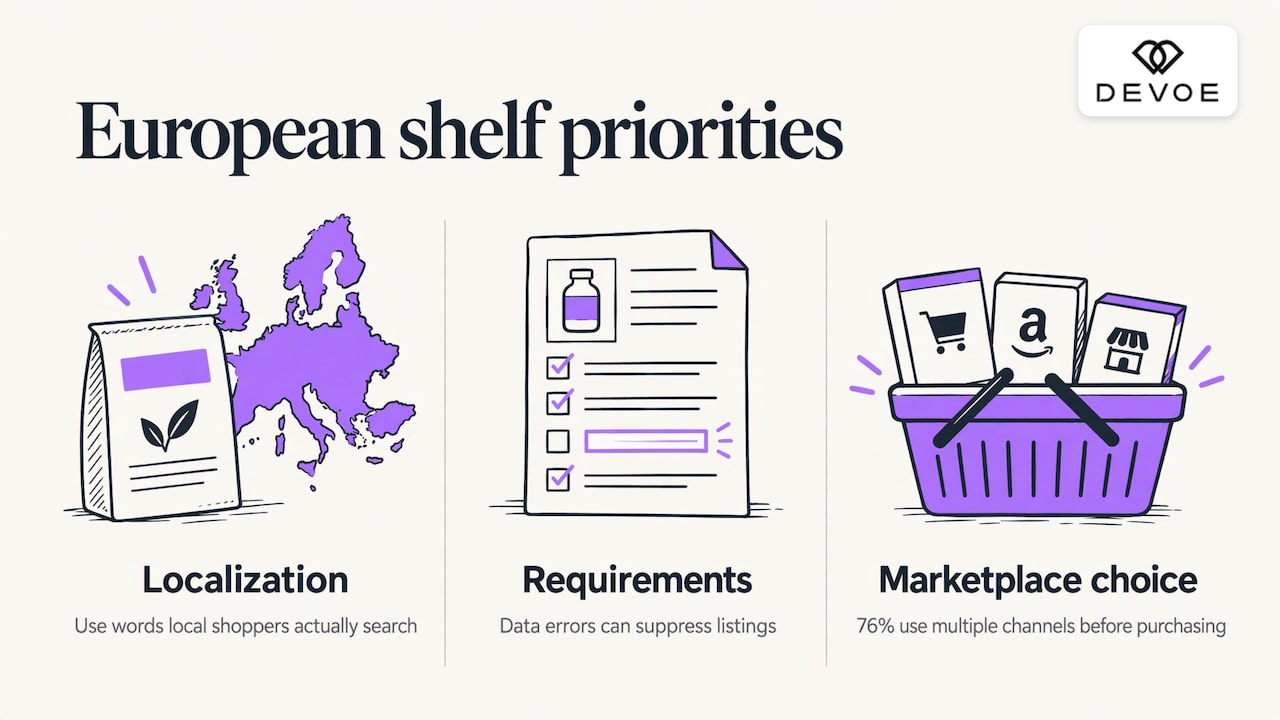
Language that sells, not just language that matches. Titles and bullet points are search surfaces, so the words local shoppers actually type matter. Literal translation tends to miss them. We cover what to translate and how in our guide to ecommerce translation services.
Marketplace requirements. Each marketplace has its own product data format, category structure and content rules. A listing that is rejected or suppressed for a data error never reaches the shelf at all. Our onboarding includes data mapping and error resolution for this reason.
The right marketplaces. Shoppers in different countries and categories favor different platforms. Fashion, beauty, pharmacy and general retail each have their own leading marketplaces. Choosing where to place your products is part of the strategy, not an afterthought. Multichannel behavior is common: Akeneo found that 76% of buyers use multiple channels before purchasing, according to Shopify’s summary, so consistency across the shelves you pick matters.
For a closer look at one major European shelf, read our guide to digital shelf management on Amazon.de. For advertising on top of organic position, see our retail media management page.
A weekly routine you can start this month
- List your priority products. Rank them by revenue and take the top group that makes up most of your sales.
- Define the best shelf for each marketplace. Set the searches to rank for, the content standard, the minimum rating and the in-stock target. Write it down so anyone on the team can audit against it.
- Audit each listing against that definition. Check titles, attributes, images, price, stock and reviews. Record gaps, not opinions.
- Fix by revenue at stake. Out-of-stock items and missing mandatory data come first, because they stop sales outright. Content and image improvements follow.
- Measure weekly, per product and per marketplace. A fixed day makes trends visible. A single global average hides the one marketplace that is slipping.
- Feed learnings back into the standard. If reviews keep raising the same question, change the description and image set for every listing, not just one.
- Add sponsored placement once the organic shelf is sound. Advertising a weak listing pays for clicks that do not convert.
Each step is manageable for one marketplace. Across several European marketplaces and languages, the volume of listings, rules and data feeds is where in-house teams stretch thin.
Where DEVOE fits
We help brands expand into and grow on European marketplaces, covering the whole route: strategic matchmaking to the right marketplaces, onboarding with data mapping and error resolution, content creation and translation, ongoing optimization, targeted advertising, store visual branding, logistics setup and performance reporting. We work across marketplaces including Amazon, Bol, eBay, Zalando, About You, Modivo, Douglas and Shop Apotheke.
If you want one team that builds the shelf and then keeps it in shape, see DEVOE Managed. If you already know the marketplace you want to start with, the pages for Amazon, Zalando, Bol.com and About You explain how we work on each.

For a product-level view, our guide to product page optimization for brands selling in Europe is a good next read.
Our view
Brands often ask us which tool to buy. We start with a different question: what should the shelf look like on each marketplace, and who owns it every week?
Marketplaces in Europe differ in rules, language and shopper habits. That is why we match a brand to the right marketplaces first, and only then build content, data and advertising around that choice. A listing built for one marketplace and copied to another usually carries the wrong words, the wrong images or missing data.
We work hands-on, and we coordinate directly with marketplace decision-makers. Digital shelf optimization is not a project with an end date. Once a brand is live, the shelf needs content upkeep, stock discipline, review attention and advertising adjustments, week after week. We combine creative and proactive work with performance reporting so that growth is measurable and sustained.
The brands that do best treat Europe as several markets with one brand voice, and give that work a dedicated, accountable team.
tinkara
FAQ
What is digital shelf optimization?
It is the continuous process of improving how your products appear, rank and convert across the places shoppers find them online, including marketplaces, retailer sites and your own store. It covers titles, images, attributes, price, stock and reviews. The aim is that shoppers find your product, trust it and buy it.
What is a digital shelf strategy?
It is the plan that defines what a good shelf looks like for your brand on each marketplace: the searches to rank for, content standards, minimum ratings and in-stock targets. The optimization routine then measures your listings against that plan and fixes the gaps.
Which metrics should I track first?
Start with availability, content quality, share of search, ratings and reviews, and price consistency. Review them weekly, per product and per marketplace, for the products that generate most of your revenue.
Does translating my listings count as optimizing for Europe?
Translation is the starting point. Optimization also means using the search terms local shoppers use, meeting each marketplace’s data and content rules, and choosing the marketplaces where your category sells. Our work on content creation and translation is built around that.
Sources
- Zoho Commerce Academy: What is a digital shelf?
- Shopify Enterprise: Digital Shelf Ecommerce
- PriceSpider: How to Create a Digital Shelf Strategy
- inriver: Digital shelf management guide
- Google shared pages and indexing