

Marketplace SEO is the work of making your product listings easy for a marketplace’s own search engine to find, understand and reward with visibility. For a brand expanding into Europe, it is not one skill but several: each marketplace ranks differently, each country has its own language and buying habits, and each platform has data rules that can hide a listing before a single shopper sees it. We built our work at DEVOE around this problem: matching brands to the right marketplaces, onboarding them, and creating and translating content so listings are built for local search from day one.
TL;DR
- Marketplace SEO means optimizing listings so they rank inside a platform’s search, such as Amazon, eBay or bol, not on Google.
- Most marketplace algorithms weigh two things: relevance (keywords, attributes, category) and performance (click-through, conversion, reviews).
- In Europe, every country-marketplace pair is its own listing project: native-language copy, correct category mapping and complete compliance data.
- Measure impressions, conversion and net margin per channel, and change one variable at a time.
- Brands that hand localization and onboarding to a managed partner avoid the data errors that suppress listings.
Table of Contents
- What marketplace SEO actually means
- How marketplace search ranks your listings
- Keyword research and listing optimization
- Localizing for Europe: where most brands lose visibility
- Reviews and ratings
- Measuring what works
- What about Facebook Marketplace?
- Perspective
- Getting it done across several marketplaces
- FAQ
- Sources
What marketplace SEO actually means
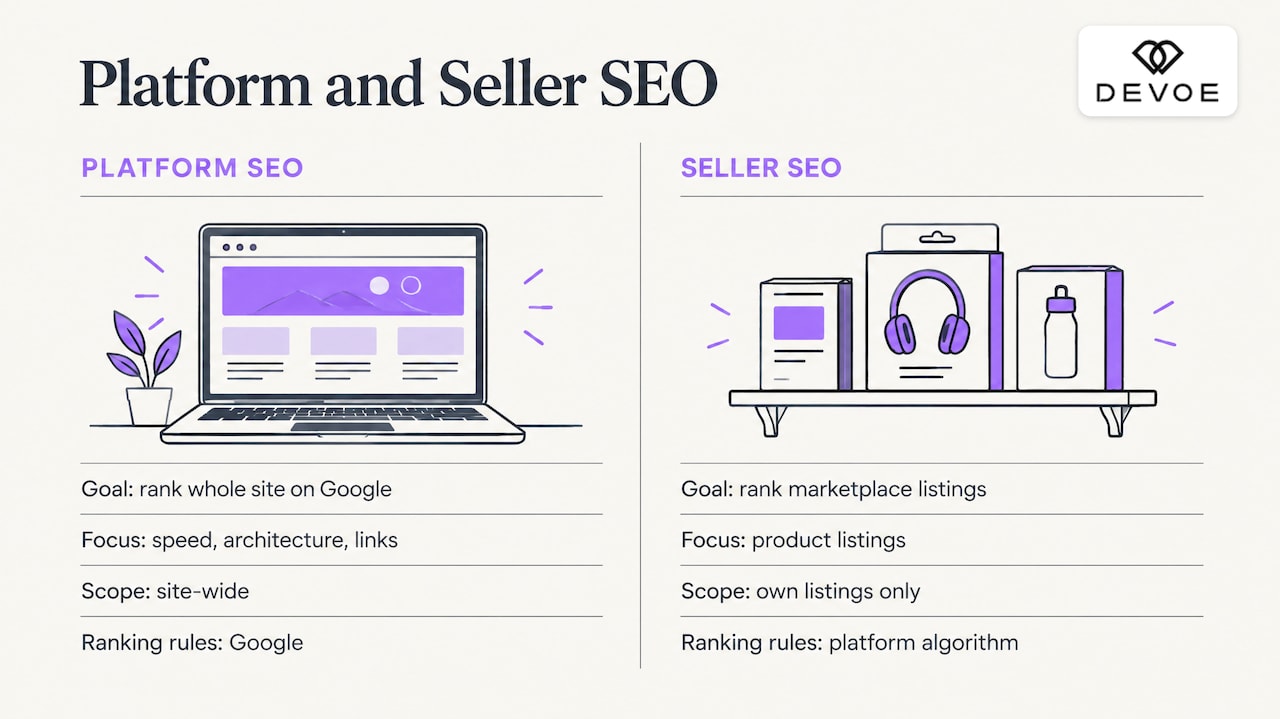
The phrase has two meanings. Operators of a marketplace platform use it for getting the whole site to rank on Google: site speed, architecture and links. Sellers use it for optimizing their own listings inside a marketplace. This article is about the second meaning, which is the one a brand selling on Amazon, bol or Zalando needs.
Shopify defines it as optimizing product listings to rank higher in search results on marketplaces, shaped by each platform’s own search behavior and discovery algorithm rather than by Google. The difference from running your own web store matters. On your store, you control every page and the ranking rules are Google’s. On a marketplace, the operator controls the design and the ranking algorithm, and you control only your listings. Your job is to give that algorithm exactly what it wants, in the format it wants it.
How marketplace search ranks your listings
The details differ by platform, but the logic is consistent. Shopify says most marketplace algorithms prioritize listing relevance and performance: relevance is how well keywords, attributes and content match the search, and performance is click-through rate, conversion rate and reviews.
Relevance: fields, not just words
Marketplaces match a query against specific fields, each with its own weight. One practitioner guide explains that on Amazon the title, category, attributes and backend search terms carry more weight than bullets and descriptions, and that eBay leans heavily on item specifics such as brand, size, color and condition, and can exclude listings missing required specifics from filtered searches. An empty field is a lost chance to be matched.
Performance: what shoppers do after they see you
Once relevance is established, the same guide notes that platforms rank on conversion, sales velocity, price competitiveness, stock, fulfillment speed and seller metrics such as returns and cancellations. eBay’s Cassini system, per Shopify’s guide, considers the total cost to the buyer including shipping, not just the listed price.
Walmart’s official guide frames this as an optimization triangle of content, offer (price, shipping speed, in-stock rate) and performance (order defect rate, policy adherence, customer response). The lesson carries across platforms: SEO on a marketplace reaches beyond copywriting into pricing, logistics and service quality. That is why pricing strategy and inventory management belong in the same plan.
What bol says about its own algorithm
For European brands, bol’s documentation is a useful model. Its search first interprets the query, with category detection, spelling correction, synonyms and normalization of plurals, then checks item relevance including category matches, and finally uses anonymous interaction data while filtering fraudulent clicks. It advises assigning items to the right category, completing all attributes and images, and using the seller account’s search trends tool to find the terms customers really use. It also notes that overly long titles do not significantly increase visitors.
Keyword research and listing optimization
Start with the marketplace’s own data, not your web store’s keywords. Shopify recommends reviewing search-bar autocomplete, top-ranking listings, and related searches and filters to find primary terms and secondary attributes.
- Build the keyword set per marketplace and per language. A term that sells in the US may not exist in Dutch or German shopping behavior. Use autocomplete and trends tools on each platform.
- Write titles around the core query. Put the most important term first, within the platform’s character limit. Do not stuff.
- Choose the exact category. Amazon’s style guide tells sellers to use the correct leaf-level category because correctly categorized products get more page views.
- Use backend search terms for what the visible copy lacks. Amazon’s guidance says to add features not mentioned elsewhere, alternate names and synonyms, without repeating title words, adding misspellings or using subjective terms like “best”.
- Fill every attribute. Attributes feed both search matching and filters.
- Meet image specifications. Amazon requires main images on a pure white background showing only the product, with no text, logos or watermarks, and these images appear in search results. Our guide to image optimization for European marketplaces goes deeper.
One caution from a seller-side roadmap: rewriting a whole listing at once destroys attribution at catalog scale, because you cannot tell which change moved the result. Test on representative products first.
Localizing for Europe: where most brands lose visibility
Europe is not one marketplace. It is a set of country-specific shopper behaviors on platforms that each have their own rules. A UK government guide to localizing an online marketplace presence advises treating each target market as its own listing: adapt search terms, spelling, seasonality, measurements and sizes, localize currency, shipping and returns, and map your categories and attributes to the target marketplace’s taxonomy, since incorrect mapping can make products invisible in search.
Translate for buyers, not for a dictionary
A European channel guide reports that machine-translated copy underperforms, especially in Germany and the Netherlands, and recommends the buyer’s own language in descriptions. It also notes that most ranking systems suppress listings priced significantly above similar products, so monitor competitor pricing per marketplace.
Do not assume one language per country
A 2026 report on listing requirements points out that bol supports Dutch and French locales, while OTTO Market is a single German-language storefront. Requirements must be checked per marketplace.
Compliance data is a ranking factor in disguise
The same report says missing product safety data under the EU’s General Product Safety Regulation (GPSR) can block or hide listings on Amazon, eBay, bol, Kaufland, Allegro and TikTok Shop, and that Amazon deactivates listings 24 hours after creation if the required attributes are missing. A listing that is hidden cannot rank. This is why onboarding, with data mapping and error resolution, is part of our service rather than an afterthought.
Reviews and ratings
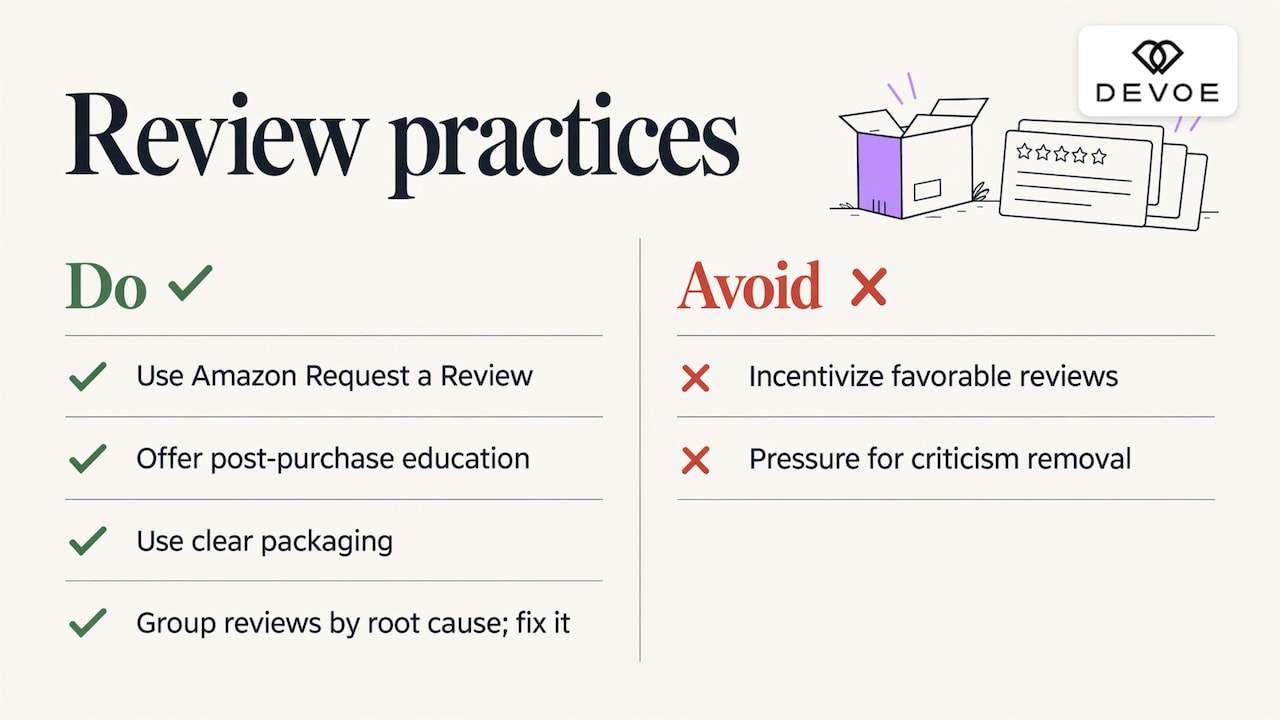
Reviews feed both sides of the algorithm: they attract clicks and lift conversion. Shopify reports that products rated 4.3 stars or higher held 73% of Amazon’s top Best Seller Rank positions in one study. Build reviews through the platform’s compliant tools: a seller roadmap describes using Amazon’s Request a Review workflow, useful post-purchase education and clear packaging, never incentives for favorable reviews or pressure to remove criticism. Negative reviews are product intelligence: group them by root cause and fix the cause. More on this in our piece on why reviews matter on European marketplaces.
Measuring what works
Track three things per channel: impressions (are you shown), conversion (do clicks become orders) and net margin after fees. Channable’s guide reads them together: low visibility despite a good listing usually points to a saturated category or suppressed pricing, while good visibility with poor conversion points to listing issues.
Platform dashboards help. Walmart’s Search Insights shows item-level impressions, clicks, add-to-cart and sales rankings with change annotations, so you can link a result to a content or price change. A seller roadmap suggests a weekly review that assigns each product one primary constraint, such as low conversion, weak visibility, ad waste or stockout risk, and changes one high-impact variable at a time.
Organic ranking and paid placement reinforce each other, so read them together. Our marketplace advertising guide covers the paid side.
What about Facebook Marketplace?
This is a different game, and mostly for individual sellers. Meta explains that its feed is ranked by an AI system that considers location, category, condition and price, plus integrity checks against low-quality content. Clear titles, the right category and accurate details help, but it is not the channel brands use to build European retail sales.
Perspective
Most brands treat marketplace SEO as a copywriting task. In our experience it is an operations task with a copywriting layer on top. A strong title does nothing if the category is wrong, the data fails a marketplace check, or the translation reads like a translation.
That is why we do not start with keywords. We start with matchmaking: which marketplaces suit the brand and its audience. Then we handle onboarding, data mapping and error resolution, content creation and translation, ongoing optimization, targeted advertising and performance reporting, so the listing is right from the first day and keeps improving after it.
Search on each marketplace changes with its shoppers and its rules. Having one team own the whole chain, from integration to reporting, is how a brand keeps its Amazon, bol, eBay and Zalando presence consistent while still sounding local in each country.
tinkara
Getting it done across several marketplaces
Optimizing one listing is manageable. Doing it across several marketplaces, languages and compliance regimes, and keeping it current, is a program. DEVOE Managed covers strategic matchmaking, onboarding, content creation and translation, ongoing optimization, targeted advertising, store visual branding, logistics setup and performance reporting across marketplaces such as Amazon, bol, eBay, Zalando, About You, Modivo and Douglas. If you are planning the wider move, see our guide to expanding an e-commerce business in Europe, or start with a marketplace page such as selling on Amazon with DEVOE or the DEVOE Managed overview.

FAQ
Is marketplace SEO the same as regular SEO?
No. Regular SEO targets Google and similar engines, and you control your own pages. Marketplace SEO targets a platform’s internal search, where the operator sets the ranking rules and you control only your listings. The skills overlap in keyword research, but the signals, including sales performance and fulfillment, are different.
What matters most for ranking on Amazon, bol or eBay?
Relevance and performance. Relevance comes from the title, category, attributes and search terms matching the query. Performance comes from click-through, conversion, reviews, price including shipping, and seller reliability. Fixing relevance first gives the performance signals something to build on.
Do I need separate listings for each European country?
Treat each marketplace and country as its own listing. Language, search terms, sizes, currency, shipping and returns differ, and platform requirements vary, so a single translated copy rarely fits all. Category and attribute mapping must also match each marketplace’s own structure.
How long before listing changes show results?
It depends on the marketplace and category, and no source gives a fixed timeline. Change one variable at a time, review impressions and conversion weekly, and judge the result against your own earlier numbers.
Sources
- Marketplace SEO Guide, Shopify
- Marketplace SEO: How to Optimize Your Online Platform, Semrush
- eBay Algorithm Guide, Shopify
- Walmart Marketplace Listing Quality guide
- The search algorithm of bol, Partnerplatform
- How Marketplace Search Really Works
- Amazon Category Style Guide
- Amazon Seller Optimization roadmap
- How to localise your online marketplace, business.gov.uk
- European marketplaces strategy, Channable
- Product listing requirements on 12 marketplaces, WisePIM
- Search Insights dashboard, Walmart Marketplace Learn
- Facebook Marketplace ranking, Meta Transparency Center
1 Comment