

Digital shelf management is the work of controlling how your products appear and perform wherever shoppers search, compare and buy online: product pages, search results, prices, stock, reviews and ads. For a brand entering Europe, the most important shelf is Amazon.de. Germany’s marketplaces now carry a majority of online sales, and a product that is missing, out of stock or badly presented there loses the sale to a competitor. We run this work for brands as a managed service, so the shelf is built, localized and kept healthy by one team.
TL;DR
- The digital shelf is every online touchpoint where shoppers discover, compare and buy your product. Managing it means keeping data, content, price, availability and reviews right on each channel at once.
- In Germany, all marketplaces together made up 57% of online retail in the HDE’s 2025 Online-Monitor, up from 54% the year before. Being absent from Amazon.de means being absent from where much of the demand is.
- Search position decides who sells: the top three results in major retailer search often get as much as 80% of clicks.
- Finding shelf problems is the easy part. Fixing content, stock, pricing and ads across languages and marketplaces is the work, and it is what a managed partner takes over.
Table of Contents
- What the digital shelf is, and what managing it means
- Why Amazon.de is the shelf that matters most in Germany
- The five things that make up your shelf
- What to measure
- Advertising: the part of the shelf you can buy
- The real challenge: running it across markets
- What a managed approach covers
- Start with Amazon.de
- FAQ
- Sources
What the digital shelf is, and what managing it means
A physical shelf has a position, a label, a price tag and a stock level. The digital shelf has the same four things, plus reviews and ads. Shopify’s 2026 guide describes it as the full set of online touchpoints where shoppers discover, research, compare and buy: search results, retailer sites, shopping apps, product pages and your own storefront.
Managing it is a continuous process, not a launch task. MediaValet frames it as controlling, publishing, monitoring and improving product data, assets, pricing, availability and reviews against each channel’s requirements. The product detail page sits at the center of everything else.
Two terms are worth separating:
- Digital shelf analytics is the measurement layer: software or audits that check search rank, content, ratings, price and availability for your products and your competitors’.
- Digital shelf management is the action layer: fixing the title, the images, the price, the stock feed and the ad bids that the measurements point to.
Buyers of analytics tools report a consistent frustration: finding a shelf problem is easier than fixing it, because someone still has to correct content, stock and search. That gap between a dashboard and a fixed listing is where most brands lose time.
Why Amazon.de is the shelf that matters most in Germany
Germany is Europe’s largest e-commerce market, and its online trade runs through marketplaces. The HDE’s 2025 Online-Monitor puts the combined marketplace share at 57% of online retail, against 54% a year earlier, and says Amazon’s marketplace keeps growing faster than the market average.
For a brand, this changes the question. It is no longer whether to be on a marketplace, but how well your shelf there is run. Three reasons stand out.
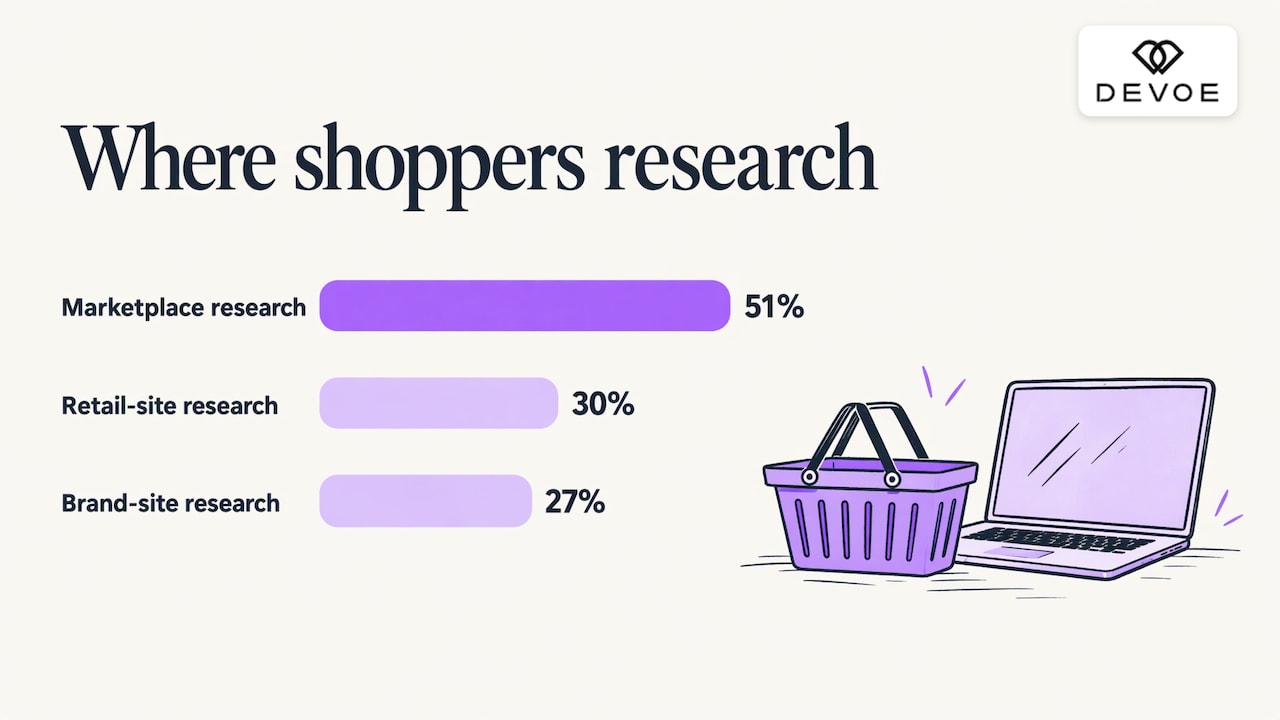
Shoppers start on marketplaces. Salsify’s 2026 consumer report, cited by Shopify, found that 51% of shoppers primarily research new products on marketplaces like Amazon, ahead of retail websites (30%) and brand websites (27%). The survey covers shoppers in the US, UK and Canada, but the habit is a useful guide to where discovery happens.
Trust is borrowed. A first-time buyer has never heard of your store. On a marketplace they see familiar checkout, delivery and returns, plus reviews from other buyers. A brand that has only its own site asks every new customer to extend that trust from zero.
Relying on one store is a concentration risk. An independent store depends on paid traffic you must keep buying, one set of algorithms and one payment of attention. A marketplace presence adds a second demand source that works from shoppers already searching with intent. It also protects you from the competitive disadvantage of being invisible: when a shopper searches your category on Amazon.de and your product is not there, they buy someone else’s.
For small and mid-sized brands the opportunity is real. A marketplace gives you national reach in Germany without a physical retail network, distributor margins or a large paid-media budget. The condition is that the shelf is run with discipline from day one.
The five things that make up your shelf
Most guides converge on the same pillars. Fieldpie lists content, search visibility, pricing, ratings and reviews, and in-stock availability. Here is what each means on Amazon.de and where it goes wrong.
1. Availability
Availability is the foundation. NIQ calls out-of-stock rate the foundational KPI, since a product that is not in stock has no digital shelf presence and cannot convert. The damage lasts beyond the stockout: in a vendor analysis of one consumer goods brand on Amazon, top-ten products lost more than 28% of their rank after a single day out of stock and 83% after three days or more. Stock needs to reach the marketplace accurately and quickly, which is why we cover marketplace inventory management as part of the work.
2. Search visibility
Position is the shelf’s eye level. NIQ reports that 80% of in-basket products appear in the top 10 keyword-search results, and that the product title is the leading lever for top organic spots (39% for omnichannel retailers, 38% for pureplayers). A German title that mirrors how German shoppers actually search will beat a literal translation of your English one. Our guide to marketplace SEO goes deeper on ranking.
3. Content
Product pages convert when they answer the shopper’s questions quickly. In Salsify’s 2026 research of 2,712 shoppers in the US, UK and Canada, 61% named images and videos the most important page element, ahead of pricing and availability (60%) and ratings and reviews (57%). Strong imagery follows marketplace rules about backgrounds, angles and infographics; this Amazon product photography workflow walks through a shot list. For the page as a whole, see our guide to product page optimization and to ecommerce image optimization.
Content also has to be localized. Translated bullet points are not enough: units, certifications, sizing and the phrases shoppers use all differ by country.
4. Price
Price is visible to every shopper and every competitor at once. Monitoring means recording what each seller advertises, with shipping and promotions, at a frequency that suits the product: high-velocity items several times a day, long-tail items weekly or monthly. One legal point matters for Europe: in the EU, resale price maintenance is a hardcore restriction under Regulation 2022/720 and its guidelines, so price monitoring should serve benchmarking and visibility, not pressure on resellers. US rules differ, so a brand selling in both markets needs each treated on its own terms. Our overview of marketplace pricing strategy covers how to set prices across countries.
5. Ratings and reviews
Reviews feed both conversion and ranking. One guide reports that products with five or more reviews are 270% more likely to sell than those with none. NIQ adds that brands should respond to negative reviews within the day, ideally within minutes. A new Amazon.de listing starts with none, so a plan for earning early reviews belongs in the launch. More in why reviews matter.
What to measure
You do not need fifty metrics. DataWeave’s guide advises starting with the top 20% of products that deliver 80% of revenue and your five to ten closest competing brands. For each, track a short set:
| Metric | What it tells you | Where it goes wrong |
|---|---|---|
| Availability rate | Share of time (or retailers) where the product is in stock | Stock feed lags, so listings sell what you no longer have |
| Share of search | How often you appear for your category keywords | Tracking only brand terms hides weak category visibility |
| Content compliance | Whether titles, bullets and images meet channel rules | Translated content passes in one country and fails in another |
| Price competitiveness | Your price against comparable offers | Matching the wrong product gives misleading data |
| Rating and review volume | Social proof and its trend | A single unanswered complaint can sink conversion |
| Conversion rate | Whether the page turns visits into orders | Read alone, it cannot tell you whether the cause is price, content or stock |
On the data side, a price matched to the wrong product is worse than no data at all, which is why SKU matching on GTINs or model numbers comes before any dashboard.
Advertising: the part of the shelf you can buy
Organic rank is earned slowly, so paid placement fills the gap on new listings. Retail media is now a major force: WPP Media estimates that commerce media reached $178.2 billion globally in 2025, or 15.6% of global ad spend. The common difficulty is proving what the spend returns: NIQ reports that 36% of brands struggle to prove retail media incrementality.
The practical answer is to connect ads to the shelf. Sponsored bids on a page with weak images, a missing price advantage or unstable stock waste budget. Fix the page first, then scale spend. See our guides to marketplace advertising and retail media management.
The real challenge: running it across markets
Every marketplace has its own data rules. Carlos Fominaya of Ysabel Mora, a fashion brand selling in over 40 markets, explained that each marketplace has its own requirements and the data had to be transformed first. That is the everyday reality of multi-market selling: attribute mapping, error messages, translations, price rules and stock sync, repeated per channel.
For a brand with a small team, the list adds up fast:
- Map product data to the marketplace’s category and attribute structure, and resolve rejected uploads.
- Write and translate content for German shoppers.
- Set prices and promotions that hold up against local competitors.
- Keep stock accurate and set up fulfillment.
- Run advertising and report on results.
- Watch the shelf weekly and fix what slips.
None of it is individually hard. The difficulty is doing all of it, continuously, in a market where you may not speak the language.
What a managed approach covers
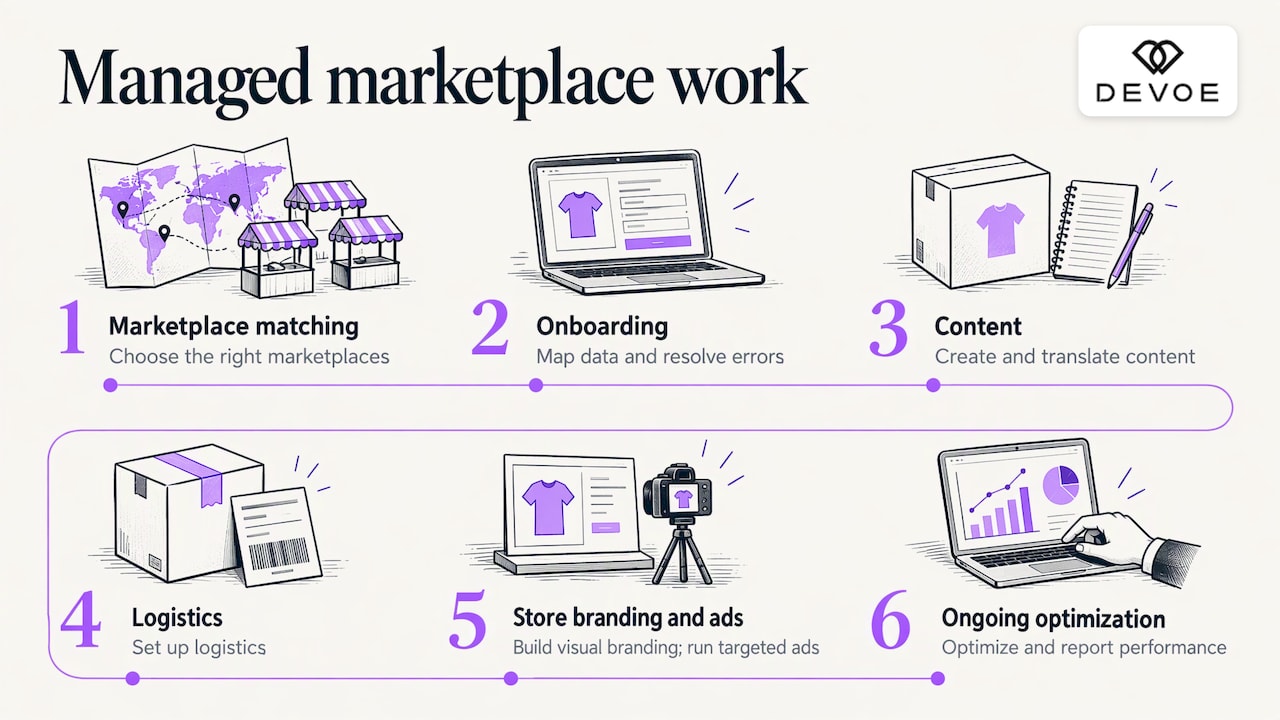
This is the work we do at DEVOE. We help brands match with the right marketplaces, then handle onboarding, including data mapping and error resolution. We also create and translate content, set up logistics, run targeted advertising, build the store’s visual branding and keep optimizing, with performance reporting along the way. We work across Amazon, Bol, eBay, Zalando, About You, Modivo and Douglas, so a brand’s shelf is managed as one system and not as a set of separate projects.
That covers the full chain from the strategy to the fixed listing, which is the part analytics tools alone do not provide.
Our view
We start from a simple observation: a marketplace listing is not a one-off upload. It is a shelf that has to be stocked, priced, described and defended every week, in the language of the shopper standing in front of it.
Brands usually arrive with one of two problems. Either they have no presence on Amazon.de and are watching shoppers in Germany buy from competitors, or they are listed but their pages are thin, translated word for word and out of stock too often. Both are shelf problems, and both are solved by the same discipline: accurate data, localized content, sensible pricing, advertising tied to the page, and someone accountable for the numbers.
That is why we work as a hands-on managed partner and not only as an adviser. Our approach covers matching, onboarding, content, advertising, logistics and ongoing optimization, with direct coordination with marketplace decision-makers. For small and mid-sized brands, this means entering Europe’s largest online market with a team that already knows the requirements, rather than learning them listing by listing.
tinkara
Start with Amazon.de
If your brand sells in Europe or plans to, Amazon.de is the shelf to get right first. We take brands from marketplace matching through onboarding, localized content, advertising and logistics, and then keep the shelf performing with reporting and optimization. Our Sell on Amazon with DEVOE page explains how the engagement works.

Ready to put your products on the shelf where German shoppers are already looking? Contact the team at devoe.club and we will talk through your catalog and your goals for Europe.
FAQ
What is digital shelf management?
It is the continuous work of controlling how your products appear and perform across online channels. That covers product data, content, pricing, availability and reviews on marketplaces, retailer sites and your own store. The aim is that shoppers can find your product, trust the page and buy it.
How is it different from digital shelf analytics?
Analytics measures: search rank, content quality, price, stock and ratings for your products and competitors’. Management acts on those findings by fixing titles, images, prices, stock feeds and ad campaigns. Measuring without acting leaves the problem in place.
Which metrics should a brand track first?
Start with availability, share of search, content compliance, price competitiveness, ratings and conversion rate for the products that generate most of your revenue. Add competitors once your own baseline is clear. Review the numbers weekly for hero products.
Why does stock affect search ranking?
Marketplace algorithms favor listings that can be bought. One guide notes that out-of-stock listings drop in search ranking and take time to recover. Keeping inventory feeds accurate protects the rank you have earned.
Is Amazon.de worth it for a small or mid-sized brand?
Germany’s marketplaces handle 57% of online retail, so a presence there gives access to a large, active customer base. A well-prepared, localized listing with a plan for advertising and reviews lets smaller brands compete on relevance rather than size.
Sources
- HDE Online-Monitor 2025
- NIQ: What is the digital shelf?
- NIQ: Future of the Digital Shelf, February 2026
- Shopify: Digital Shelf Ecommerce
- MediaValet: Digital Shelf Management
- Alium Research: What Is Digital Shelf Analytics
- Fieldpie: What Is Digital Shelf Management
- Grip: What Is the Digital Shelf?
- Zoho: What is a digital shelf?
- DataWeave: Digital Shelf Analytics Guide
- Similarweb: What Is Price Intelligence?
- Actowiz: Channel Conflict Price Monitoring
- Datawebot: Price Intelligence and Digital Shelf Analytics
- The Interline: Ysabel Mora market expansion
- Amazon product photography workflow