

Reviews matter because an online shopper cannot touch your product, so other buyers’ experience stands in for the shop counter. For a brand entering a new European marketplace the effect is strongest: nobody there knows you yet, and the review count and content are the first proof of quality they see. At DEVOE we manage marketplace expansion for brands, and a listing built for the local audience, with its content and ongoing optimization, is where that proof starts to work.
TL;DR
- Nearly 95% of Slovenian consumers at least occasionally use online reviews when deciding on a purchase, according to Empirik’s 2024 data.
- Reviews help most for lesser-known brands, which is exactly the position of a brand entering a new country.
- Credible reviews describe real use, include positive and negative points, and often carry photos or video.
- Volume matters: research cited in a 2022 review links five or more reviews on a product to a 270% higher conversion rate than no reviews.
- Reply to every review, preferably within 24 hours, and never pay for them: Google treats rewarded reviews as a rule violation.
Table of Contents
- What a review does for a shopper who cannot touch the product
- The numbers: how many shoppers read reviews
- What makes a review worth something
- Reviews do more than persuade
- Do Google reviews matter, or just marketplace reviews?
- What to do about reviews on a new marketplace
- Where DEVOE fits in
- Our perspective
- FAQ
- Sources
What a review does for a shopper who cannot touch the product
In a physical shop you pick the product up, read the label, ask the assistant. On a marketplace you have a photo, a title and a few bullet points. A 2025 University of Ljubljana study of user reviews in online consumer behavior describes reviews as an indirect experience of the product: they let shoppers judge quality and reduce the uncertainty of buying something they have not held. The same source notes that this matters most for lesser-known brands.
That last point is the one an expanding brand should read twice. At home you may have years of recognition. In the Netherlands, Germany, Poland or the Baltics on a new marketplace, you start with a blank page. Research published in Nature in 2023 found that consumers were willing to pay more for products from non-famous brands when those products had more reviews, because the reviews lowered the perceived quality risk. In other words, reviews can do part of the job a famous name would otherwise do.
A 2011 University of Ljubljana study points the same way: positive online reviews led to more positive brand attitudes and higher purchase intention, particularly for lesser-known brands.
The numbers: how many shoppers read reviews
The figures below come from different surveys with different samples, so read them as a pattern, not as one precise rate.
| Finding | Figure | Source |
|---|---|---|
| Slovenian consumers who at least occasionally use online reviews before buying | Nearly 95% (2024) | Empirik |
| Buyers more likely to use a company because of positive reviews | 94% | Finance |
| People who trust online reviews as much as personal recommendations | 79% | Finance |
| People saying online reviews influence their purchase decisions | 81% | Primerjam.si |
| Conversion rate of products with 5+ reviews vs. none | 270% higher | Management Review Quarterly (2022) |
The 270% figure is research cited in that review article, not a promise for your product. What it shows is the size of the gap between a listing with no reviews and one with a few. For a new listing, getting from zero to a handful of genuine reviews is one of the first jobs.
A 2024 meta-analysis in ScienceDirect adds that review valence, meaning whether the rating is positive or negative, was the most potent factor affecting purchase intention across cultural contexts. That matters when you sell in several countries at once: the effect of a rating does not stop at the border.
Reviews also matter on the business side. Finance.si’s 2024 piece quotes marketing experts noting that reviews often influence purchasing decisively and that businesses also check providers’ references in B2B decisions. If you sell to retailers as well as to consumers, your review record is read by both.
What makes a review worth something
Not every review moves a buyer. Slovenian shoppers are not naive: Empirik found that about 32.1% of consumers expressed moderate to high distrust of online reviews in 2024. A review has to be believable to count, and the research is fairly specific about what that means.
Real use, with good and bad points
A 2021 University of Ljubljana thesis on review credibility in Slovenia found that the strength of argumentation was the most important credibility factor for Slovenian online shoppers. That means descriptions of how the product is used and both its positive and negative attributes. A wall of five-star one-liners is weaker than a balanced three-sentence review from someone who explains what they did with the product.
Photos and video
A 2024 University of Ljubljana thesis based on quantitative research found that reviews with photo or video material of the product in use were of key importance for Slovenian consumers’ purchase intent. For fashion, beauty and home products, where fit, color and texture decide the purchase, this is where you see the difference between a listing that converts and one that does not.
Enough of them
One marketing expert quoted by Finance.si says reviews on Google and Facebook tend to reflect a provider’s real quality once there are at least 30, because more reviews reduce manipulation and give a more realistic picture. Treat 30 as a useful marker, not a law. The principle is that a larger and more varied pool is more convincing than a few glowing ones.
Reviews do more than persuade
An academic paper on user-generated product reviews from the University of Ljubljana notes that reviews can promote a product or damage a company’s or brand’s reputation and sales. It also says positive reviews can raise brand awareness and support repeat purchases and loyalty. And it adds that reviews give companies substantial, quick information about consumers’ purchase behavior, satisfaction, trends and competition.
For a brand running several marketplaces, that second use is easy to overlook. Reviews are a free, continuous feed of what customers say about size, packaging, delivery, instructions and value. Recurring complaints about the same thing tell you what to fix in the product or the listing text before it costs you more sales.
There is a risk on the other side too. A 2025 study by Rolando and Chondro, published in IJEBS, highlights that businesses that neglect the credibility and transparency of their review systems risk eroding trust, which makes review management a strategic matter rather than a side task.
Do Google reviews matter, or just marketplace reviews?
It depends on where the decision is made. Finance.si explains that Google reviews carry substantial weight when someone assesses a business or a physical location in Google Maps, while specialist portals can influence some decisions more. Businesses can also collect reviews on their own website, social-media profiles and marketplaces.
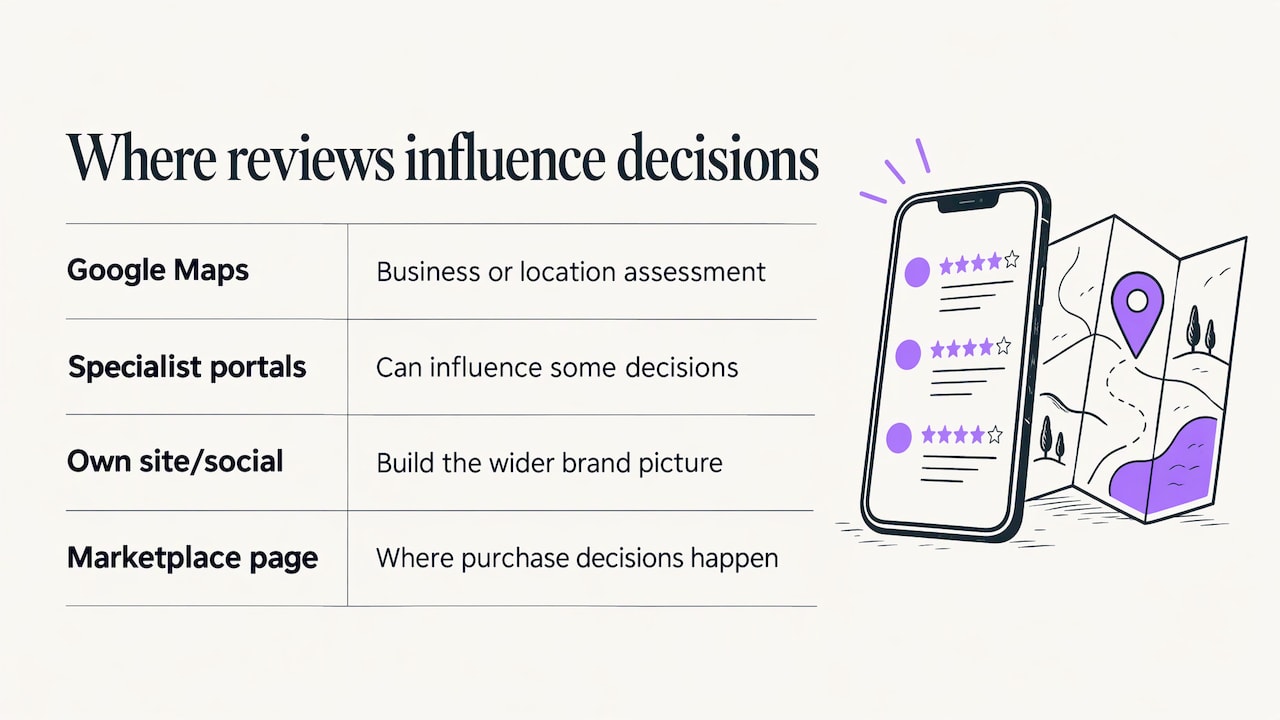
For a brand selling through European marketplaces, the review that counts at the moment of purchase is the one on the product page where the shopper is about to click buy. Your own site, social channels and brand pages build the wider picture, but product-page reviews on each marketplace are where the sale is decided.
What to do about reviews on a new marketplace
- Make the listing accurate first. Reviews punish gaps between what the page promises and what arrives. Correct data, local-language content and clear images set realistic expectations, and realistic expectations produce better reviews.
- Ask in ways the rules allow. Google states that offering compensation, rewards, payment or gifts for a review violates its rules and may be sanctioned, per Finance.si. Each marketplace has its own review policy, so read it before you launch any request campaign. Our guide to 7 tactics to get great customer reviews covers the practical side.
- Reply to everything. Primerjam.si advises answering every review, positive or negative, preferably within 24 hours. Finance.si adds that responding to negative reviews can help you improve your services and shows you value the feedback.
- Read the reviews as product data. Sort them by theme: sizing, quality, delivery, expectations. Feed the findings back into the listing text, images and, where needed, the product itself.
- Track by marketplace and country. A product can collect praise in one country and complaints in another because of language, delivery time or local expectations. Compare them separately.
Where DEVOE fits in
Expanding to several marketplaces means doing all of this in several languages, under different rules, at the same time. DEVOE supports brands through the whole process: strategic matchmaking with the right marketplaces, onboarding with data mapping and error resolution, content creation and translation, ongoing optimization, targeted advertising, store visual branding, logistics setup and performance reporting. That is the groundwork on which good reviews grow: accurate listings, content that speaks to the local shopper and a store that looks credible from the first visit.
We work across marketplaces including Amazon, Bol, eBay, Zalando, About You, Modivo, Douglas and Shop Apotheke. If you are deciding where to launch, start from the marketplace page that fits your category, for example selling on Amazon with DEVOE or selling on Zalando with DEVOE, or look at the full DEVOE Managed service.

Our perspective
Brands often treat reviews as something that happens after the launch. We see it the other way round: the review a customer writes in week six is decided by the work done before week one. The listing, the translation, the product data, the images and the delivery promise all set an expectation, and the review reports whether it was met.
That is why we approach marketplace entry as one connected process, from strategic matchmaking to onboarding, content creation and ongoing growth management, instead of a set of separate tasks. A shopper in a new country judges your brand by what is in front of them, and the research is clear that for lesser-known brands reviews carry extra weight.
Our view is simple: start with a listing that is accurate and written for the local audience, keep it optimized as the reviews and the performance data come in, and use that evidence to decide where to grow next. Reviews are the proof that your marketplace presence is working, and a managed expansion is built to earn it.
tinkara
FAQ
Are Google reviews important?
Yes, particularly for businesses and physical locations that people look up in Google Maps. Finance.si notes they carry substantial influence there, though specialist portals can matter more for some decisions. For product sales on marketplaces, the reviews on the product page matter most.
How many reviews does a product need?
There is no universal number. Research cited in a 2022 review found that products with at least five reviews had a 270% higher conversion rate than products with none. A Slovenian expert quoted by Finance.si suggests that around 30 reviews on Google or Facebook give a more realistic picture of quality.
Can I offer customers a reward for a review?
Offering compensation, payment or gifts for a review violates Google’s rules and may be sanctioned. Marketplaces set their own review policies, so check the one for each channel before you run any request campaign.
Should I answer negative reviews?
Yes. Answer every review, positive or negative, preferably within 24 hours. A calm, specific reply shows you value the feedback, and the complaint itself often points to something in the product or listing you can improve.
Sources
- User reviews as a key factor in online consumer behavior (University of Ljubljana, 2025)
- Spletne ocene: Potrošniki jih uporabljajo (Empirik, 2024)
- Ocene uporabnikov nas lahko vzdignejo v nebo ali prizemljijo (Finance, 2024)
- Dejavniki kredibilnosti uporabniških ocen v Sloveniji (University of Ljubljana, 2021)
- Factors that affect consumer trust in product quality (Nature, 2023)
- How online reviews affect purchase intention: a meta-analysis (ScienceDirect, 2024)
- Kako prevzamete nadzor nad spletnimi ocenami (Primerjam.si)
- The importance of user-generated product reviews (University of Ljubljana, 2020)
- Vpliv spletnih komentarjev potrošnikov na stališče in nakupno namero (University of Ljubljana, 2011)
- What makes an online review credible? (Management Review Quarterly, 2022)
- The influence of customer reviews on trust and online purchase decisions (IJEBS, 2025)
- Vpliv spletnih uporabniških ocen na nakupno vedenje (University of Ljubljana, 2024)