

A good marketplace pricing strategy starts from your floor, not from your competitor. Work out the lowest price at which each marketplace and country still pays you, set a corridor above it, and only then react to the market. Brands that skip the floor end up winning visibility at a loss. Brands that copy one home-market price to every country do the same, only more slowly. Managing this across several marketplaces is a daily job, and it is one we take on for brands through DEVOE Managed.
TL;DR
- Build prices from the bottom up: product cost, marketplace commission, fixed fees, shipping, VAT and a target margin give you a floor per marketplace and per country.
- Set a price corridor between that floor and a ceiling you can defend with your brand and reviews. Repricing happens only inside the corridor.
- Coordinate channels with one anchor price, then adjust for landed cost, local VAT and channel rules instead of copying one number everywhere.
- Manage prices over time with scheduled reviews, margin reporting and a small set of rules, not with constant manual undercutting.
- Slovenian and EU shoppers compare prices, so clear, consistent pricing across your own shop and marketplaces protects trust.
Table of Contents
- What a marketplace pricing strategy has to achieve
- Step 1: Build your floor price for each marketplace
- Step 2: Choose your pricing approach
- Step 3: Set a corridor, then reprice inside it
- Step 4: Coordinate prices across platforms and countries
- Step 5: Manage prices over time
- Common mistakes to avoid
- Our view: pricing is part of market entry, not an afterthought
- How DEVOE supports your marketplace pricing
- FAQ
- Sources
What a marketplace pricing strategy has to achieve
A marketplace pricing strategy is the set of rules that decides what you charge on each marketplace, in each country, and when you change it. It has three jobs: keep every sale profitable, make your offer competitive enough to be shown and chosen, and keep your brand’s price image consistent across channels.
Those jobs pull against each other. Cheaper listings win visibility, but on a marketplace the buyer pays the price while you pay the commission, the shipping and the VAT. A price that looks competitive on screen can be a loss on your statement.
The pressure is real in Slovenia. A University of Ljubljana Faculty of Economics study of Slovenian e-commerce notes that transparent and clear prices are extremely important on both the Slovenian and wider EU markets, and that Slovenian retail chains run aggressive, constant promotions. A 2026 guide to selling online in Slovenia adds that shoppers actively compare prices and that Ceneje.si is the dominant price-comparison platform. If your marketplace price, your own-shop price and a comparison feed disagree, buyers notice.
Step 1: Build your floor price for each marketplace
The floor is the lowest price at which a sale still reaches your target margin. Everything else in your strategy sits above it.
Add up these items for every marketplace and every country separately:
- Product cost, including landed cost if you import or ship from a central warehouse.
- Marketplace commission, usually a percentage of the sale that varies by category.
- Fixed fees, such as monthly subscriptions or per-order charges.
- Shipping and fulfilment, to the buyer’s country.
- VAT, which differs by country and decides whether the shelf price must include tax.
- Returns allowance, especially in fashion, where return rates are high.
- Target margin, the amount you need left over.
The fee structures are public and differ a lot. Slovenian marketplace Mimovrste’s partner terms show a monthly subscription of 12 EUR for manual product entry or 40 EUR for XML/API, a commission from 8% up to a maximum of 20%, and 0.40 EUR per processed order. The same terms say partners keep control of catalogue, price and delivery conditions. That fixed per-order fee barely matters on a 200 EUR item, but on a 10 EUR item it is 4% of the price before commission.
A worked example
The numbers below are an illustration, not a quote from any marketplace. Assume a product that costs you 10 EUR, a 15% commission charged on the net (ex-VAT) price, and a target margin of 3 EUR.
| Slovenia | Germany | |
|---|---|---|
| Product cost | 10.00 EUR | 10.00 EUR |
| Shipping to buyer | 4.00 EUR | 6.00 EUR |
| Target margin | 3.00 EUR | 3.00 EUR |
| Needed after commission | 17.00 EUR | 19.00 EUR |
| Net price (divide by 0.85) | 20.00 EUR | 22.35 EUR |
| VAT rate assumed | 22% | 19% |
| Floor price shown to buyer | 24.40 EUR | 26.60 EUR |
Two markets, two floors, 2.20 EUR apart. A brand that lists 24.40 EUR in both loses money in Germany on every order, and nobody sees it until the month-end report. Check each marketplace’s own rules before you copy this formula: some charge commission on the gross price, and some add fees for advertising or fulfilment.
Step 2: Choose your pricing approach
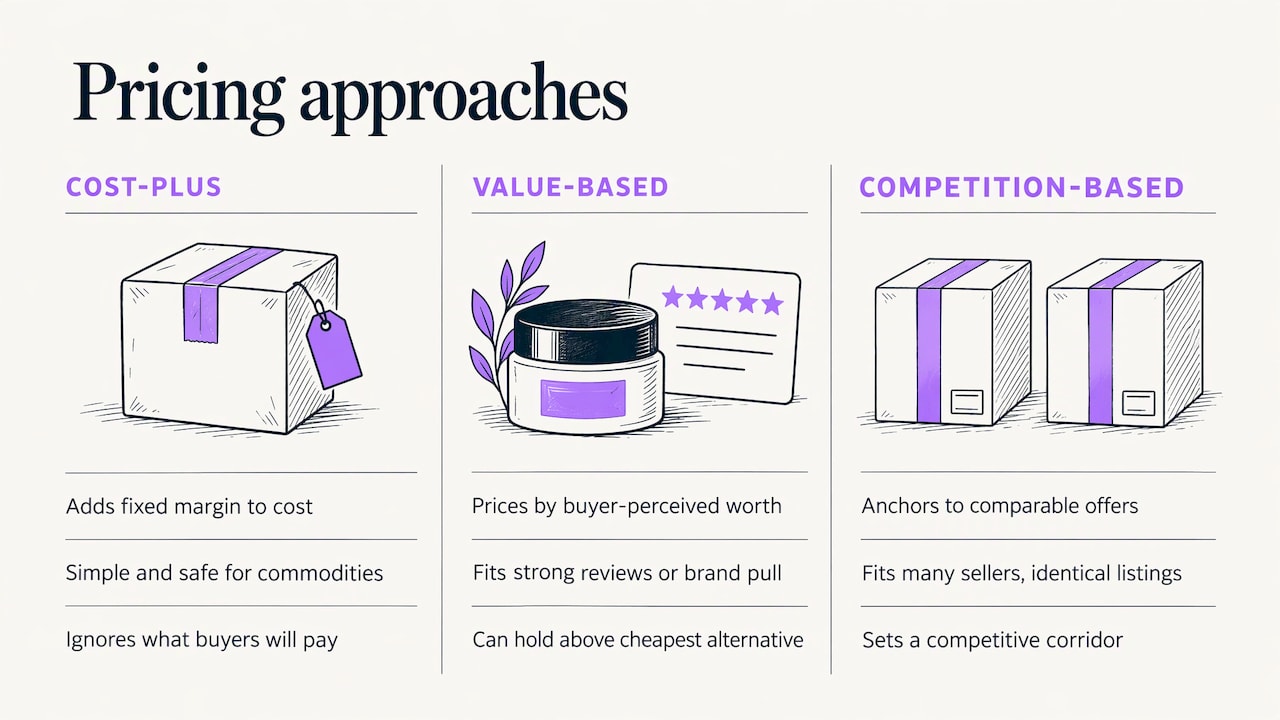
Once the floor is known, you choose where above it to sit. Three approaches cover most cases.
Cost-plus pricing adds a fixed margin to cost. It is simple and safe for commodity items, but it ignores what buyers will pay.
Value-based pricing sets the price by what the product is worth to the buyer. It fits brands with strong reviews, recognizable design or exclusive ranges. A premium cosmetics brand on a beauty marketplace, or a fashion label with a loyal following, can hold prices well above the cheapest alternative.
Competition-based pricing anchors to what comparable offers cost. It fits products that are sold by many sellers, where the buyer sees several identical listings side by side.
Most brands use a mix. Hero products with brand pull get value-based prices. Products that share a listing with other sellers get a competitive corridor. Long-tail items get cost-plus with a review every quarter.
Visibility versus margin
On marketplaces where several sellers share one product page, the featured offer is not decided by price alone. It usually weighs the total price including shipping, delivery speed, seller rating and availability. That means you can sometimes win by shipping faster or keeping stock deeper rather than by cutting price. Small price gaps of a few percent are often what decides between otherwise equal offers, so the discipline is to match, not to race to the bottom.
On brand-owned listings, where you are the only seller, the question changes. There is no one to undercut, so the real competitor is the buyer’s alternative: another brand, or a price-comparison result. Here price should reflect brand value, and discounts should be planned promotions with a start and an end.
Step 3: Set a corridor, then reprice inside it
A corridor has three numbers per product and marketplace:
- Floor, from Step 1. Never go below it automatically.
- Target, the price you want to hold most of the time.
- Ceiling, the highest price you can defend before sales drop.
Repricing, whether manual or by rule, moves the price between floor and ceiling in response to stock, competitor offers or demand. The corridor stops a rule from chasing a competitor into a loss.
Change prices in small steps and read the result. A useful habit is to look at the last few sales after each change: did volume move, and did margin per unit hold? If a 3% rise cost you almost no orders, the next test can go higher. If volume fell sharply, return to the target. This is elasticity thinking, and it works better than reacting to every competitor move.
Keep a stock link. A product with 12 units left and slow replenishment should drift toward the ceiling. A product with a full warehouse and a seasonal deadline can drop toward the floor in a planned way.
Step 4: Coordinate prices across platforms and countries
Selling on Amazon, Zalando, Bol, eBay or a Slovenian marketplace at once multiplies the problem. Without a system, you get four prices for one product and a customer who finds the cheapest one.
A workable coordination model has four parts:
- An anchor price. One reference price, usually your own web shop or recommended retail price, that every channel is measured against.
- Landed cost per channel. Item plus shipping, so the total a buyer compares is coherent.
- Channel constraints. Each marketplace has price rules, fees and promotion mechanics. Some forbid listing cheaper elsewhere, and some run their own campaigns.
- Margin floors. Alignment never means selling below the floor.
Local conditions then change the final number. Slovenian marketplace Enaa’s terms show how much the model differs by platform: partners manage their own offers, delivery times and purchase prices, while Enaa itself shapes the retail price for customers under its business rules, and promotions can be run by the marketplace, the partner or both by agreement. On a platform like that, your wholesale price is the number you control, and your margin depends on how the marketplace sets the shelf price.
Currency and VAT matter too. In the euro area you avoid conversion, but VAT rates still differ, and in some markets shoppers expect tax-inclusive prices. Selling outside the euro area adds exchange-rate movement to every floor. Never copy a home-market floor into a new country. Rebuild it from that country’s fees, shipping and tax.
Promotions need the same care. A 20% discount on a product with a 25% margin leaves very little, and marketplace-funded campaigns can stack on top of yours. Plan promotions in a calendar, with the discounted price checked against the floor before it goes live.
Step 5: Manage prices over time
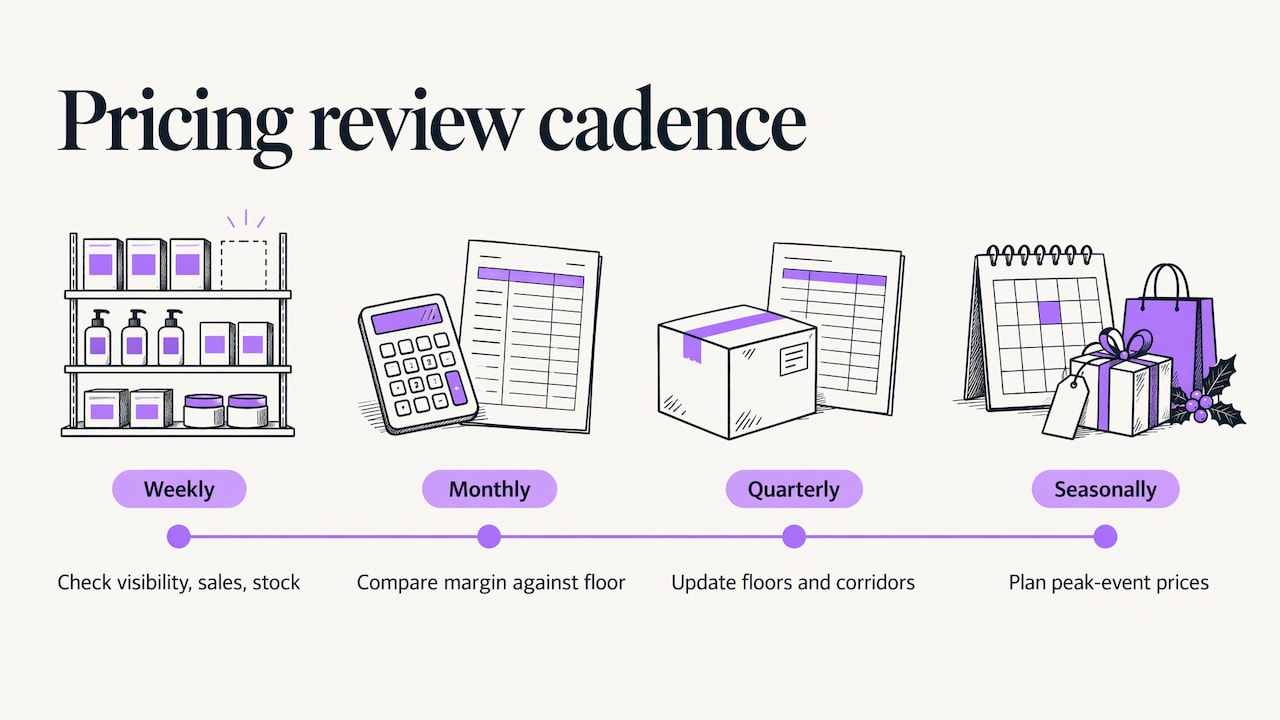
Pricing is not set once. Costs, fees, competitor behavior and demand all move, so the strategy needs a rhythm.
Weekly: check products that lost visibility or sales, review stock against price position, and look for listings where a price rule triggered a loss.
Monthly: compare actual margin per marketplace and country against the floor model. Fee changes, returns and advertising spend show up here, and they are the usual reasons real margin drifts below plan.
Quarterly: revisit the corridors. Update floors for new commission rates, shipping contracts and exchange rates, and reset ceilings for products whose reviews or brand pull have grown.
Seasonally: plan the peaks. Autumn and winter sales events, back-to-school and summer clearance each need a price plan made weeks in advance, not a reaction on the day.
The data you need is modest: sales and margin per product, per marketplace and per country; competitor price positions on shared listings; stock levels; and advertising cost per sale. Whether you track it in a spreadsheet, a repricing tool or a managed service, the point is that one person owns the numbers and looks at them on schedule.
Common mistakes to avoid
- One price for every country. It hides losses in high-shipping or high-VAT markets.
- Ignoring fixed fees. Per-order and monthly fees weigh most on low-priced items.
- Matching every competitor move. Without a floor, automatic matching drags margin down for visibility you could have earned differently.
- Letting the own shop and marketplaces drift apart. Buyers compare, and so do comparison sites.
- Treating promotions as separate from pricing. Every discount should be checked against the floor and the calendar.
- Reviewing only revenue. Revenue can rise while margin falls.
Our view: pricing is part of market entry, not an afterthought
We see pricing as the point where marketplace strategy becomes real money. A brand can have excellent content and a well-chosen marketplace and still lose its margin if prices are copied from one country to the next.
That is why we treat pricing as part of the whole expansion, from strategic matchmaking to onboarding, content, advertising and performance reporting. The price a buyer sees is shaped by the same things we work on: the marketplace you choose, how your listing is presented to the local audience, the logistics you set up and the advertising behind it.
Our approach is hands-on. We coordinate directly with marketplace decision-makers and manage growth after launch, so the floor, the corridor and the reporting live in one place and one team keeps them current. A brand entering several European marketplaces should not have to build that routine from scratch in each one.
tinkara
How DEVOE supports your marketplace pricing
If you are planning to enter or expand on European marketplaces, pricing works best when it is built into the launch. We match brands to the right marketplaces, handle onboarding including data mapping and error resolution, create and translate content, set up logistics, run targeted advertising and report on performance, then keep optimizing after launch. You can see how this works for individual platforms on our pages for Amazon, Zalando, Bol.com and eBay, or start with DEVOE Managed.

Fashion and beauty brands can also look at our offers for About You, MODIVO and Douglas, and pharmacy and health brands at Shop Apotheke.
FAQ
What is the best pricing strategy for a marketplace?
There is no single best one. Start with a cost-based floor per marketplace and country, then use value-based pricing for products with strong brand pull and competition-based pricing where several sellers share a listing. Combining them inside a floor-and-ceiling corridor protects margin while keeping you competitive.
How do I price the same product on several marketplaces?
Choose an anchor price, then adjust for each channel’s commission, fixed fees, shipping, VAT and rules. The result is often a different shelf price per marketplace, but all of them stay above your floor and close enough that buyers do not feel misled.
How often should I change marketplace prices?
Check weekly, review margins monthly and rebuild floors quarterly. Change prices in small steps and look at what happened to volume and margin before the next move. Plan seasonal sales weeks ahead.
Should I always match the lowest competitor?
No. Match only when the price stays above your floor and when price is what decides the sale. Speed of delivery, availability and ratings also influence which offer wins, so you can often hold your price and improve those instead.
Sources
- University of Ljubljana Faculty of Economics: improving business with an online shop
- Selling on Shopify in Slovenia: Complete Guide (2026)
- Mimovrste partner terms
- Enaa Marketplace benefits and general terms