

The fastest way to expand an ecommerce business into Europe is to enter one market at a time through the large European marketplaces, with listings written for local shoppers and a logistics and payment setup that matches local habits. A marketplace gives a new brand an existing audience, and a managed launch gives it the local content, data setup and ongoing optimization that decide whether that audience buys. DEVOE does exactly this for brands: matchmaking with the right marketplaces, onboarding, content, and growth management.
This guide walks through the whole route, from choosing your first country to measuring results after launch. It is written for brands and retailers that already sell online and want to grow sales across Europe.
TL;DR
- Start with one or two markets chosen from your own sales data and category demand, not from the size of a country’s overall ecommerce.
- Marketplaces are the quickest route to European shoppers because they bring traffic, trust, payment handling and customer assistance with them.
- Localization means more than translation: local search terms, local price points, local units and compliant text for every listing.
- Delivery and returns are the most common obstacle for Slovenian sellers who sell across the EU, so settle logistics before you launch.
- Set go/stop targets before launch and review them after a fixed period.
Table of Contents
- Why Europe, and why marketplaces first
- Step 1: Choose your first markets with data
- Step 2: Get the legal basics right
- Step 3: Localize the catalog, not just the storefront
- Step 4: Settle payments, delivery and returns before launch
- Step 5: Integrate with the marketplace
- Step 6: Measure visibility and sales after launch
- Promo: let DEVOE run the expansion
- Our view: why a managed launch beats going market by market alone
- FAQ
- Sources
Why Europe, and why marketplaces first
Online buying is mainstream in the region you are likely selling from. Statistics Slovenia reports that 67% of Slovenian residents aged 16 to 74 bought or ordered something online between April 2024 and March 2025. The same release shows that Slovenian enterprises generated about €1.668 billion in web-sales turnover from private consumers in 2024, excluding VAT.
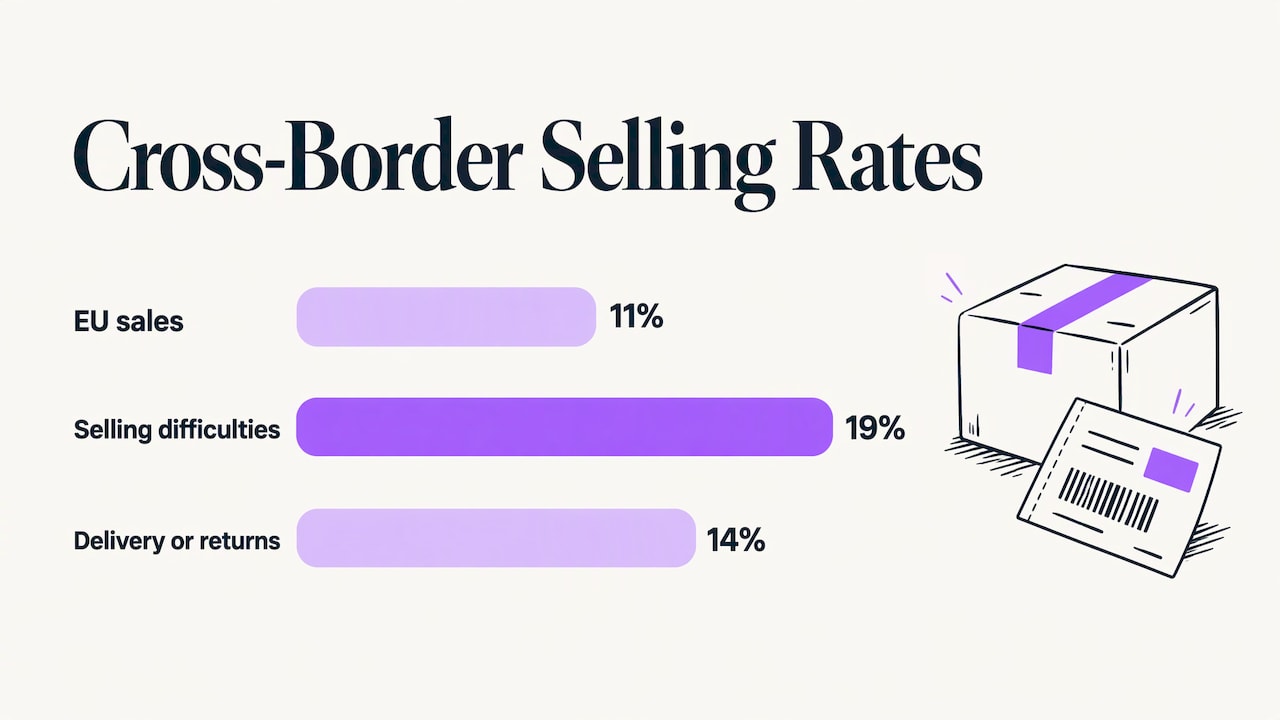
Cross-border selling is still the smaller part of that picture. In 2024 only 11% of Slovenian enterprises made web sales to customers in other EU member states, while 19% reported difficulties selling to other EU countries, according to the same Statistics Slovenia release. The most common difficulty, reported by 14%, was costly delivery or returns. That is a useful map of where to put your planning effort: not the idea of selling abroad, but the practical side of getting goods to buyers and back.
Marketplaces remove a large share of that friction. The European Commission’s Your Europe guide explains that on a marketplace the operator manages the transactions, and lists the benefits for sellers: lower marketing costs, instant access to international markets, greater customer trust, handling of order payment and processing, and assistance for sellers and buyers through the sales process. The Enterprise Europe Network adds that marketplaces help a new brand build customer trust and offer a cost-effective route to market. It also reminds sellers to budget for listing fees, commission and currency charges, which is simply part of planning your margin per marketplace.
The European marketplace landscape is not one place. Amazon, Bol in the Netherlands and Belgium, eBay, and fashion and beauty platforms such as Zalando, About You, Modivo and Douglas each reach different shoppers and expect different catalog data. Choosing among them is the first real decision.
Step 1: Choose your first markets with data
Do not pick a country because its ecommerce market is the biggest. Pick it because shoppers there want your category and can be served profitably.
- Read your own data first. Sessions, abandoned baskets and orders by country already show where interest exists, before you spend anything on marketing. A country that sends steady traffic and unplanned orders is a better candidate than one you merely admire.
- Shortlist three or four markets and compare them on your category. Look at category demand, typical order value, delivery preferences and payment habits. A country with large overall ecommerce can still be a poor fit for a niche product.
- Read competition correctly. Many similar offers can mean a saturated market, but very few can mean weak interest. Bestseller lists on the local marketplaces and a few test purchases from local sellers show you real prices, delivery costs and what the shopping experience feels like.
- Enter one market at a time. Each launch then stays measurable, and what you learn in the first country makes the second one cheaper.
- Agree your targets before launch. Four are enough: conversion rate, landed cost per order (product, shipping, duties and fees together), return rate and delivery time. Test them over a fixed period such as two quarters, and decide in advance what result means continue and what means stop.
Choosing the marketplace is part of choosing the market. A beauty brand and a fashion brand will not head to the same platforms, and that matching is the first thing DEVOE does: strategic matchmaking between your brand and the marketplaces that fit it, with coordination with the marketplaces’ decision-makers.
Step 2: Get the legal basics right
The EU is a single market for selling goods, but each seller still has obligations. This section covers the ones that most often trip up a Slovenian company, and your accountant or lawyer should confirm the details for your own case, particularly VAT.
Business registration and disclosure. The Slovenian business portal SPOT states that online sellers must register the activity 63.120 and, when selling goods to consumers by post or internet, 47.910. They must show company, registration and tax details on the site, including the SI-prefixed tax number if VAT-registered. See SPOT’s guidance on online selling for the full list. Slovenia’s Electronic Commerce Market Act adds that providers must give easy, direct and permanent access on their main website to company and seat data, a valid e-mail address, registration number and tax number.
Consumer rules. SPOT notes that sellers must give pre-contract information under the Consumer Protection Act, perform within 30 days unless agreed otherwise, and answer for non-conformity that existed at delivery and appears within two years.
No blocking of EU customers. Under the EU geo-blocking Regulation 2018/302, as SPOT explains, you may not block or restrict access to your website based on a consumer’s citizenship, residence or establishment, redirect them to another version of your site without explicit consent, or discriminate on payment methods, for example by refusing a card brand issued in another EU country while accepting the same brand issued at home.
Platform rules. The U.S. Commercial Service’s Slovenia ecommerce guide notes that the E-Commerce Directive requires providers to follow the rules of the country where they are established, and that the Digital Services Act covers counterfeit goods and illegal online content, while the Digital Markets Act sets rules for gatekeeper platforms. For marketplace sellers, the EU’s P2B Regulation, according to Your Europe, protects against unpredictable terms, unjustified account suspension and unclear ranking rules.
Product requirements differ by category and country: labels, safety marking, packaging and waste obligations. The KVK guide to European ecommerce rules advises checking the destination country’s product contact point for local product requirements before delivering across borders.
Step 3: Localize the catalog, not just the storefront
Most of the work and most of the mistakes in localization sit in the product catalog. A translated website with untouched product data still underperforms on a marketplace, where the listing is the shop window.
A practical per-market checklist:
- Titles and descriptions in local search terms. Direct translation of your English keywords often misses how people actually search. Research the terms shoppers use on the local marketplace.
- Units, sizes and variants. Convert measurements and apply local size systems. Where plugs, voltage, labels or packaging differ, create market-specific SKUs.
- Local price points. Converting a price is arithmetic, localizing it is a decision. Use fixed prices with local endings that include VAT where the market expects it, and account for each marketplace’s commission rather than applying a currency converter.
- Compliance text in the local language. Warnings, legal notices and return information need to be in the shopper’s language.
- Consistent terminology. Keep a glossary of brand and category terms so every listing, ad and email uses the same words.
- A native-speaker check. Review a sample of products from each category before launch; tone, cultural fit and regulatory wording are easiest to catch for someone who lives there.
If you handle translation yourself, specialist localization and translation services cover European languages and marketing content. If you work with DEVOE, content creation and translation are part of the service, alongside store visual branding, so the listing text and the images arrive together.
Step 4: Settle payments, delivery and returns before launch
Logistics decides whether a launch stays profitable. Since costly delivery or returns is the most-cited difficulty for Slovenian companies selling in the EU, treat it as a design problem at the start.
Payments. Match payment methods to local habits. The KVK guide points to national favorites such as iDEAL in the Netherlands and Bancontact in Belgium, plus international options like credit cards and PayPal. In Slovenia itself, the U.S. Commercial Service reports that international cards such as MasterCard, Visa and Diners Club dominate online payments, with PayPal, Apple Pay and Google Pay growing and the Slovenian provider Moneta often used for domestic purchases. On marketplaces, the operator handles order payment and processing, which removes much of this work.
Delivery. Work out the cost and promised delivery time per country, and price them into the product. Shoppers abroad compare your delivery promise with that of local sellers.
Returns. Decide where returned goods go, who pays and how quickly refunds are issued. Marketplaces set their own return standards, so check them for each platform you join.
Fees. Add listing fees, commission and currency charges to your landed cost per order, as the Enterprise Europe Network recommends. Your margin should be calculated per marketplace, not once for all of Europe.
DEVOE includes logistics setup in its service, so this part of the plan is built alongside the listings rather than after them.
Step 5: Integrate with the marketplace
Onboarding is where good plans stall. Every marketplace has its own catalog template, required attributes, category rules and approval process, and a feed that does not match produces errors and rejected products.
A realistic onboarding sequence:
- Apply and get approved for the categories you sell in.
- Map your product data to the marketplace’s fields: titles, attributes, images, identifiers, sizes and prices.
- Resolve upload errors and fix rejected items.
- Connect inventory and order flow so stock and shipments stay accurate.
- Prepare customer service responses in the local language.
- Launch with a focused range first, then widen it as the data comes in.
This is the stage where DEVOE takes work off your hands: onboarding with data mapping and error resolution, so your team is not working through marketplace templates line by line. The marketplaces DEVOE works with include Amazon, Zalando, eBay, Bol, About You, Modivo and Douglas, and Shop Apotheke is also covered.
Step 6: Measure visibility and sales after launch
Launch is the beginning of the data, not the end of the project. After entering a market, review the same four measures you set in advance, per marketplace and per country:
| Measure | What it tells you | What to do with it |
|---|---|---|
| Conversion rate | Whether the listing convinces the shopper | Improve titles, images and descriptions |
| Landed cost per order | Whether the market is profitable | Adjust price, shipping and fees |
| Return rate | Whether the product and its description match | Fix sizing, content and expectations |
| Delivery time | Whether the promise is competitive | Change carrier or stock location |
Visibility on a marketplace comes from the same levers each time: complete and accurate product data, search terms that match local shopping language, competitive pricing, strong images and, where it makes sense, targeted advertising. Review them regularly and compare against the category bestsellers you studied before launch. DEVOE’s service covers ongoing optimization, targeted advertising and performance reporting, so these reviews are part of the engagement, not a separate project.
Promo: let DEVOE run the expansion
If you want to enter European marketplaces without building the local know-how first, DEVOE manages the route from the first conversation to growth. That means matching your brand to suitable marketplaces, onboarding, localized content creation and translation, store visual branding, logistics setup, targeted advertising, optimization and reporting.

Start on the DEVOE home page to see the managed service, or go straight to the marketplace you have in mind, such as selling on Amazon with DEVOE or selling on Zalando with DEVOE.
Our view: why a managed launch beats going market by market alone
Expanding into Europe is not one project, it is many small ones: a catalog per marketplace, a language per country, a price per channel, a delivery promise per region. Each is manageable. Together they are what slows most brands down.
That is why we handle the whole chain. We match the brand to the marketplaces where its category belongs, we map the data and resolve onboarding errors, we write and translate content for the local audience, and we stay on to optimize listings, advertising and results. We also work directly with marketplace decision-makers, which helps a new brand get started properly.
Our advice to brands is to treat the first market as a learning investment. Pick one marketplace, launch a focused range, measure, and then repeat the pattern in the next country. Brands that do this build a presence across Europe step by step, with every launch faster than the last.
tinkara
FAQ
How do I choose which European country to enter first?
Start with your own sales and traffic data by country, then compare a shortlist on demand for your specific category, order value, delivery expectations and payment habits. Look at local marketplace bestsellers rather than overall country ecommerce size. Launch in one market first so you can measure the result.
Do I need a local company to sell in other EU countries?
Slovenian businesses can sell to consumers across the EU from Slovenia, and geo-blocking rules prevent you from refusing customers because of where they live. VAT, product compliance and packaging obligations can still differ by country, so confirm them with your accountant before launch.
Why use a marketplace instead of my own website?
A marketplace brings existing traffic, customer trust and order payment handling, and gives you instant access to international buyers. Your own website can run alongside it, and many brands use both.
What does it cost to expand through marketplaces?
Costs typically include listing fees, commission and currency charges, plus delivery, returns, content and advertising. DEVOE does not publish prices, as each engagement depends on the brand, marketplaces and scope, so the practical step is to contact the team through devoe.club.
Sources
- Statistics Slovenia: Web sales, 2024
- Your Europe: Selling online using third-party platforms
- Enterprise Europe Network: A guide to e-commerce
- SPOT: Spletna prodaja
- PISRS: Electronic Commerce Market Act (ZEPT)
- U.S. Commercial Service: Slovenia ecommerce
- KVK: European e-commerce rules
2 Comments