

Cross-border ecommerce is selling online to customers in another country. For a brand outside Europe, the fastest and least risky way to do it is usually through the continent’s established marketplaces, because they already bring the shoppers, payments and delivery networks. The hard part is not getting a listing live. It is making each listing meet the marketplace’s data rules, read naturally in the local language and stay competitive after launch. That is the work DEVOE does for brands, from matching you with the right marketplaces to managing growth once you are live.
TL;DR
- Cross-border ecommerce covers B2B and B2C online sales across a border, and global cross-border revenue is approaching US$1.2 trillion in 2026.
- In Europe, marketplaces carry most of the cross-border volume: the top 100 are projected to generate 79.5% of their 2026 sales across borders.
- A sound plan answers three questions in order: are we ready, which country first, and how do we win there.
- Budget for more than shipping: VAT registration, customs duty on non-EU parcels, translation, listing content, advertising and returns all belong in the model.
- A managed partner takes onboarding, content and ongoing optimization off your team so you can expand in several marketplaces without hiring in each country.
Table of Contents
- What cross-border ecommerce means
- Why brands are going cross-border
- Why Europe’s marketplaces are the entry point
- A cross-border strategy in three questions
- Localization: what shoppers actually see
- What to budget: costs of selling across borders
- VAT, duties and compliance in the EU
- Logistics, payments and service
- Perspective
- How DEVOE takes expansion off your hands
- FAQ
- Sources
What cross-border ecommerce means
The U.S. International Trade Administration defines it as selling across a border using ecommerce, as opposed to domestic transactions. It includes two models. B2B means bulk sales between businesses. B2C means a company selling to a consumer in another country, either from its own website or through an online marketplace.
This guide is written for brands that sell B2C and want to enter European markets. If your customers are other businesses, many of the same logistics and tax points apply, but the channels differ.
Why brands are going cross-border
The demand side is large and still growing. ECDB’s Cross-Border E-Commerce report puts global cross-border ecommerce revenue above US$1.0 trillion in 2024 and approaching US$1.2 trillion in 2026, a 7.7% compound annual growth rate for 2023 to 2026. The same report shows the U.S. led imports at US$65.3 billion, which tells you American shoppers already buy from abroad as readily as European ones.
Domestic ecommerce is also maturing. ECDB’s Global E-Commerce Trends 2026 expects global growth of 8.6% in 2026 and revenues passing US$5 trillion for the first time, with the market projected to pass US$6 trillion by 2028. Brands whose home market is saturated find that new demand sits abroad.
Shoppers are ready. DHL’s 2026 E-Commerce Trends Report finds 70% of shoppers buy internationally, up from 60% the year before, and 45% buy across borders more than once a month.
Why Europe’s marketplaces are the entry point
Europe is a set of distinct markets with different languages, tastes and retail habits, so a single website rarely reaches all of them. Marketplaces solve part of that. eMarketer’s Europe Marketplaces 2026 report projects the top 100 European marketplaces will generate €175.8 billion in gross merchandise value in 2026, and 79.5% of those sales will be cross-border transactions.
The UK government’s guidance on using online marketplaces explains why: marketplaces account for more than half of global ecommerce transactions, are the main destination for cross-border shoppers, and offer built-in payments, currency localization and logistics. The industry body IMRG, writing in 2024, describes marketplaces as mini ecosystems that handle platform development, payments and customer acquisition.
The Brussels export guidelines compare three online routes: e-tailers, marketplaces and direct-to-consumer. Marketplaces suit brands with high product availability that want a quick start. Direct-to-consumer gives full brand control but needs heavy IT and audience-building investment. For most brands the marketplace is the first step, and it can be followed later by your own storefront once you know which countries respond.
A cross-border strategy in three questions
The Brussels guidelines recommend a plan built on three steps: how to start, where to play and how to win. They also advise moving step by step rather than launching everywhere at once. Here is how that works in practice.
How to start: are you ready?
Readiness is about operations, not ambition. Before choosing a country, check that you can answer yes to these:
- Your product catalog has clean, complete data: titles, descriptions, dimensions, identifiers such as GTIN or EAN barcodes, images.
- You have stock that can be shipped to or within Europe without breaking your domestic service.
- Someone owns customer questions and returns for European buyers, in their language.
- You know your margin after marketplace commission, VAT, shipping and advertising.
Catalog data is where most onboarding stalls. Every marketplace has its own attribute templates, category trees and image rules, and a feed that works on one will be rejected on another. Our onboarding work includes data mapping and error resolution for exactly this reason: the first weeks go to getting products accepted, not to selling them.
Where to play: choosing a country and a marketplace
Pick the market where your product has a natural audience and the marketplace fits your category. A few examples of how the main European channels differ:
| Marketplace | Typical strength | Our page |
|---|---|---|
| Amazon | Broad reach across several European countries | Sell on Amazon |
| Bol | Dutch and Belgian shoppers | Sell on Bol.com |
| eBay | Wide general audience and many categories | Sell on eBay |
| Zalando | Fashion and lifestyle | Sell on Zalando |
| About You | Fashion with a younger audience | Sell on About You |
| MODIVO | Fashion across Central and Eastern Europe | Sell on MODIVO |
| Douglas | Beauty and perfumery | Sell on Douglas |
| Shop Apotheke | Pharmacy and health products | Sell on Shop Apotheke |
Strategic matchmaking, meaning choosing which marketplaces to approach for your brand and in what order, is the first thing we do with a new brand. Getting accepted by a curated marketplace such as a fashion or beauty platform depends on how the brand is presented, and we coordinate directly with marketplace decision-makers on your behalf. Our guide on how to expand your ecommerce business internationally in Europe goes deeper on country selection.
Canada’s Trade Commissioner Service, in its guide to selling online in the EU, tells exporters to decide between marketplaces and their own website, and to plan for consumer protection, product compliance, VAT, data privacy and cross-border sales rules before they enter. Treat that as the checklist for the shortlist you build.
How to win: value proposition and local fit
Winning means a shopper in Amsterdam, Berlin or Warsaw sees a listing that looks written for them. That comes down to localization, which goes well beyond translation.
Localization: what shoppers actually see
A localized listing adapts the product title to how people search locally, converts sizes and units, rewrites claims for the local audience and uses images that suit the marketplace’s style. Our guides on product localization and ecommerce translation services cover what to translate and what to rewrite. Content creation and translation are part of our managed service, so the listings that go live match each marketplace’s requirements.
Images matter as much as text. A shopper cannot touch the product, so the main photo does most of the selling. Our page on ecommerce image optimization for European marketplaces covers the technical rules, and this explanation of why product photos fail to convert shows how small flaws in a listing cost sales. We also handle store visual branding, so your brand pages look consistent across marketplaces.
The Brussels guidelines add a point many brands miss: reduce the steps to purchase and do not focus only on new customers when expanding. Repeat buyers in a new country are the sign that the expansion is working.
What to budget: costs of selling across borders
Brands often compare marketplace commission with their domestic margin and stop there. The real cost picture has more lines:
- Marketplace fees: commission by category, plus any fulfillment or subscription fees. These vary by marketplace and category, so take them from each marketplace’s current fee schedule.
- VAT: you charge the buyer’s local rate, and the compliance route depends on where your stock sits (see below).
- Customs duty: applies to goods entering the EU from outside it.
- Shipping and returns: international parcels cost more, and European consumers expect easy returns.
- Content and translation: a one-off cost per language plus upkeep as the catalog changes.
- Advertising: new listings have no sales history, so most brands pay for visibility at launch. Our guide to retail media management explains how marketplace advertising works.
- Pricing: your price must absorb all of the above and still sit right against local competitors. See our guide to marketplace pricing strategy across Europe.
A useful exercise is to build a landed-cost sheet for your five best-selling products in one target country. If the margin survives, you have a viable first market.
VAT, duties and compliance in the EU
Rules here have moved quickly, so check the official pages below for the current position before you ship.
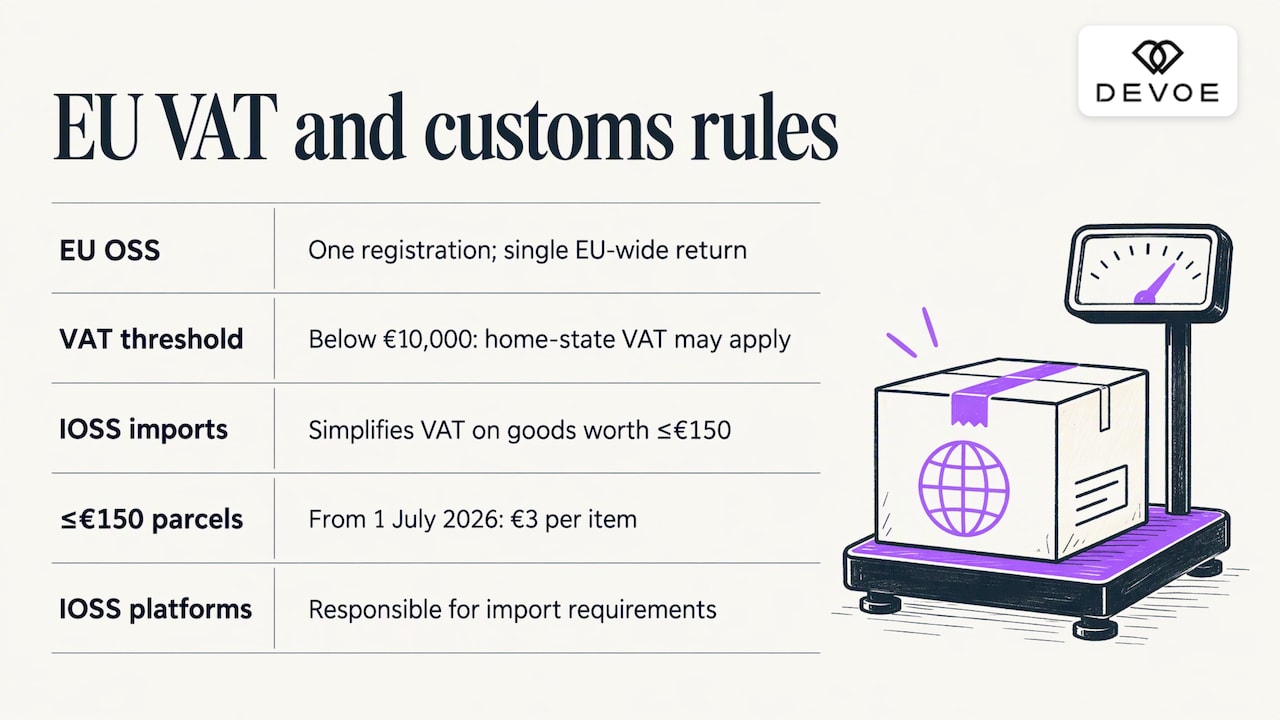
VAT within the EU. The European Commission’s One Stop Shop page explains that sellers can register in one member state and declare VAT on distance sales to customers across the EU through a single return. It also sets an EU-wide threshold of €10,000, below which sales may stay subject to VAT in the seller’s home member state.
VAT on low-value imports. The same page describes the Import One Stop Shop (IOSS), which simplifies declaring VAT on goods worth €150 or less imported from outside the EU.
Customs duty. For brands shipping from the U.S., the key change is the end of the low-value exemption. Ireland’s Revenue authority states in its FAQ that from 1 July 2026, most parcels sent from outside the EU with goods worth €150 or less face €3 customs duty per distinct item until 1 July 2028, when the EU Customs Data Hub is due to be operational. With IOSS, VAT is charged at checkout and not on the €3 duty.
Platform responsibility. In a reply to the European Parliament, the European Commission describes the customs reform proposal’s deemed importer concept: platforms registered for IOSS become responsible for the financial and non-financial requirements on ecommerce imports. This is another reason marketplaces simplify entry, since they carry part of the compliance load.
For product-specific rules such as cosmetics, textiles or health products, check requirements per category before listing. Questions on VAT registration or customs classification belong with a qualified tax adviser or customs broker in your target country.
Logistics, payments and service
DHL’s report notes that over three in ten orders are now sent internationally, and that 25% of businesses not yet shipping across borders plan to prioritize cross-border delivery in the next 12 months. Delivery is a competitive field, so plan it early.
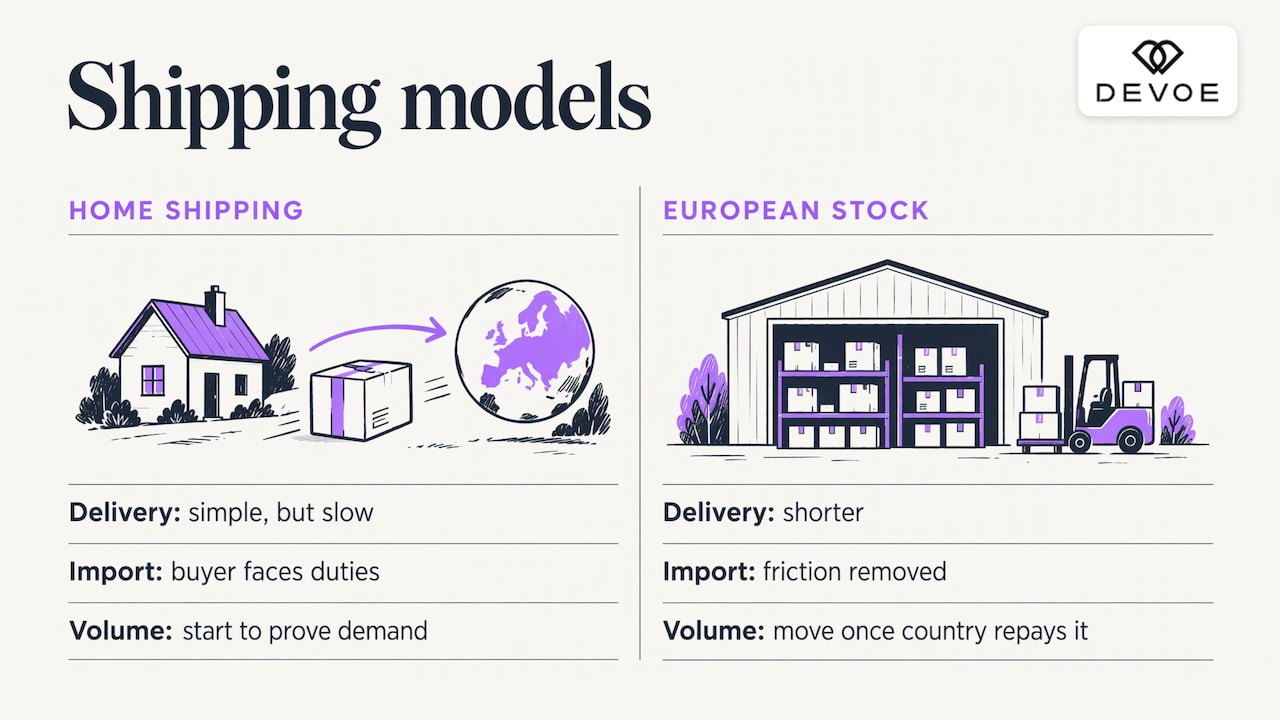
You have two broad models. Ship each order from your home country, which is simple but slow and exposes the buyer to duties. Or hold stock in Europe, which shortens delivery and removes import friction. The choice should follow order volume: start with direct shipping to prove demand, then move stock closer to the shoppers once a country repays it. We set up logistics as part of the engagement, so the fulfillment model matches the marketplace’s delivery promise.
Payments are the easier piece on marketplaces, because the marketplace handles checkout, local currency and payment methods. Customer service is not: questions and returns arrive in local languages, and slow answers hurt your seller rating.
Perspective
Most brands we meet do not fail abroad because the product is wrong. They stall because each marketplace is a separate project: its own data template, its own content rules, its own advertising tools and its own contacts. Doing that for three or four countries at once is a full team’s job.
Our view is that expansion works best when one partner owns the whole chain: matching the brand to the right marketplaces, onboarding with clean data, localized content, advertising, logistics setup and reporting. When those pieces sit in one place, learning from one market carries over to the next instead of being rebuilt.
That is why we work hands-on and proactively rather than handing over a checklist. We coordinate directly with marketplace decision-makers, adapt listings for local audiences and keep optimizing after launch, because visibility on a marketplace is something you keep earning.
tinkara
How DEVOE takes expansion off your hands
If you want to enter European marketplaces without building a team in each country, DEVOE Managed covers the full path: strategic matchmaking, integration, onboarding with data mapping and error resolution, content creation and translation, targeted advertising, store visual branding, logistics setup and performance reporting.

We work across Amazon, Bol, eBay, Zalando, About You, Modivo, Douglas and Shop Apotheke. To see how the service works on a specific channel, start with the relevant page above, or read our overview of marketplace integration services to understand what a good integration covers.
FAQ
What is the difference between cross-border ecommerce and domestic ecommerce?
Domestic ecommerce sells to customers in your own country. Cross-border ecommerce sells to customers abroad, which adds currency, language, tax, customs and delivery questions. The core idea is the same, but each new country needs its own localization and compliance.
Is cross-border ecommerce worth it for a small brand?
Global cross-border revenue is approaching US$1.2 trillion in 2026, and marketplaces let brands reach shoppers without building their own European infrastructure. Starting with one country and one marketplace keeps the investment contained. Expand once you see repeat orders.
Which European marketplace should a brand start with?
It depends on category and target country. Fashion brands often look at Zalando, About You and MODIVO, beauty brands at Douglas, and broader catalogs at Amazon, Bol or eBay. Matching brand, category and country is the first step of our process.
Do I need to pay duty when shipping from the U.S. to Europe?
Goods entering the EU from outside it are subject to customs duty and VAT. From 1 July 2026, most parcels worth €150 or less face a €3 duty per distinct item, as set out in Irish Revenue’s guidance. Confirm your product classification with a customs broker.
How long does it take to go live on a European marketplace?
It depends on the marketplace’s approval process and how clean your product data is. Curated marketplaces review brands before accepting them, and data errors delay launch. Preparing the catalog first is the quickest way to shorten the timeline.
Sources
- eCommerce Definitions, U.S. International Trade Administration
- Cross-Border eCommerce 2025, ECDB
- Global E-Commerce Trends 2026, ECDB
- 2026 E-Commerce Trends Report, DHL eCommerce
- Europe Marketplaces 2026, eMarketer
- How to use online marketplaces, business.gov.uk
- Beyond borders: Expanding our eCommerce horizons, IMRG
- Export guidelines 2024, hub.brussels
- Guides to selling online in the European Union, Trade Commissioner Service
- VAT One Stop Shop, European Commission
- Removal of the De Minimis Relief for Low Value Consignments, Irish Revenue
- Answer to a European Parliament question on EU Customs Reform, European Commission
- Why your product photos aren’t converting