

Product localization is the work of adapting a product, its content and its presentation to the language, culture and rules of a specific market. For a brand selling on European marketplaces, it decides whether a shopper in Amsterdam, Berlin or Warsaw finds your listing, trusts it and buys. We handle this for brands as part of DEVOE Managed, covering matchmaking, onboarding, content and ongoing optimization in one engagement.
TL;DR
- Localization is not translation. It adapts currency, formats, units, sizes, images, legal details and tone, and sometimes involves no translation at all.
- Start with the market and the channel: which country, which marketplace, which rules and buyer expectations.
- Follow a repeatable workflow: market analysis, legal check, adaptation plan, pilot, full launch, continuous updates.
- Measure by locale against your home-market baseline: conversion, revenue, returns, support contacts and ratings.
- On marketplaces, localization lives in the listing: titles, attributes, images, data mapping and advertising all need local treatment.
Table of Contents
- What product localization means
- Why localization pays off
- What to localize in a cross-border product launch
- A product localization strategy in six steps
- Involve your localization partner early
- What to look for in localization services and technology
- How to measure localization results
- Common mistakes
- Taking your products to European marketplaces
- FAQ
- Sources
What product localization means
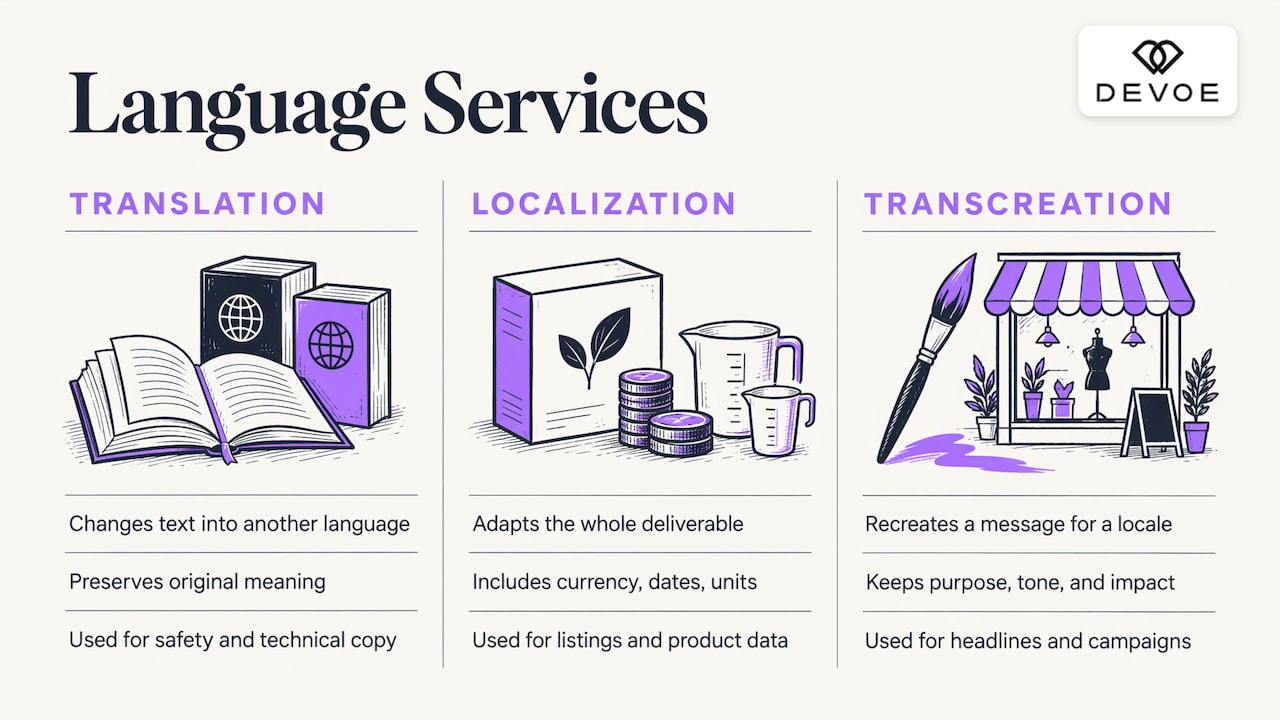
Microsoft’s globalization documentation says localization is not the same as translation. Translation changes text into another language. Localization adapts the whole deliverable for the target audience, including currency and date formats. Adapting US English to UK English can involve no translation at all.
The W3C describes localization as adapting a product to the language and cultural requirements of a locale. Its list includes number, date and time formats, currency, symbols, icons, colors, address formats and legally varying requirements. Some products need a deeper rethink of design, not just new labels.
The Chartered Institute of Linguists separates three services. Translation converts content while preserving meaning; localization adapts it for a country or region, including units, sizes, images and payment methods; transcreation recreates a message to keep its purpose, tone and impact. A good program uses all three where they fit: translation for safety and technical copy, localization for the listing and product data, transcreation for headlines and campaigns.
Localization, internationalization and globalization
Two neighboring terms are worth knowing. Internationalization is designing a product so it can be localized easily, for example by separating localizable elements from the source code. Globalization is the wider business strategy: which markets to enter and in what order. For a physical-goods brand, internationalization means keeping your product data clean and structured so it can be adapted for many countries without starting over.
Why localization pays off
The evidence that language alone moves sales is strong. An Academia Sinica study of more than 10,000 Steam games across more than 70 countries found that local-language translations produced at least 10% and up to 12.1% higher sales revenue. That is translation only. Full localization goes further.
Big brands show the same logic. Coca-Cola’s European bottler states that over 90% of the drinks it sells are produced in the country where they are consumed, and it markets local products such as Mezzo Mix in Germany. An academic thesis describes the company’s move from global standardization to a “glocal” approach after local teams were given authority to develop locally appropriate ideas in 2000. Domino’s India localized its menu with regional pizzas, hired local chefs and built a local website and app, growing from 128 stores in 2006 to nearly 1,500 by 2021.
The lesson for a brand: keep the identity recognizable, change what the local buyer needs to see.
What to localize in a cross-border product launch
For a brand entering Europe through marketplaces, work through these layers:
| Layer | What to adapt | Example |
|---|---|---|
| Language | Titles, bullets, descriptions, A+ content, keywords | Search terms a Dutch shopper actually uses, not a literal translation |
| Formats | Currency, units, date formats, sizes | Euro pricing, metric units, EU clothing sizes |
| Visuals | Images, colors, symbols, lifestyle context | Models and settings that feel local |
| Compliance | Labeling, legally required information, product category rules | Local-language safety and ingredient details |
| Commerce | Payment methods, delivery options, returns | Payment options buyers in that country expect |
| Marketing | Tone, promotions, seasonal calendar | Local shopping events and holidays |
Microsoft’s release methodology also advises that a localization partner be selected and a process agreed before release. The same applies to marketplaces: decide who owns content, data and updates before you list.
A product localization strategy in six steps
A practical sequence, adapted from a published product adaptation guide, looks like this.
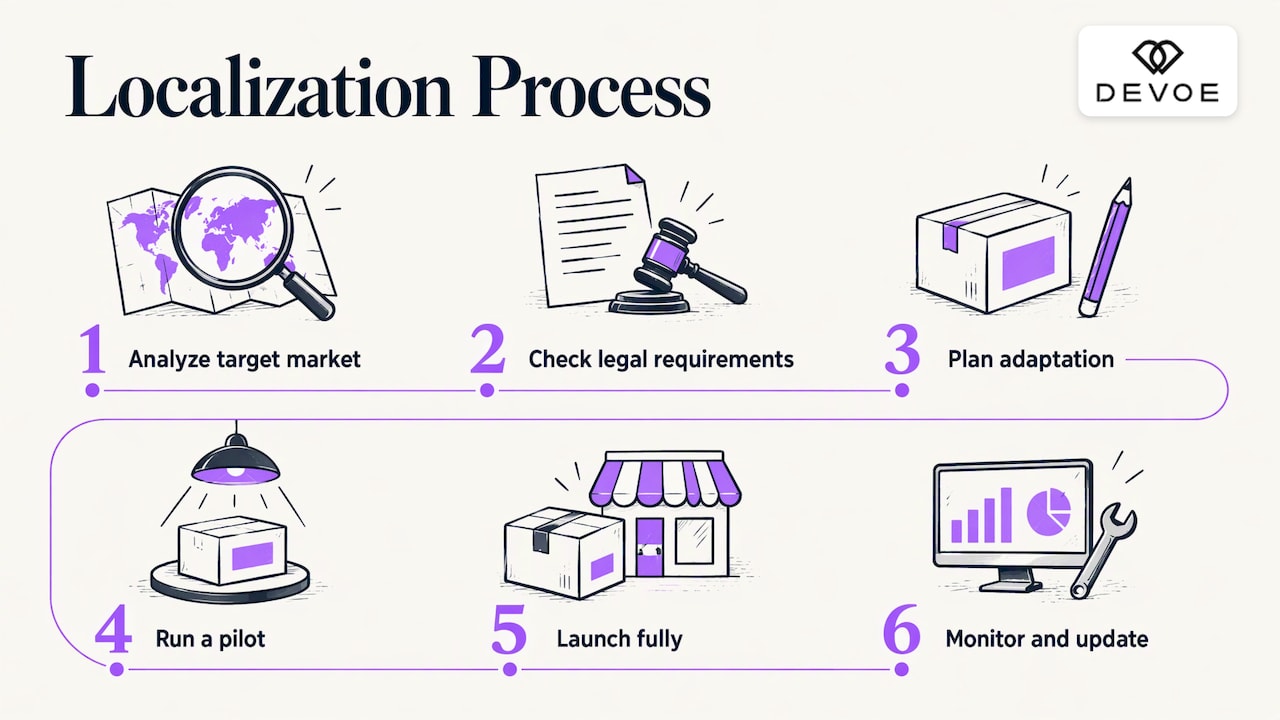
1. Analyze the target market
Study who buys, what competitors list, which price points hold and which marketplaces dominate. Marketplace choice is a localization decision in itself: Bol is central in the Netherlands and Belgium, Zalando and About You lead in fashion, Douglas in beauty, Shop Apotheke in health. We handle strategic matchmaking, so a brand starts on the marketplace that fits its category and target country rather than spreading thin.
A partner resource compares fees and fit across channels in Europe, which helps when you weigh social commerce against a marketplace.
2. Check legal and regulatory requirements
Labeling, product claims, category restrictions and consumer rules differ by country and by product type. Settle these before you write a single listing, because a rejected listing costs weeks.
3. Plan the adaptation
Decide what changes: name, pack size, bundles, images, claims, price. Follow a minimum viable approach. Spotify’s localization leaders describe stripping the product down to what matters most to users in local markets and delivering quickly to learn and iterate. For a marketplace seller that means launching a focused core range, not the full catalog.
4. Run a pilot
List a limited set of products, gather buyer feedback and watch conversion, reviews and returns. Fix what the data shows before you scale.
5. Launch fully
Expand the range, switch on advertising and roll out the adapted marketing. At this stage onboarding quality matters: data mapping, attribute completion and error resolution decide whether listings go live cleanly. In our onboarding we handle data mapping and error resolution, and we create and translate content for each marketplace.
6. Monitor and update
Localization is never one and done. Prices, stock, regulations and search behavior shift. Track competitors, customer feedback and sales continuously, and keep content current across every locale.
Involve your localization partner early
Spotify found that including vendors from day one, with market and language research, input on the business case and a say in decisions before production, was critical to success. The same holds for marketplace expansion. A partner brought in after the content is written can only fix it. A partner brought in at the start shapes which markets, which channels and which range make sense.
What to look for in localization services and technology
Technology helps at volume. Localization platforms pull in content, translate it with AI and translation memory, route it to reviewers and return it to source systems. Buyers are advised to compare connectors and APIs, translation memory and glossaries, workflow controls, quality measurement and cost reporting.
A localization partner buyer’s guide suggests evaluating language coverage, subject-matter expertise, scalability, transparency about in-house versus outsourced resources and independent quality assurance.
For a brand selling physical goods, add three marketplace-specific criteria: does the provider know each marketplace’s content and data requirements, can it handle onboarding and listing errors, and can it run advertising and reporting afterward? Our service covers content creation and translation, ongoing optimization, targeted advertising, store visual branding, logistics setup and performance reporting across Amazon, Bol, eBay, Zalando, About You, Modivo and Douglas.
How to measure localization results
Compare each locale with your home-market baseline. A practical set includes activation, conversion, adoption, retention, support contacts and ratings by locale, with a narrowing gap indicating that localization is working.
Forrester argues that teams default to cost, usage and quality, and should instead measure financial outcomes, audience impact, operational efficiency and agility. Another guide separates operational KPIs such as cost per word from outcome metrics like revenue by market, conversion before and after localization and localization ROI.
For marketplace sellers, a simple dashboard per country and marketplace covers:
- Revenue and units by marketplace
- Conversion rate and advertising cost of sales
- Return rate and top return reasons
- Review score and review themes
- Update lag: how long a change in your source content takes to appear live in each locale, one of three post-launch health metrics
We provide performance reporting as part of the managed service, so these numbers reach you in one place.
Common mistakes
- Literal translation of titles. Shoppers search with local words, so keyword research must be done per market.
- Ignoring formats. Sizes, units and currency that look foreign lower trust.
- Reusing home-market images. Visuals carry cultural cues.
- Launching everywhere at once. A pilot teaches more than a wide, thin launch.
- No update process. Stale content in one locale is an incident, not a detail.
Our view: localize the listing, not just the language
Most brands think of localization as a translation job. On a marketplace it is a commercial job. The listing is your shop window, your sales pitch and your search ranking at once, and it has to work in the local language, the local category structure and the local buyer’s habits.
That is why we run the whole path together: choosing the marketplace, onboarding the data, creating and translating content, setting up logistics, advertising and reporting. Split across several vendors, each handoff is a place where meaning, formats and timing get lost. Done as one managed engagement, a brand gets one accountable team and one set of numbers.
Our positioning rests on hands-on support through the entire expansion process, including direct coordination with marketplace decision-makers. Our tailored solutions are designed to optimize listings for local audiences and to keep performance managed after launch.
tinkara
Taking your products to European marketplaces
If you are ready to adapt a range for Europe, we can take the work off your hands, from matchmaking to onboarding, localized content and ongoing growth management. Start with the marketplace that fits your category: Amazon, Zalando, Bol, eBay, About You, MODIVO, Douglas or Shop Apotheke. Or talk to us about DEVOE Managed.

FAQ
What is an example of product localization?
Domino’s India is a well-documented case: it adapted its menu with regional pizzas, hired local chefs and marketers, and built a localized website and app. Coca-Cola’s Share a Coke campaign, which used locally relevant names and nicknames, is another. On a marketplace, an example is rewriting a listing with local search terms, local sizes and local imagery.
What is the difference between localization and translation?
Translation converts text from one language to another. Localization adapts the whole product experience: currency, units, sizes, images, payment methods, legal details and tone. Localization can even happen within one language, as with US and UK English.
What is Coca-Cola’s localization strategy?
Coca-Cola balances a global identity with local adaptation. Its European bottler says most drinks it sells are produced in the country where they are consumed, and it markets local brands. Its campaigns, flavors and limited editions are adapted country by country.
How often should localized content be updated?
Continuously. Prices, regulations, stock and search behavior change, so track how long source changes take to reach each locale and review content on a regular schedule.
Sources
- Localize your product, Microsoft Learn
- Localization vs. Internationalization, W3C
- Translation, localisation or transcreation, CIOL
- What Is Localization, Smartling
- Study shows product translation benefits sales revenue, Taipei Times
- Global Scale, Local Impact, CCEP
- Coca-Cola’s Latin American advertising, University of Padua
- Product localization strategy guide, Smartling
- How to release products internationally, Microsoft Learn
- Product adaptation strategy in a foreign market, S-Rocket
- TikTok Shop vs Amazon: fees and fit in Europe
- Scaling Translations at Spotify
- Localization platform guide, Smartcat
- Software localization practical guide, Lilt
- Measure Localization Using a Balanced Scorecard, Forrester
- Measuring localization success, Rubric
- After launch: keeping every locale current, Ollang
1 Comment